PORTRUSH, Northern Ireland (AP) — Justin Rose has been dreaming of winning the British Open since the age of 8. He’s approaching 45 now and has yet to lift the claret jug.
He knows the clock is ticking.
“Obviously later in your career you’re never quite sure how many chances are going to be left,” Rose said at Royal Portrush on Wednesday, a day before he begins his 22nd attempt to win his home major. “And when you do come close, clearly it’s like, ahh.”
And, boy, has this English Rose come close to adding a late-career major to his résumé.
He challenged for the Open Championship at Royal Troon last year, finishing second to Xander Schauffele.
He was then one putt away from winning the Masters in April, losing out to Rory McIlroy in a playoff in a major finish for the ages.
Rose has a major title in his collection — the U.S. Open in 2013 — as well as an Olympic gold medal and four Ryder Cup victories. He has been No. 1 in the world, too.
But he wants more, even at his age.
“What I’m chasing at this point in my career are the big moments in the sport, whether that’s Ryder Cups, major championships. Those are the memories I’m trying to make,” Rose said.
“I feel like I’ve been lucky enough to achieve a lot in the game, and I’d like to have achieved more of the same things, more majors, more wins, more everything."
Finally winning the Open Championship would surely be the sweetest of all moments for Rose, who first made a name for himself as a 17-year-old amateur at Royal Birkdale in 1998 when, wearing a baggy red sweater, he holed out for eagle to secure a tie for fourth place.
“As a British player, it’s been the one that I’ve dreamed about winning and holed the putt many times in my mind,” Rose said.
Rose isn’t slowing down in his pursuit, remaining supremely fit in an attempt to keep in touch with the younger players on the circuit.
In the United States, he travels to tournaments with a custom-made RV that's essentially a traveling gym — containing things like a cold plunge and a sauna — which he calls a “recovery room” and he posts videos on Instagram of him working out.
It is keeping him competitive — he’s the world No. 21 — and a definite contender this week as he bids to become the second oldest winner of the Open, behind Old Tom Morris, who was the champion at age 46 in 1867.
“I would say overall week in and week out, it’s going to be hard to get a ton better and transform my game to suddenly add new dimensions to it where I can kind of become incredibly dominant over the top young players,” Rose said.
“But I think in certain situations and in certain environments, I can still kind of bring my best."
He showed that at Augusta National, where he had a front-row seat as McIlroy achieved the career Grand Slam.
Rose said it stung but that he wasn't “completely devastated" because of how well he played.
“I think I’m over it,” he said, “I don’t know. Who knows?”
AP golf: https://apnews.com/hub/golf

Justin Rose of England prepares to putt on the 1st green during a practice round for the British Open golf championship at the Royal Portrush Golf Club, Northern Ireland, Wednesday, July 16, 2025. (AP Photo/Jon Super)

Justin Rose of England prepares to putt on the 1st green during a practice round for the British Open golf championship at the Royal Portrush Golf Club, Northern Ireland, Wednesday, July 16, 2025. (AP Photo/Jon Super)

Justin Rose of England plays his tee shot off the 2nd hole during a practice round for the British Open golf championship at the Royal Portrush Golf Club, Northern Ireland, Wednesday, July 16, 2025. (AP Photo/Jon Super)
WASHINGTON (AP) — Sluggish December hiring concluded a year of weak employment gains that have frustrated job seekers even though layoffs and unemployment have remained low.
Employers added just 50,000 jobs last month, nearly unchanged from a downwardly revised figure of 56,000 in November, the Labor Department said Friday. The unemployment rate slipped to 4.4%, its first decline since June, from 4.5% in November, a figure also revised lower.
The data suggests that businesses are reluctant to add workers even as economic growth has picked up. Many companies hired aggressively after the pandemic and no longer need to fill more jobs. Others have held back due to widespread uncertainty caused by President Donald Trump’s shifting tariff policies, elevated inflation, and the spread of artificial intelligence, which could alter or even replace some jobs.
Still, economists were encouraged by the drop in the unemployment rate, which had risen in the previous four straight reports. It had also alarmed officials at the Federal Reserve, prompting three cuts to the central bank's key interest rate last year. The decline lowered the odds of another rate reduction in January, economists said.
“The labor market looks to have stabilized, but at a slower pace of employment growth,” Blerina Uruci, chief economist at T. Rowe Price, said. There is no urgency for the Fed to cut rates further, for now."
Some Federal Reserve officials are concerned that inflation remains above their target of 2% annual growth, and hasn't improved since 2024. They support keeping rates where they are to combat inflation. Others, however, are more worried that hiring has nearly ground to a halt and have supported lowering borrowing costs to spur spending and growth.
November's job gain was revised slightly lower, from 64,000 to 56,000, while October's now shows a much steeper drop, with a loss of 173,000 positions, down from previous estimates of a 105,000 decline. The government revises the jobs figures as it receives more survey responses from businesses.
The economy has now lost an average of 22,000 jobs a month in the past three months, the government said. A year ago, in December 2024, it had gained 209,000 a month. Most of those losses reflect the purge of government workers by Elon Musk's Department of Government Efficiency.
Nearly all the jobs added in December were in the health care and restaurant and hotel industries. Health care added 38,500 jobs, while restaurants and hotels gained 47,000. Governments — mostly at the state and local level — added 13,000.
Manufacturing, construction and retail companies all shed jobs. Retailers cut 25,000 positions, a sign that holiday hiring has been weaker than previous years. Manufacturers have shed jobs every month since April, when Trump announced sweeping tariffs intended to boost manufacturing.
Wall Street and Washington are looking closely at Friday's report as it's the first clean reading on the labor market in three months. The government didn’t issue a report in October because of the six-week government shutdown, and November’s data was distorted by the closure, which lasted until Nov. 12.
The hiring slowdown reflects more than just a reluctance by companies to add jobs. With an aging population and a sharp drop in immigration, the economy doesn't need to create as many jobs as it has in the past to keep the unemployment rate steady. As a result, a gain of 50,000 jobs is not as clear a sign of weakness as it would have been in previous years.
And layoffs are still low, a sign firms aren't rapidly cutting jobs, as typically happens in a recession. The “low-hire, low-fire” job market does mean current workers have some job security, though those without jobs can have a tougher time.
Ernesto Castro, 44, has applied for hundreds of jobs since leaving his last in May. Yet the Los Angeles resident has gotten just three initial interviews, and only one follow-up, after which he heard nothing.
With nearly a decade of experience providing customer support for software companies, Castro expected to find a new job pretty quickly as he did in 2024.
“I should be in a good position,” Castro said. “It’s been awful.”
He worries that more companies are turning to artificial intelligence to help clients learn to use new software. He hears ads from tech companies that urge companies to slash workers that provide the kind of services he has in his previous jobs. His contacts in the industry say that employees are increasingly reluctant to switch jobs amid all the uncertainty, which leaves fewer open jobs for others.
He is now looking into starting his own software company, and is also exploring project management roles.
December’s report caps a year of sluggish hiring, particularly after April's “liberation day” tariff announcement by Trump. The economy generated an average of 111,000 jobs a month in the first three months of 2025. But that pace dropped to just 11,000 in the three months ended in August, before rebounding slightly to 22,000 in November.
Last year, the economy gained just 584,000 jobs, sharply lower than that more than 2 million added in 2024. It's the smallest annual gain since the COVID-19 pandemic decimated the job market in 2020.
Subdued hiring underscores a key conundrum surrounding the economy as it enters 2026: Growth has picked up to healthy levels, yet hiring has weakened noticeably and the unemployment rate has increased in the last four jobs reports.
Most economists expect hiring will accelerate this year as growth remains solid, and Trump's tax cut legislation is expected to produce large tax refunds this spring. Yet economists acknowledge there are other possibilities: Weak job gains could drag down future growth. Or the economy could keep expanding at a healthy clip, while automation and the spread of artificial intelligence reduces the need for more jobs.
Productivity, or output per hour worked, a measure of worker efficiency, has improved in the past three years and jumped nearly 5% in the July-September quarter. That means companies can produce more without adding jobs. Over time, it should also boost worker pay.
Even with such sluggish job gains, the economy has continued to expand, with growth reaching a 4.3% annual rate in last year's July-September quarter, the best in two years. Strong consumer spending helped drive the gain. The Federal Reserve Bank of Atlanta forecasts that growth could slow to a still-solid 2.7% in the final three months of last year.
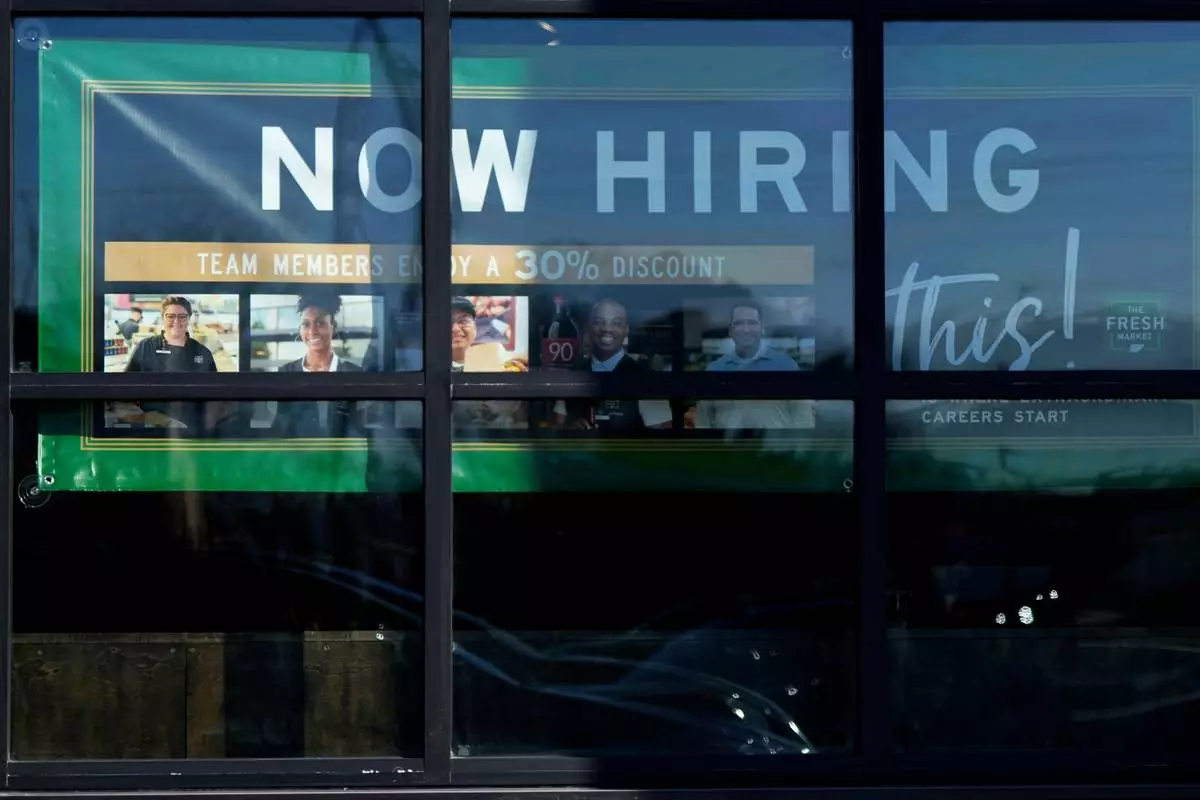
FILE - A hiring sign is displayed at a grocery store in Northbrook, Ill., Tuesday, Jan. 21, 2025. (AP Photo/Nam Y. Huh)