OMAHA, Neb. (AP) — Nebraska is suing Colorado over the amount of water it draws from the South Platte River, the latest in a long history of water rights disputes between the states that have been left increasingly dry by climate change.
Nebraska Gov. Jim Pillen and state Attorney General Mike Hilgers held a news conference Wednesday to announce the lawsuit, which was filed with the U.S. Supreme Court.
“It’s crystal clear. Colorado has been holding water back from Nebraska for almost 100 years and getting more and more egregious every single day,” Pillen said, pointing to Colorado's rapidly expanding population over the past decade.
“So today it’s really, really simple: We’re here to put our gloves on," Pillen said. "We’re going to fight like heck. We’re going to get every drop of water.”
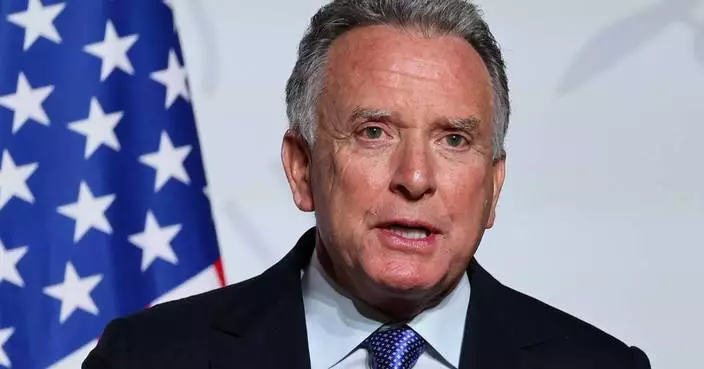
Colorado Attorney General Phil Weiser called the lawsuit “unfortunate” in a written statement and said Nebraska officials failed “to look for reasonable solutions.”
The lawsuit accuses Colorado of depriving Nebraska of as much as 1.3 million acre-feet (about 160,350 hectare-meters) of water from the river over several years that Nebraska is entitled to under a 1923 compact between the states. The suit also accuses Colorado officials of blocking Nebraska's effort to construct a massive canal — often called the Perkins County Canal — and reservoir project that would see Nebraska seize land in Colorado to divert water into Nebraska, which is also allowed under the compact.
Nebraska needs the water not only for agriculture production in its southwestern region — which climate experts predict will grow hotter and drier in the coming decades — but also to feed water supplies in the eastern part of the state, officials said. Nebraska's capital, Lincoln, is expected to get 12% of its water from the proposed canal, Pillen said.
The compact entitles Nebraska to 120 cubic feet (3.4 cubic meters) per second from the river during the irrigation season between April 1 and Oct. 15 each year, and 500 cubic feet (about 14 cubic meters) per second during the non-irrigation fall and winter months. Hilgers said Colorado has been shortchanging Nebraska during the irrigation season, allowing only about 75 cubic feet (about 2 cubic meters) per second of water daily into Nebraska this summer.
“I think this may be the most consequential lawsuit that this office will be a part of in my generation,” Hilgers said. “It is almost impossible to overstate the importance of the South Platte River to the future of the state of Nebraska.”
Colorado Gov. Jared Polis issued a statement calling the lawsuit meritless and denied that Colorado had violated the compact.
The South Platte, which flows through northeastern Colorado into southwestern Nebraska, has been at the center of a tempest brewing between the two states going back to 2022, when Nebraska announced it would build the canal.
Since then, officials from the two states have been haggling over how to carry out both the terms of the compact and land acquisition to build the canal.
Hilgers said the two states are at an impasse. Weiser countered that Nebraska officials should have remained at the negotiating table.
“Nebraska’s actions will force Colorado water users to build additional new projects to lessen the impact of the proposed Perkins County Canal,” he said. “When the dust finally settles, likely over a billion dollars will have been spent — tens of millions of that on litigation alone — and no one in Nebraska or Colorado will be better off.”
The lawsuit was filed directly with the Supreme Court because it handles disputes between states, Hilgers said. The process “isn't fast,” he warned.
“We’ll probably have a special master appointed within the next 12 months, and under normal litigation timelines, that’s maybe 3 to 5 years before we get a result,” he said.
That does not mean work on the canal will stop, he said, as he expects work on permitting and design of the canal to continue.
Nebraska has been at the center of interstate water disputes for decades. In 2002, Nebraska, Colorado and Kansas reached a settlement over Republican River water allocation after years of legal wrangling. But disputes continued, and new agreements were reached among the states again in 2014.
Water disputes could become more common as climate change worsens shortages, said Dr. Carly Phillips, a research scientist at the Union of Concerned Scientists — a nonprofit that advocates for climate change solutions.
Warmer temperatures affect multiple parts of the hydrological cycle, Phillips said. It is decreasing the snowpack, which is the main way water is stored in the western U.S. Higher temperatures also mean the snow melts earlier each year, changing the availability of stream flow. And states like Nebraska might see increased irrigation demand when it’s hotter.
“These patterns are all in the same direction across the board,” Phillips said. “The trends are really consistent when it comes to snowpack, stream flow, evaporation and irrigation demand.”
Associated Press reporter Sarah Raza contributed from Sioux Falls, South Dakota.

This photo combination shows, from left, Nebraska Gov. Jim Pillen taking part in a panel discussion, Nov. 16, 2022, in Orlando, Fla., Colorado Attorney General Phil Weiser speaking during an interview with The Associated Press, Nov. 21, 2024, in Philadelphia and State Sen. Mike Hilgers, of Lincoln, speaking during a debate in Lincoln, Neb., April 3, 2018. (AP Photo/Phelan M. Ebenhack, Matt Slocum, Nati Harnik, file)