Democrats can win back disaffected voters by addressing their everyday concerns to counter the anticipated fallout from President Donald Trump's budget-and-policy package, Kentucky Gov. Andy Beshear said Wednesday as he began a tour of South Carolina.
Offering blunt advice to fellow Democrats in the traditionally early primary state, Beshear said the national party should take its message directly to places where voters shifted to the Republican Party in 2024, when the GOP won the White House and Congress. The potential 2028 presidential candidate said that message should concentrate on core issues such as jobs, health care, education, transportation and public safety, and how Democrats can make Americans' lives better.
Beshear introduced himself to South Carolina voters as someone with an established record of winning in a deeply Republican state. He is the son of a two-term Kentucky governor, and is now in his second and final term after serving as the state attorney general.
“If you don’t know me, I’m the guy who’s won three straight races in deep-red Kentucky,” Beshear said at an organized labor conference in Greenville. “I’m the guy that’s beaten Mitch McConnell’s handpicked candidates. I’m the guy that’s beaten Donald Trump’s handpicked candidates.” McConnell is a veteran Kentucky lawmaker who was the longtime Republican leader in the Senate.
Beshear said Trump’s tax and spending cut bill, which passed without any Democratic support, was an attack on rural America and on "Southerners like us,” but also gives his party a political opening heading into election in 2026 and beyond.
“Democrats can win again by winning back that middle, and it’s there for the taking," he said. “There’s so much discourse right now about the messaging and how Democrats get out of the wilderness. We do it by showing up. We do it by getting dirt on our boots. And we do it by governing well.”
In his speech, Beshear stressed his pro-union credentials, his Southern kinship with the audience and how his Christian faith shapes how he governs. He said health care is a basic human right and he played up Kentucky's record pace of job growth and private-sector investment, saying it shows “you can be pro-jobs, pro-business and pro-worker all at the same time.”
The governor said Americans have experienced “chaos, incompetence and cruelty" since Trump returned to the White House, and that the new tax and spending cuts will hurt people on Medicaid and receiving food assistance, in particular. The fallout from Medicaid cuts will threaten many rural hospitals that are major employers, he said.
Republicans say they have delivered broad tax cuts, invested heavily in immigration enforcement and put new restraints on social safety net programs. Democrats say it rolls back health insurance access and raises costs for middle-class Americans while cutting taxes mostly for the rich.
For Beshear, going on the offense against Trump is not enough for Democrats. The party needs to communicate better, he said.
“We put out major policy papers and then talk about the nuance on it," he said. “But when we explain our why, that’s when people see how bought in we are, how much we care and how hard we’ll work.”
Though the first presidential primary votes are more than two years away, several possible contenders have traveled to South Carolina, New Hampshire and Iowa, states that usually have an early and oversize role in the nomination.
Looking to connect with his South Carolina audience, Beshear punctuated his speech by referring to the group as “y'all.”
“As a Southern governor, this isn’t the first time I’ve said ‘y’all,’" he said. "I also know when you say ‘bless your heart,’ that ain’t good.”
—-
Schreiner reported from Shelbyville, Kentucky.

FILE - Kentucky Gov. Andy Beshear delivers his State of The Commonwealth address in the House chamber at the State Capitol in Frankfort, Ky., Jan. 8, 2025. (AP Photo/Timothy D. Easley, File)
JERUSALEM (AP) — Over two dozen families from one of the few remaining Palestinian Bedouin villages in the central West Bank have packed up and fled their homes in recent days, saying harassment by Jewish settlers living in unauthorized outposts nearby has grown unbearable.
The village, Ras Ein el-Auja, was originally home to some 700 people from more than 100 families that have lived there for decades.
Twenty-six families already left on Thursday, scattering across the territory in search of safer ground, say rights groups. Several other families were packing up and leaving on Sunday.
“We have been suffering greatly from the settlers. Every day, they come on foot, or on tractors, or on horseback with their sheep into our homes. They enter people’s homes daily,” said Nayef Zayed, a resident, as neighbors took down sheep pens and tin structures.
Israel's military and the local settler governing body in the area did not respond to requests for comment.
Other residents pledged to stay put for the time being. That makes them some of the last Palestinians left in the area, said Sarit Michaeli, international director at B’Tselem, an Israeli rights group helping the residents.
She said that mounting settler violence has already emptied neighboring Palestinian hamlets in the dusty corridor of land stretching from Ramallah in the West to Jericho, along the Jordanian border, in the east.
The area is part of the 60% of the West Bank that has remained under full Israeli control under interim peace accords signed in the 1990s. Since the war between Israel and Hamas erupted in October 2023, over 2,000 Palestinians — at least 44 entire communities — have been expelled by settler violence in the area, B'Tselem says.
The turning point for the village came in December, when settlers put up an outpost about 50 meters (yards) from Palestinian homes on the northwestern flank of the village, said Michaeli and Sam Stein, an activist who has been living in the village for a month.
Settlers strolled easily through the village at night. Sheep and laundry went missing. International activists had to begin escorting children to school to keep them safe.
“The settlers attack us day and night, they have displaced us, they harass us in every way” said Eyad Isaac, another resident. “They intimidate the children and women.”
Michaeli said she’s witnessed settlers walk around the village at night, going into homes to film women and children and tampering with the village’s electricity.
The residents said they call the police frequently to ask for help — but it seldom arrives. Settlement expansion has been promoted by successive Israeli governments over nearly six decades. But Benjamin Netanyahu’s far-right government, which has placed settler leaders in senior positions, has made it a top priority.
That growth has been accompanied by a spike in settler violence, much of it carried out by residents of unauthorized outposts. These outposts often begin with small farms or shepherding that are used to seize land, say Palestinians and anti-settlement activists. United Nations officials warn the trend is changing the map of the West Bank, entrenching Israeli presence in the area.
Some 500,000 Israelis have settled in the West Bank since Israel captured the territory, along with east Jerusalem and the Gaza Strip, in the 1967 Mideast war. Their presence is viewed by most of the international community as illegal and a major obstacle to peace. The Palestinians seek all three areas for a future state.
For now, displaced families of the village have dispersed between other villages near the city of Jericho and near Hebron further south, said residents. Some sold their sheep and are trying to move into the cities.
Others are just dismantling their structures without knowing where to go.
"Where will we go? There’s nowhere. We’re scattered,” said Zayed, the resident, “People’s situation is bad. Very bad.”
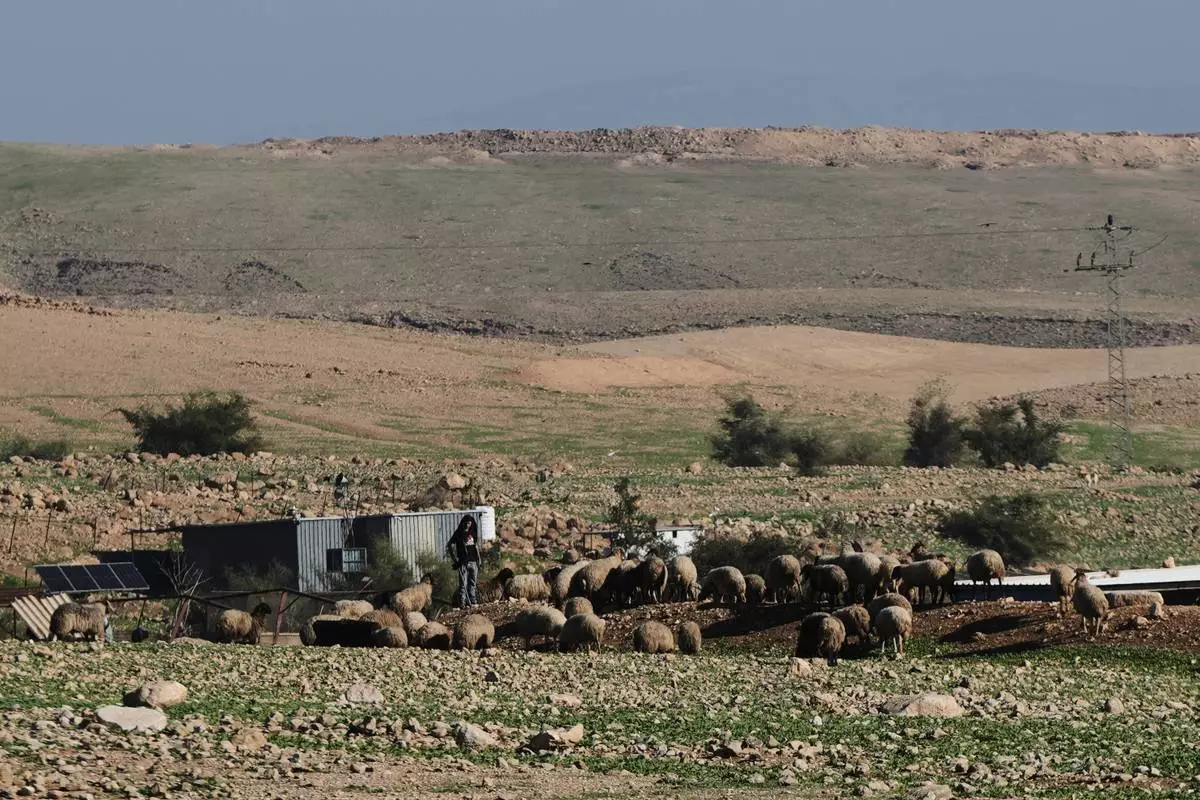
An Israeli settler herds his flock near his outpost beside the Palestinian village of Ras Ein al-Auja in the West Bank, Sunday, Jan. 11, 2026. (AP Photo/Mahmoud Illean)
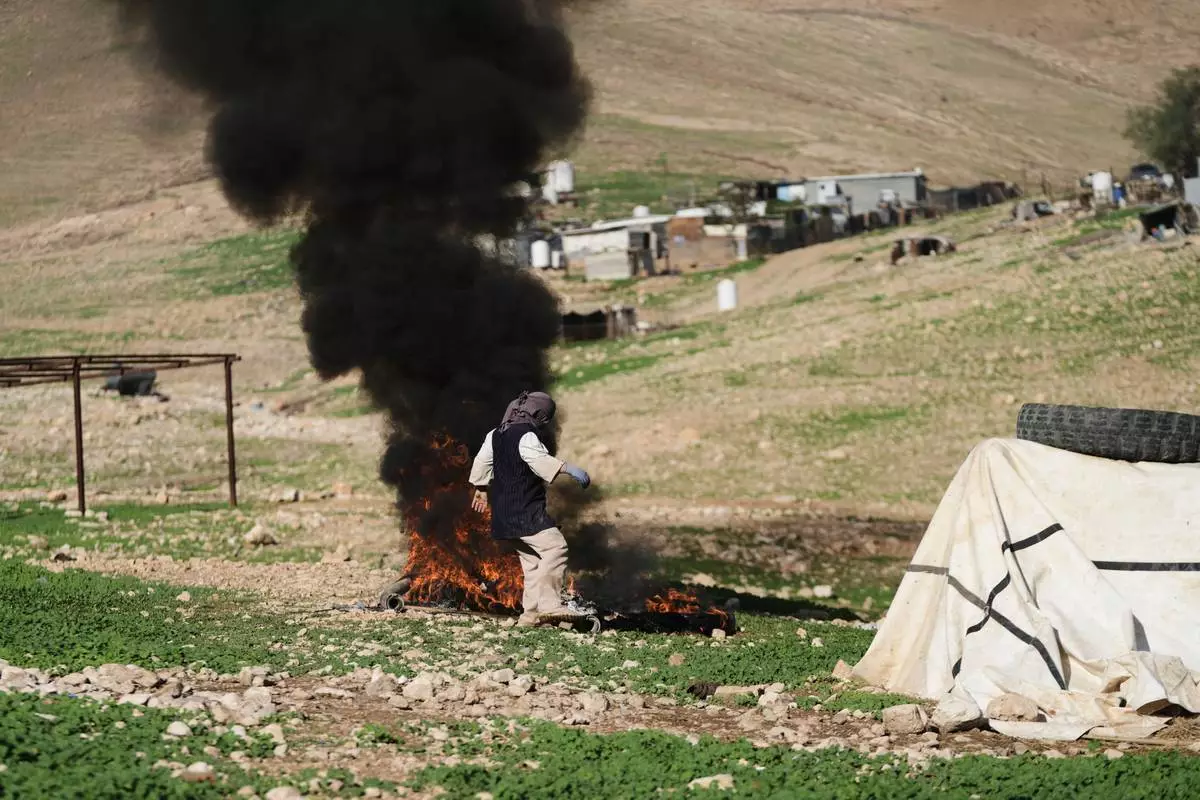
A Palestinian resident of Ras Ein al-Auja village, West Bank burns trash, Sunday, Jan. 11, 2026. (AP Photo/Mahmoud Illean)
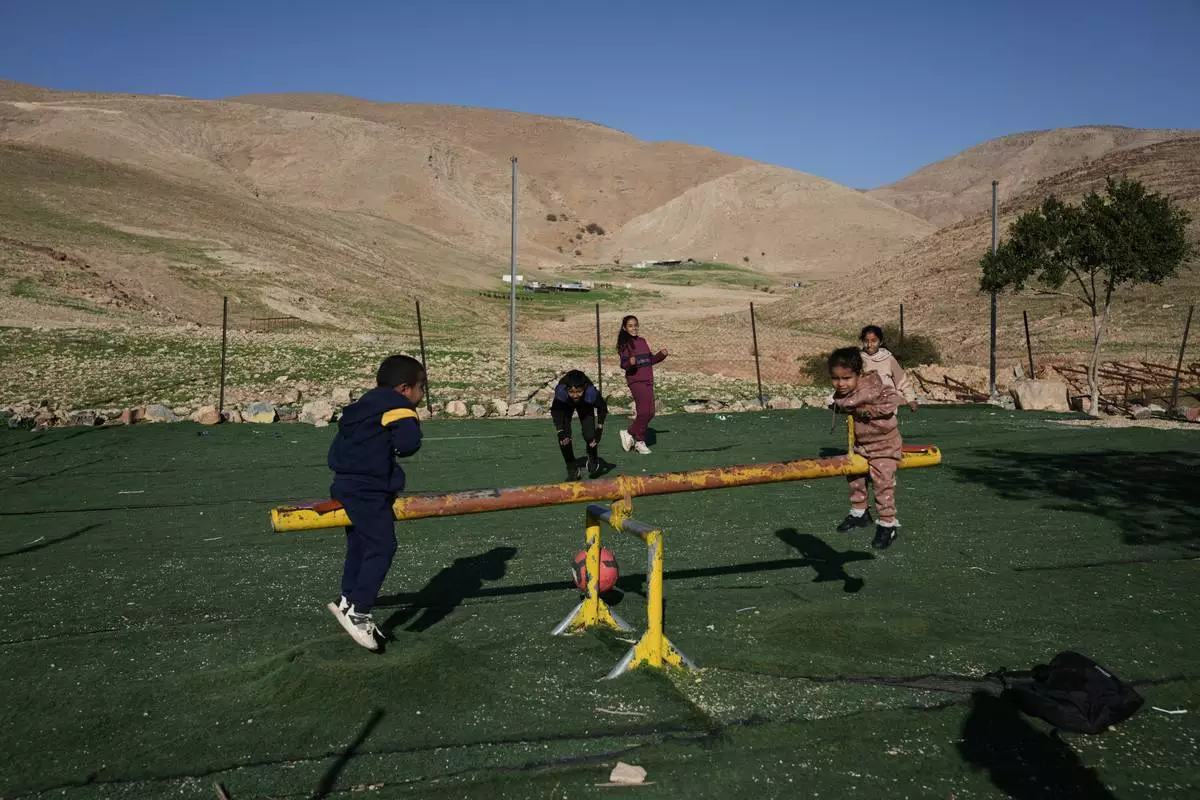
Palestinian children play in the West Bank village of Ras Ein al-Auja, Sunday, Jan. 11, 2026. (AP Photo/Mahmoud Illean)
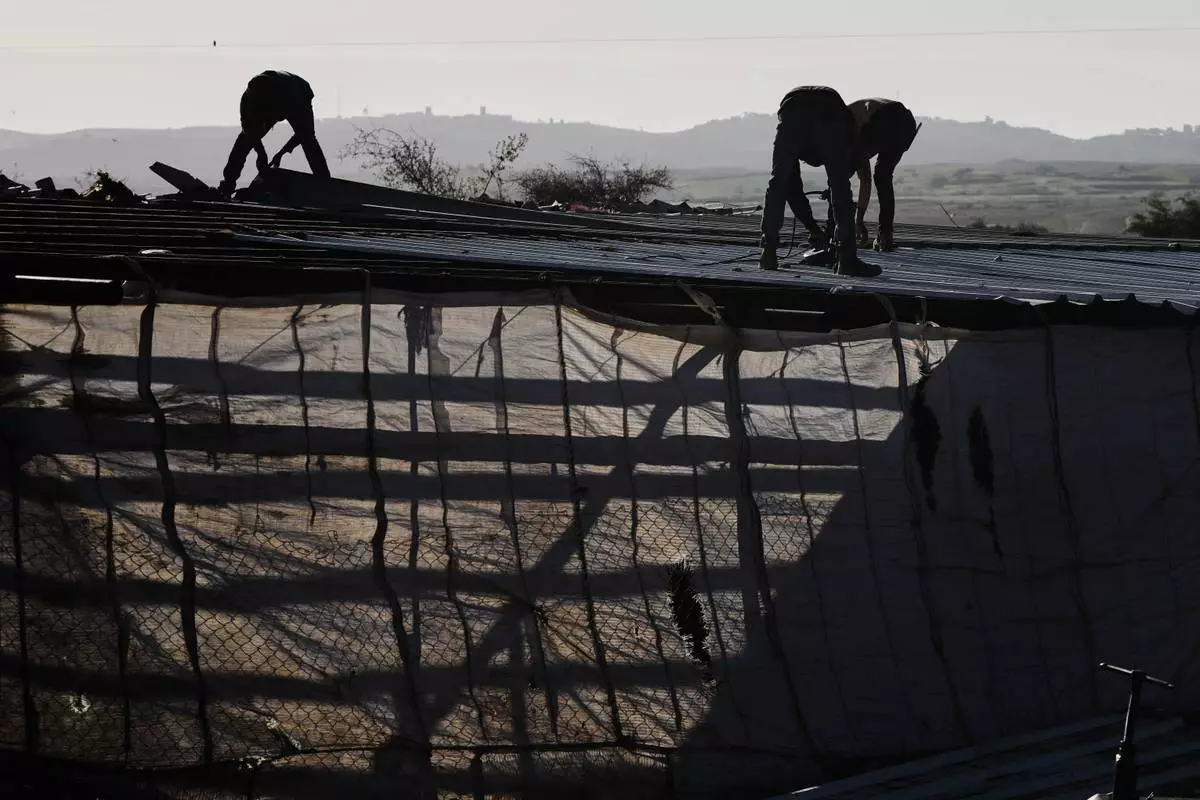
Palestinian residents of Ras Ein al-Auja village, West Bank pack up their belongings and prepare to leave their homes after deciding to flee mounting settler violence, Sunday, Jan. 11, 2026. (AP Photo/Mahmoud Illean)
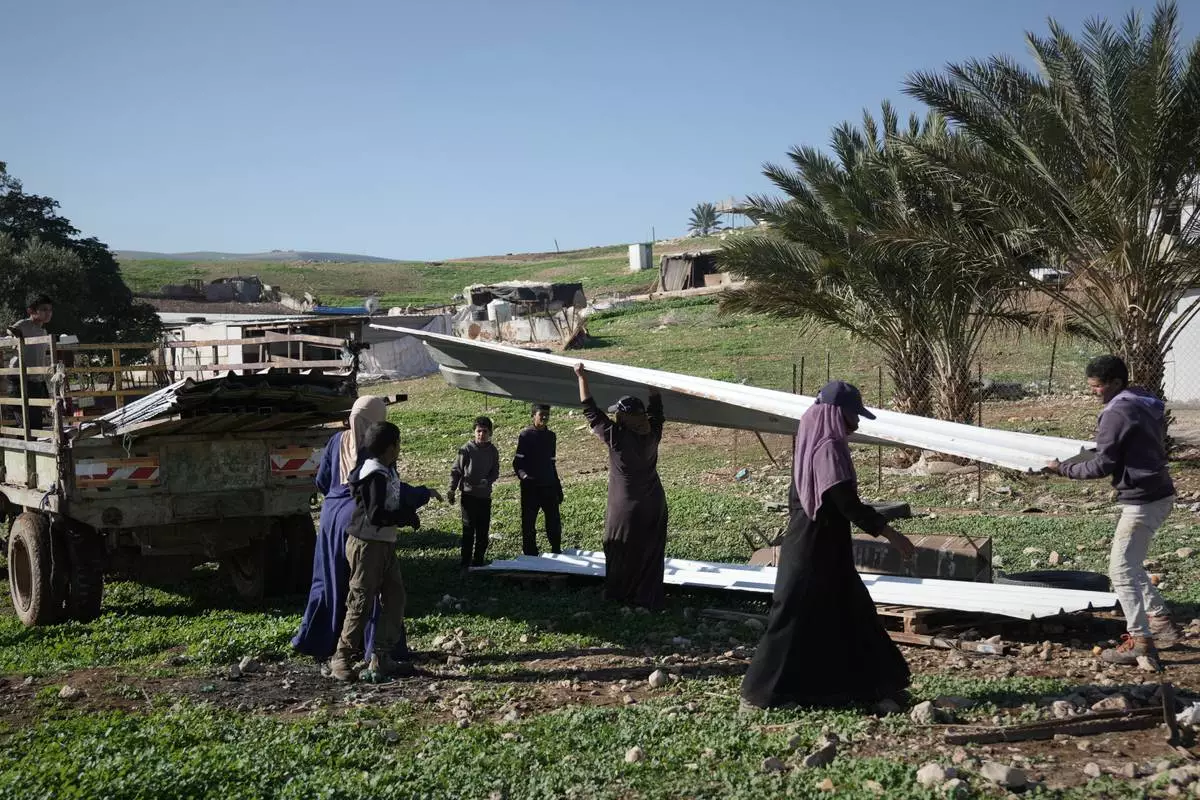
Palestinian residents of Ras Ein al-Auja village, West Bank pack up their belongings and prepare to leave their homes after deciding to flee mounting settler violence, Sunday, Jan. 11, 2026. (AP Photo/Mahmoud Illean)