CHP reminds public on precautions against heat stroke during very hot weather
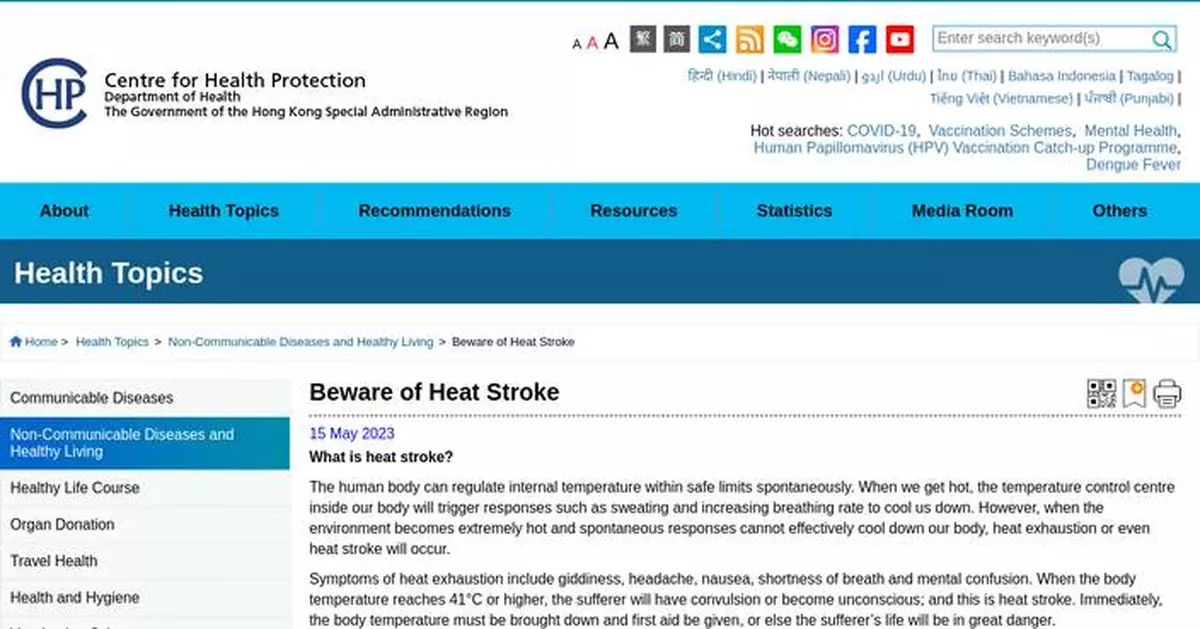
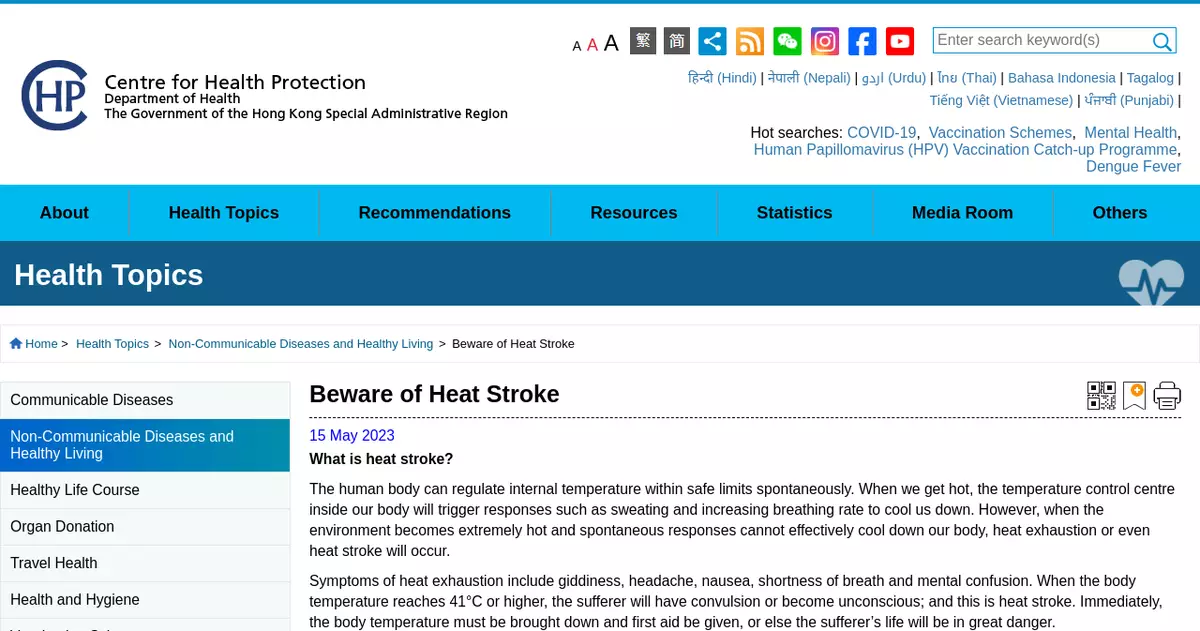
The Centre for Health Protection (CHP) of the Department of Health (DH) today (July 17) reminded members of the public, particularly those undertaking outdoor activities, to take heed of necessary measures against heat stroke and sunburn in very hot weather.
"The public should carry and drink plenty of water to prevent dehydration while engaging in outdoor activities," a spokesman for the CHP said.
"Those engaged in strenuous outdoor activities should avoid beverages containing caffeine, such as coffee and tea, as well as alcohol, as they speed up water loss through the urinary system," the spokesman explained.
"Infants and children, the elderly, pregnant women, those with chronic illnesses such as heart disease or high blood pressure, outdoor/manual workers, and individuals who are overweight are more vulnerable to heat stroke. They should pay special attention," the spokesman added.
The public should adopt the following precautions:
 Wear loose and light-coloured clothing to reduce heat absorption and facilitate sweat evaporation and heat dissipation;
Avoid vigorous exercise and prolonged activities like hiking or trekking as heat, sweating and exhaustion can place additional demands on the physique;
Perform outdoor activities in the morning or the late afternoon, if possible;
For indoor activities, open all windows, use a fan or use air-conditioning to maintain good ventilation;
Do not stay inside a parked vehicle; and
Reschedule work to cooler times of the day if feasible. If working in a hot environment is inevitable, introduce shade in the workplace where practicable. Start work slowly and pick up the pace gradually. Move to a cool area for rest at regular intervals to allow the body to recuperate.
Wear loose and light-coloured clothing to reduce heat absorption and facilitate sweat evaporation and heat dissipation;
Avoid vigorous exercise and prolonged activities like hiking or trekking as heat, sweating and exhaustion can place additional demands on the physique;
Perform outdoor activities in the morning or the late afternoon, if possible;
For indoor activities, open all windows, use a fan or use air-conditioning to maintain good ventilation;
Do not stay inside a parked vehicle; and
Reschedule work to cooler times of the day if feasible. If working in a hot environment is inevitable, introduce shade in the workplace where practicable. Start work slowly and pick up the pace gradually. Move to a cool area for rest at regular intervals to allow the body to recuperate.
The public should also note the latest and the forecast Ultraviolet (UV) Index released by the Hong Kong Observatory (HKO). When the UV Index is high (6 or above):
Minimise direct exposure of the skin and the eyes to sunlight;
Apply a broad-spectrum water-resistant sunscreen product with a sun protection factor (SPF) of at least 30 or higher when participating in outdoor activities. Reapply every two hours if you need to stay outdoors for a prolonged period, or after swimming, sweating or towelling off;
While using DEET-containing insect repellents for personal protection against mosquito-borne diseases, apply sunscreen first, then insect repellent;
Seek shade;
Wear UV-blocking sunglasses;
Wear long-sleeved and loose-fitting clothes; and
Wear a wide-brimmed hat or use an umbrella.
If symptoms develop, such as dizziness, headache, nausea, shortness of breath or confusion, rest and seek help immediately, and seek medical advice as soon as possible.
The public may obtain more information from the DH's Health Education Infoline (2833 0111),heat strokepage andUV radiationpage; the HKO's Dial-a-Weather (1878 200),latestweather report and forecast,UV Indexand weather information forhiking and mountaineering; andpress releasesof the Labour Departmenton precautions against heat stroke for outdoor workers and their employers when the Very Hot Weather Warning is in force.
Source: AI-found images
Speech by CS at Nobel Heroes Forum: Shaping Science and Future
Following is the speech by the Chief Secretary for Administration, Mr Chan Kwok-ki, at the Nobel Heroes Forum: Shaping Science and Future today (January 12):
Dr Wong (Chairman of the University of Hong Kong (HKU) Council, Dr Peter Wong), Professor Zhang (President and Vice-Chancellor of the HKU, Professor Zhang Xiang), Mr Turner (Executive Director of Foundation Lindau Nobel Laureate Meetings, Mr Nikolaus Turner), distinguished Nobel Laureates, esteemed scientists,ladies and gentlemen,
Good morning. It is my great pleasure to join you today for the Nobel Heroes Forum: Shaping Science and Future.
To our Nobel Laureates – we are truly privileged to have you with us. You represent the very best of human curiosity and perseverance. Your ground-breaking work expands our understanding of the universe, lights the path for future discovery, and inspires generations. Thank you for joining this extraordinary gathering.
And to all our distinguished guests from around the world – a very warm welcome to Hong Kong.
Today's dialogue is more than an academic event. It is a powerful convergence of the world's finest scientific minds, right here in a city that is determined to play its part in global innovation.
Hong Kong's mission is clear and unwavering: to become a premier international innovation and technology centre. A hub where top scientists, scholars and entrepreneurs can thrive, collaborate and serve the world.
To achieve this, the Government is fully committed. We are building a world-class ecosystem and nurturing the talent to power it.
First, we are building the infrastructure for greatness.
We have established a strategic I&T framework centred on three major I&T (innovation and technology) parks and five key research and development institutions.
Building on the success of the Science Park and Cyberport, we officially launched the Hong Kong Park of the Hetao Shenzhen-Hong Kong Science and Technology Innovation Co-operation Zone last month.
The Hetao Co-operation Zone is a major co-operation platform in the Guangdong-Hong Kong-Macao Greater Bay Area under the National 14th Five-Year Plan. The Hong Kong Park is envisioned as a world-class hub for technological innovation, connecting the Chinese Mainland with the international community, and serving as an important source for fostering new quality productive forces.
Together with our five key R&D (research and development) institutions focus on frontier technologies, these developments will create more favourable conditions for Hong Kong to attract global I&T resources and talent.
Second, we are investing decisively.
We back our words with resources. We have launched significant funding schemes across the entire innovation chain.
To support excellent and impactful research, the Research Grants Council (RGC) under the University Grants Committee administers more than 20 competitive research grant and fellowship schemes.
Furthermore, last year we launched the 3 billion HK dollars Frontier Technology Research Support Scheme to empower ground-breaking basic research led by world-class researchers and academics.
To accelerate the midstream and downstream development, we rolled out three separate 10 billion HK dollars initiatives to drive the commercialisation of R&D outcomes and new industrialisation.
Third, and most crucially, we are nurturing and attracting top talent.
Talent is our ultimate driving force. We are expanding our talent pool through multiple strategies.
On nurturing young research talent, the Government has launched the Young Collaborative Research Grant to support early-stage researchers in leading and managing collaborative research. We are also actively fostering research collaboration between Hong Kong, the Chinese Mainland and overseas research funding agencies through operating various Joint Research Schemes. These partnerships not only foster academic exchange but also provide opportunities to nurture researchers in exploring new frontiers in their respective fields.
On attracting global talent, the RGC Junior Research Fellow Scheme has supported some 300 doctoral graduates from Hong Kong and around the world to pursue research careers at our universities.
Our international research flagship, the InnoHK research clusters, is also there to bring together brilliant minds from all over the world to conduct world-class scientific research. To date, our two existing InnoHK research clusters – one focusing on healthcare technology and another on AI and robotics – have successfully built links with over 30 world-class universities and research institutes from 12 economies, pooling together around 3 000 researchers locally and across the globe.
To go further, the Government is now expediting the development of the third InnoHK research cluster, with the focus on sustainable development, energy, advanced manufacturing and materials.
Our strategy follows a powerful cycle: promoting technology with talent, leading industries with technology, and attracting talent with industries.
And we are seeing results. Hong Kong ranks third globally in "Technology" in the World Digital Competitiveness Ranking. The Shenzhen-Hong Kong-Guangzhou cluster ranks first in the 2025 Global Innovation Index Ranking of the World's Top 100 innovation clusters.
Our startup community has grown nearly fivefold in the past decade, producing homegrown unicorns.
This progress is no accident. It is built on Hong Kong's unique strengths. Under "one country, two systems", we enjoy unwavering national support and unparalleled global connectivity. Our robust rule of law, free-flowing capital and vibrant multicultural society make Hong Kong the perfect incubator for scientific exploration and technological breakthroughs.
To every scientist, researcher and innovator here today: Hong Kong is open for you. We provide the platform, the funding, the freedom and the connections to turn visionary ideas into reality.
We invite you to build your legacy here. To join us in shaping not just the future of Hong Kong, but the future of science for humanity.
On this note, let the dialogue begin. I look forward to the fruitful and inspirational exchanges. Thank you.

Source: AI-found images