China's first compounded wind tunnel dedicated to low-altitude aircraft aerodynamic testing was inaugurated on Wednesday in Guangzhou, the provincial capital of Guangdong in the south, marking a major breakthrough in the low-altitude aviation research and development in the Guangdong-Hong Kong-Macao Greater Bay Area.
Wind tunnels are controlled environments used to generate airflow for testing aircraft designs. Compared with outdoor flight tests, wind tunnel experiments are faster and more cost-effective.
"We fix the aircraft to a test platform and let the air flow, creating a relative movement and simulating the conditions of flight in the sky to measure technological parameters," said Sun Liangbao, head of wind tunnel technology at the Guangdong Aerospace Research Academy (GARA), who developed the wind tunnel.
As a hub for drone development in China, Guangdong aims to leverage the new facility to provide efficient, local testing services. The wind tunnel is expected to significantly reduce research and development costs and accelerate technology breakthroughs and commercial applications.
"There were companies who waited for over a year for a testing slot in Harbin. Now, with the wind tunnel launched in the Greater Bay Area, the entire process for wind tunnel experiments, from coordination to testing, takes just three to four months," said Shang Zuming, the director of the wind tunnel testing platform.
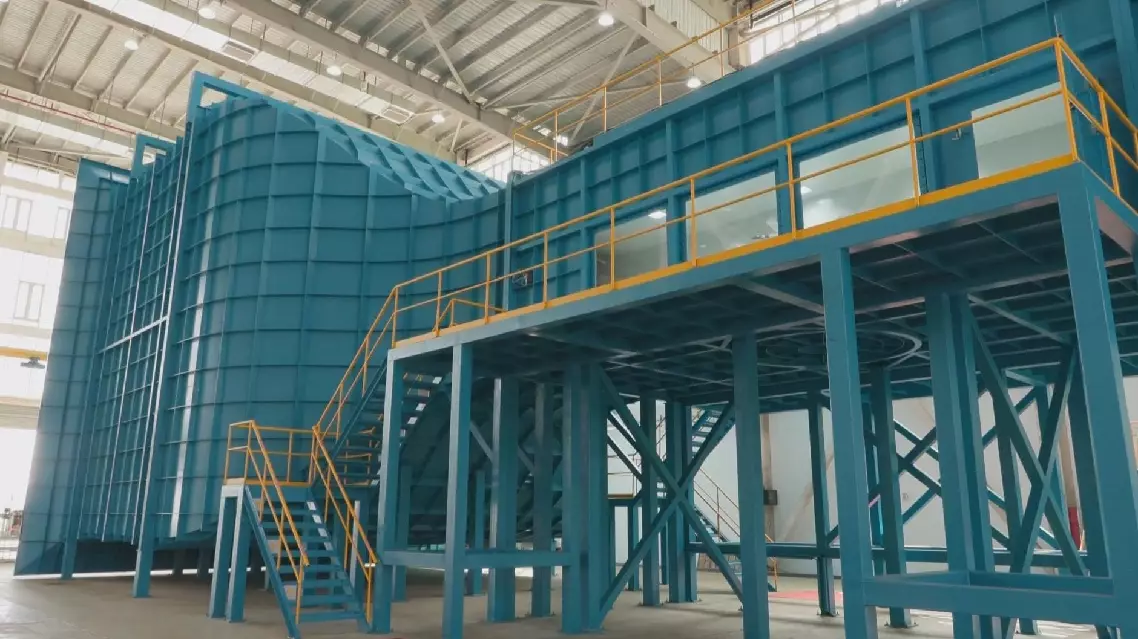
Guangdong builds China's first wind tunnel for low-altitude aircraft
Both the Israeli and the United Arab Emirates (UAE) sides confirmed that Prime Minister Benjamin Netanyahu visited the UAE and met with UAE President Sheikh Mohamed bin Zayed Al Nahyan in Abu Dhabi on Sunday.
In a post on social media platform X, the Office of the Prime Minister of Israel said on Monday that Netanyahu and his wife visited the United Arab Emirates on Sunday at the invitation of the UAE president.
"The visit focused on strengthening relations between the two countries and on regional challenges. The Prime Minister was accompanied by the head of the National Security Council, the head of the Mossad, the military secretary and the foreign policy adviser," said the post.
The UAE's state-run Emirates News Agency said on Monday that the two leaders discussed bilateral relations and ways to strengthen ties, without providing further details.
Citing officials familiar with the meeting, Israeli state-owned Kan TV News reported that Netanyahu had asked the UAE president to publicly deny reports that he had warned the Israeli prime minister before Hamas' Oct. 7, 2023 surprise attack that the group was planning a major operation.
Netanyahu has previously denied receiving such a warning.
In a separate statement, his office denied the report as "fake news," claiming that the visit "focused exclusively on strengthening relations between the two countries and on regional challenges."
Netanyahu traveled to the UAE on a private plane and spent the day there, Kan TV News said.

Israeli PM's visit to UAE confirmed by both sides