Skip to Content Facebook Feature Image

Key players in Syria's latest eruption of violence, from the Druze and Bedouin to government forces

News

Key players in Syria's latest eruption of violence, from the Druze and Bedouin to government forces
News

News

Key players in Syria's latest eruption of violence, from the Druze and Bedouin to government forces

2025-07-18 03:48 Last Updated At:04:01

BEIRUT (AP) — Clashes that shook southern Syria this week killed hundreds of people, including civilians, and drew in an array of local and international players, harking back to the dynamics of the country's yearslong civil war.

The violence underscored the difficulties facing the Syrian new government struggling to consolidate control over the country, months after Islamist-led insurgents ousted longtime autocrat Bashar Assad in a lightning offensive last December.

Some key players and alliances in Syria are different now than during the civil war, but the landscape remains complex.

Here's a look at the main parties in the four days of violence in Sweida province before a ceasefire mediated by the United States, Turkey and Arab countries took effect. The truce mostly held on Thursday, though scattered violence was reported.

Interim President Ahmad al-Sharaa leads the new government and is Syria's international face. His Hayat Tahrir al-Sham group, once an al-Qaida affiliate that later split from it, spearheaded the anti-Assad charge.

Since taking power, al-Sharaa has taken a more moderate tone, preached coexistence and formed diplomatic ties with Western countries, including the U.S.

His government has faced suspicion from minority communities — including Assad's Alawite sect, Christians, Syrian Kurds and the Druze — and there have been outbreaks of sectarian violence. Damascus also struggles to turn a patchwork of former rebel groups — including some extremists — into a professional army.

In Sweida, al-Sharaa's government forces intervened in clashes that started between local Bedouin tribes and Druze militias, but ended up themselves clashing with the Druze, drawing Israeli airstrikes, purportedly in defense of the Druze. Some government fighters allegedly killed Druze civilians, and looted and burned houses.

The Druze sect began as a 10th-century offshoot of Ismailism, a branch of Shiite Islam. More than half the roughly 1 million Druze worldwide live in Syria. Others mostly live in Lebanon and Israel, including in the Golan Heights, which Israel captured from Syria in the 1967 Mideast War and annexed in 1981.

During Syria's civil war, the Druze were split between supporting Assad, who offered them a degree of autonomy and exemption from army conscription, and his opposition. They established their own militias, partly to defend against Islamic militants who consider them heretics.

Until this week's clashes, the Druze were split between those who wanted to integrate with the new government and those seeking to maintain autonomy.

While predominantly Druze, Sweida is also home to Bedouin tribes who are Sunni Muslim and who have on occasion clashed with the Druze.

In 2000, unrest broke out after a Bedouin killed a Druze man in a land dispute. Assad's forces intervened, shooting Druze protesters. After a 2018 Islamic State group attack on the Druze in Sweida that killed more than 200 people, the Druze accused the Bedouins of helping the militants.

The latest escalation began with a Bedouin tribe in Sweida setting up a checkpoint and attacking and robbing a Druze man, which triggered tit-for-tat attacks and kidnappings, according to the Syrian Observatory for Human Rights, a Britain-based war monitor.

Al-Sharaa's forces then intervened, ostensibly to restore calm, but sided with the Bedouins. Some Druze groups allegedly carried out revenge attacks against Bedouins after a ceasefire was reached.

Israel frequently launched strikes on Iranian and Iran-backed forces who were Assad's allies during Syria's civil war. Since Assad's fall, Israel has been suspicious of the new Islamist authorities in Damascus.

Israeli forces seized have control of a U.N.-patrolled buffer zone in Syria and carried out airstrikes on military sites in what officials they was a move to create a demilitarized zone south of Damascus.

Washington has been pushing for Syria and Israel to move toward normalizing relations. Syrian officials have acknowledged holding indirect talks with Israel to defuse tensions.

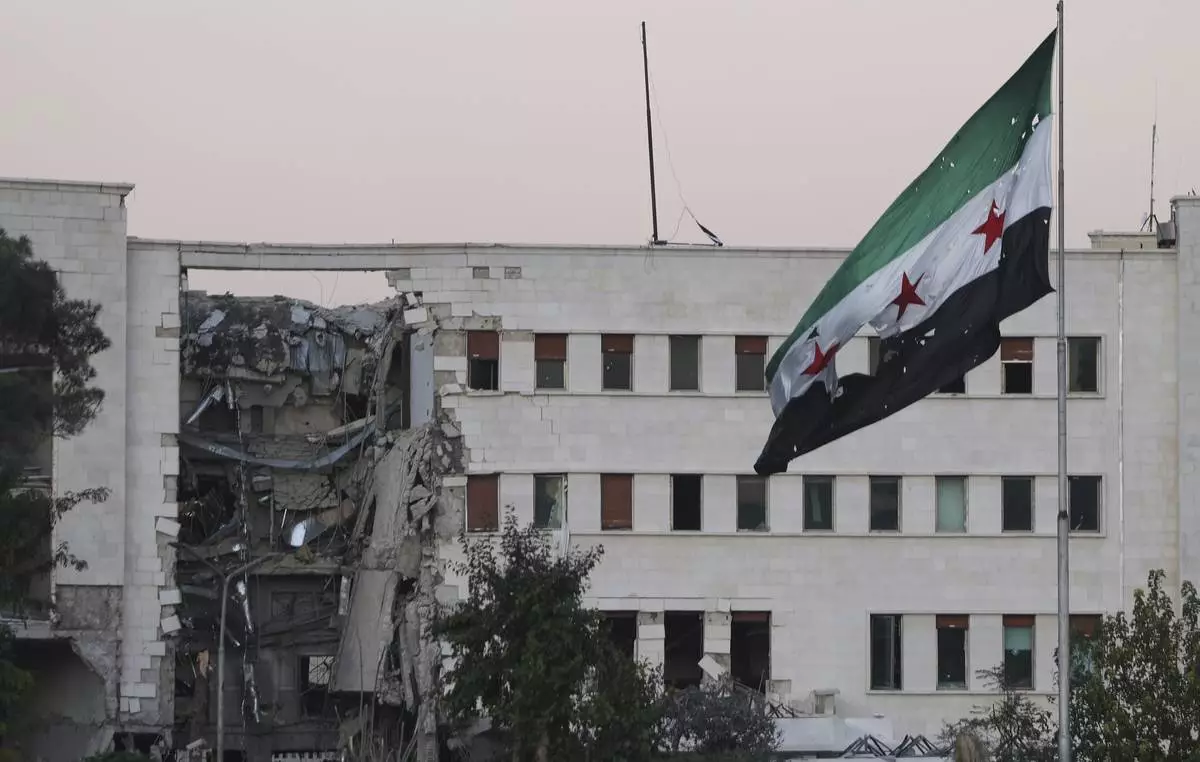
Israel stepped up its intervention during the Sweida escalation this week, saying it was acting to protect the Druze, who are seen as a loyal minority in Israel and often serve in the military. Israel launched dozens of airstrikes on convoys of Syrian forces around Sweida and struck the headquarters of the Syrian Ministry of Defense in the heart of Damascus.

In a watershed moment, President Donald Trump met with al-Sharaa during a visit to Saudi Arabia in May, a major boost from Washington as the new Damascus authorities try to consolidate control.

Amid the Sweida violence, the U.S., which has been pushing to broker ties between Syria and Israel, launched a flurry of diplomacy to push for a ceasefire.

Secretary of State Marco Rubio said the U.S. was “very worried” about the violence, describing it as a “direct threat to efforts to help build a peaceful and stable Syria,” and added that Washington was in “repeated and constant talks with the governments of Syria and Israel” to deescalate.

Turkey, an ally of both the U.S. and al-Sharaa's government, was also part of the mediation efforts over Sweida.

Ankara wants a strong state in Damascus and is primarily concerned with curtailing the influence of Kurdish groups in Syria along the border with Turkey — specifically, the Kurdish-led Syrian Democratic Forces, or SDF.

While the Kurdish SDF fighters are allied with the U.S. and were key in defeating the Islamic State militants, Ankara considers them terrorists because of their association with the Kurdistan Workers’ Party, or PKK, which has waged a long-running insurgency in Turkey.

The Kurdish-led SDF controls much of northeast Syria and was not part of the Sweida violence. But its fighters have in the past clashed with Turkish-backed groups that are now part of the new Syrian government forces.

In March, the SDF and Damascus signed a landmark deal — backed by Washington — under which the Kurdish-led forces would merge with the new Syrian national army. The deal also said Syria's border crossings with Iraq and Turkey, as well as airports and oil fields in the northeast that are now under the SDF control would be turned over to the central government.

But the details of the deal were left vague, and the two sides have been at odds over how to implement it. The Sweida escalation could further sideline those discussions.
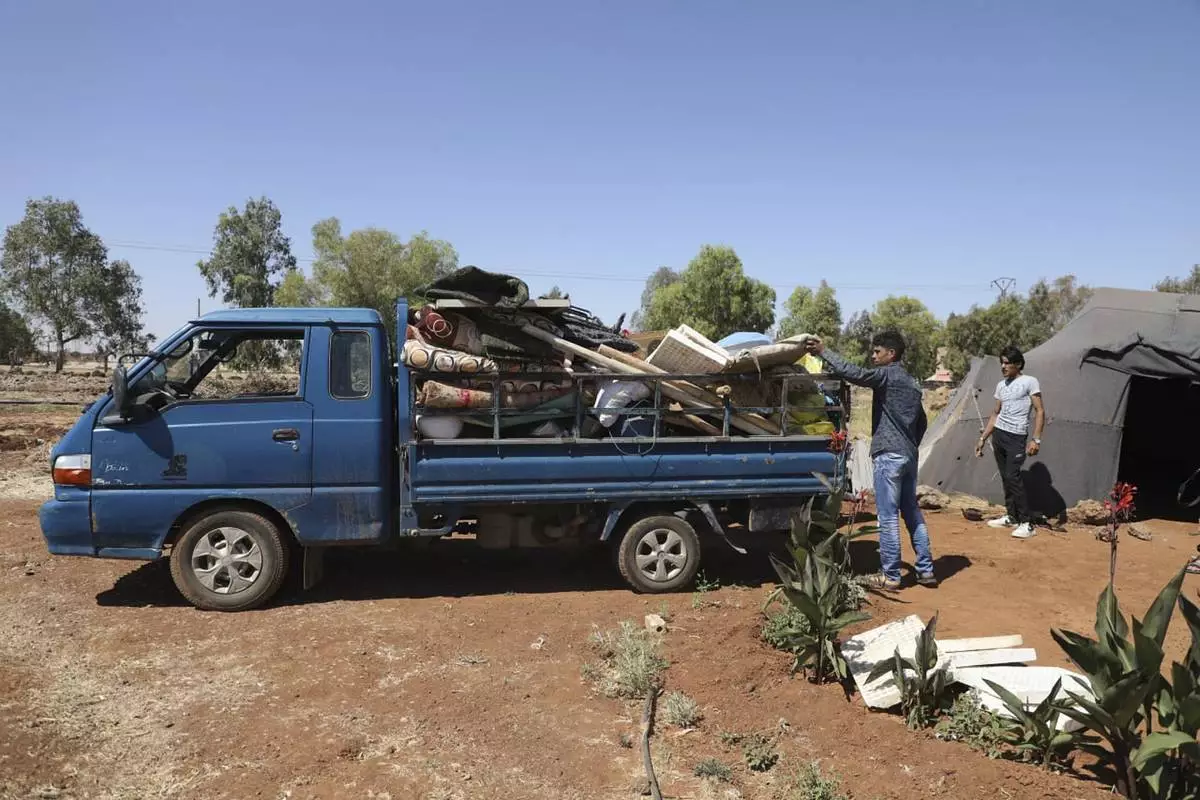
In this photo released by the Syrian official news agency SANA, Bedouin people pack their belongings onto a truck, as they flee their villages after Druze militias launched revenge attacks following days of clashes in Sweida city, southern Syria, Thursday, July 17, 2025. (SANA via AP)
In this photo released by the Syrian official news agency SANA, Bedouin people pack their belongings onto a truck, as they flee their villages after Druze militias launched revenge attacks following days of clashes in Sweida city, southern Syria, Thursday, July 17, 2025. (SANA via AP)

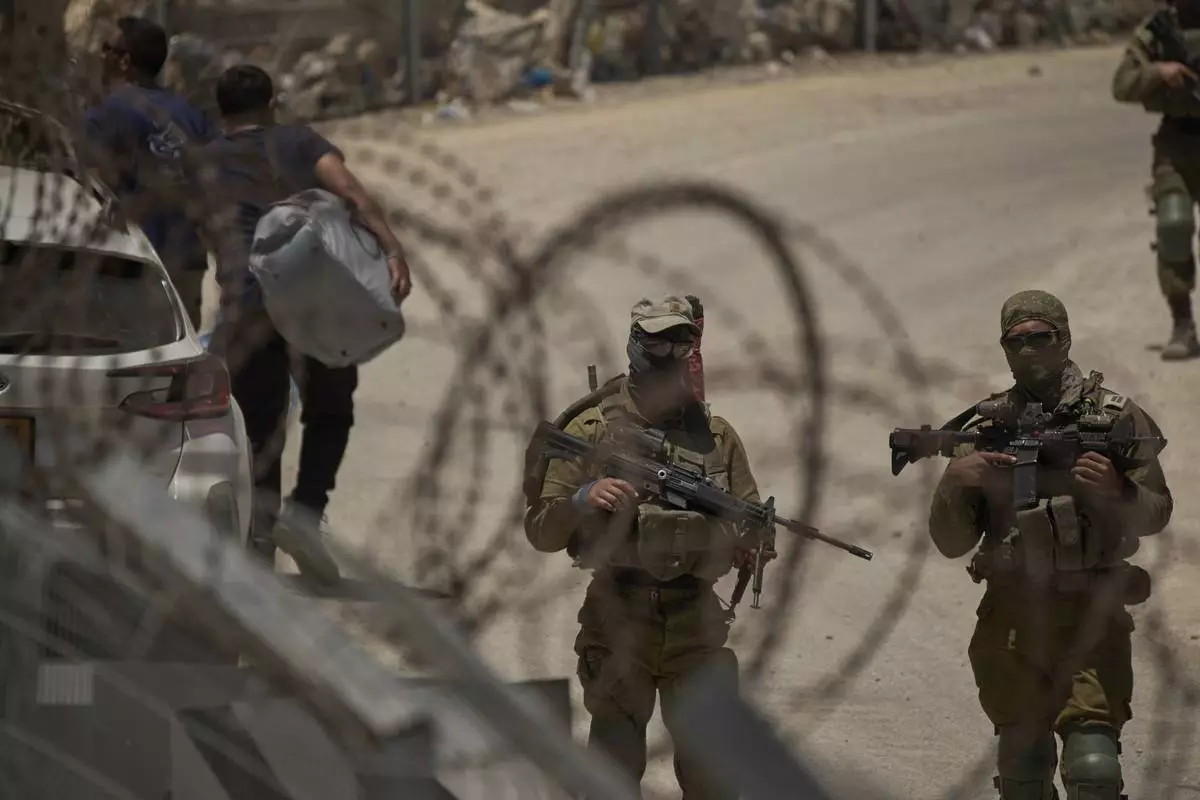
Israeli soldiers stand guard as Syrian Druze people cross back into Syria at the Israeli-Syrian border, in the Israeli-controlled Golan Heights town of Majdal Shams, Thursday, July 17, 2025. (AP Photo/Leo Correa)
Israeli soldiers stand guard as Syrian Druze people cross back into Syria at the Israeli-Syrian border, in the Israeli-controlled Golan Heights town of Majdal Shams, Thursday, July 17, 2025. (AP Photo/Leo Correa)

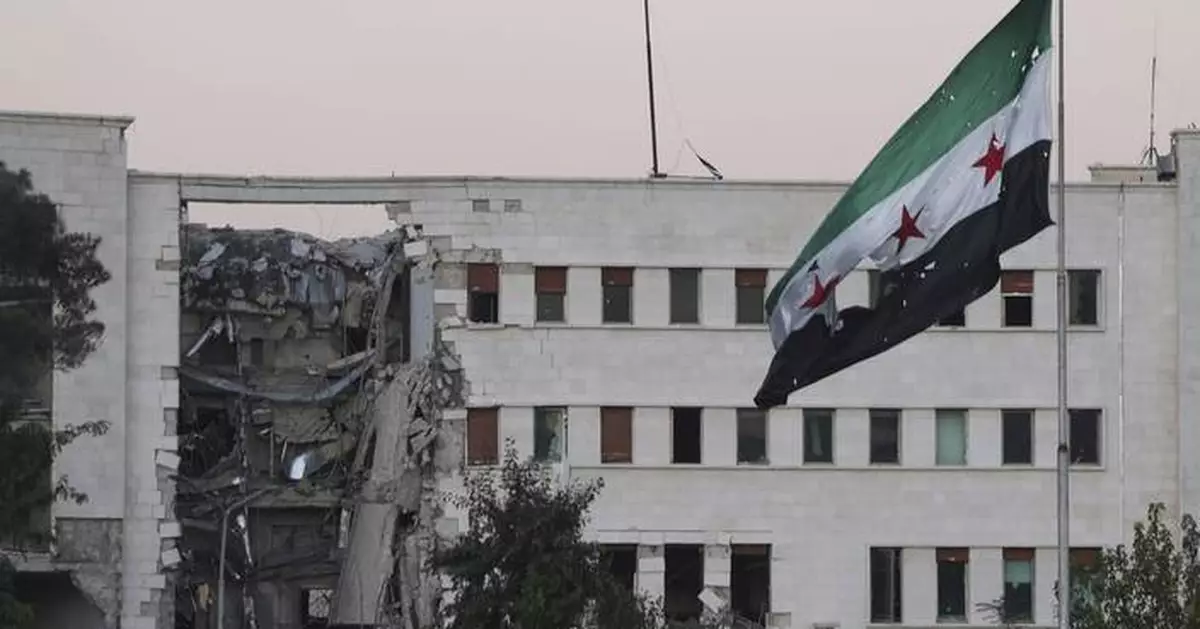
The Syrian Defense Ministry building sits heavily damaged after alleged Israeli airstrikes in Damascus, Syria, Wednesday, July 16, 2025. (AP Photo/Ghaith Alsayed)

The Syrian Defense Ministry building sits heavily damaged after alleged Israeli airstrikes in Damascus, Syria, Wednesday, July 16, 2025. (AP Photo/Ghaith Alsayed)
RHO, Italy (AP) — No ice is colder and harder than speedskating ice. The precision it takes has meant that Olympic speedskaters have never competed for gold on a temporary indoor rink – until the 2026 Milan Cortina Winter Games.

In the pursuit of maximum glide and minimum friction, Olympic officials brought on ice master Mark Messer, a veteran of six previous Olympic speedskating tracks and the ice technician in charge of the Olympic Oval in Calgary, Canada — one of the fastest tracks in the world with over 300 records.

Messer has been putting that experience to work one thin layer of ice at a time since the end of October at the new Speed Skating Stadium, built inside adjacent trade fair halls in the city of Rho just north of Milan.

“It’s one of the biggest challenges I’ve had in icemaking,’’ Messer said during an interview less than two weeks into the process.

If Goldilocks were a speedskater, hockey ice would be medium hard, for fast puck movement and sharp turns. Figure skating ice would be softer, allowing push off for jumps and so the ice doesn’t shatter on landing. Curling ice is the softest and warmest of all, for controlled sliding.

For speedskating ice to be just right, it must be hard, cold and clean. And very, very smooth.

“The blades are so sharp, that if there is some dirt, the blade will lose the edge,’’ Messer said, and the skater will lose speed.

Speedskater Enrico Fabris, who won two Olympic golds in Turin in 2006, has traded in his skates to be deputy sports manager at the speedskating venue in Rho. For him, perfect ice means the conditions are the same for all skaters — and then if it's fast ice, so much the better.

"It's more of a pleasure to skate on this ice,'' he said.

Messer’s first Olympics were in Calgary in 1988 — the first time speedskating was held indoors. “That gave us some advantages because we didn’t have to worry about the weather, wind blowing or rain,’’ he said. Now he is upping the challenge by becoming the first ice master to build a temporary rink for the Olympics.

Before Messer arrived in Italy, workers spent weeks setting up insulation to level the floor and then a network of pipes and rubber tubes that carry glycol — an antifreeze — that is brought down to minus 7 or minus 8 degrees Celsius (17.6 to 19.4 degrees Fahrenheit) to make the ice.

Water is run through a purification system — but it can’t be too pure, or the ice that forms will be too brittle. Just the right amount of impurities “holds the ice together,’’ Messer said.

The first layers of water are applied slowly, with a spray nozzle; after the ice reaches a few centimeters it is painted white — a full day’s work — and the stripes are added to make lanes.

“The first one takes about 45 minutes. And then as soon as it freezes, we go back and do it again, and again and again. So we do it hundreds of times,’’ Messer said.

As the ice gets thicker, and is more stable, workers apply subsequent layers of water with hoses. Messer attaches his hose to hockey sticks for easier spreading.

What must absolutely be avoided is dirt, dust or frost — all of which can cause friction for the skaters, slowing them down. The goal is that when the skaters push “they can go as far as possible with the least amount of effort,’’ Messer said.

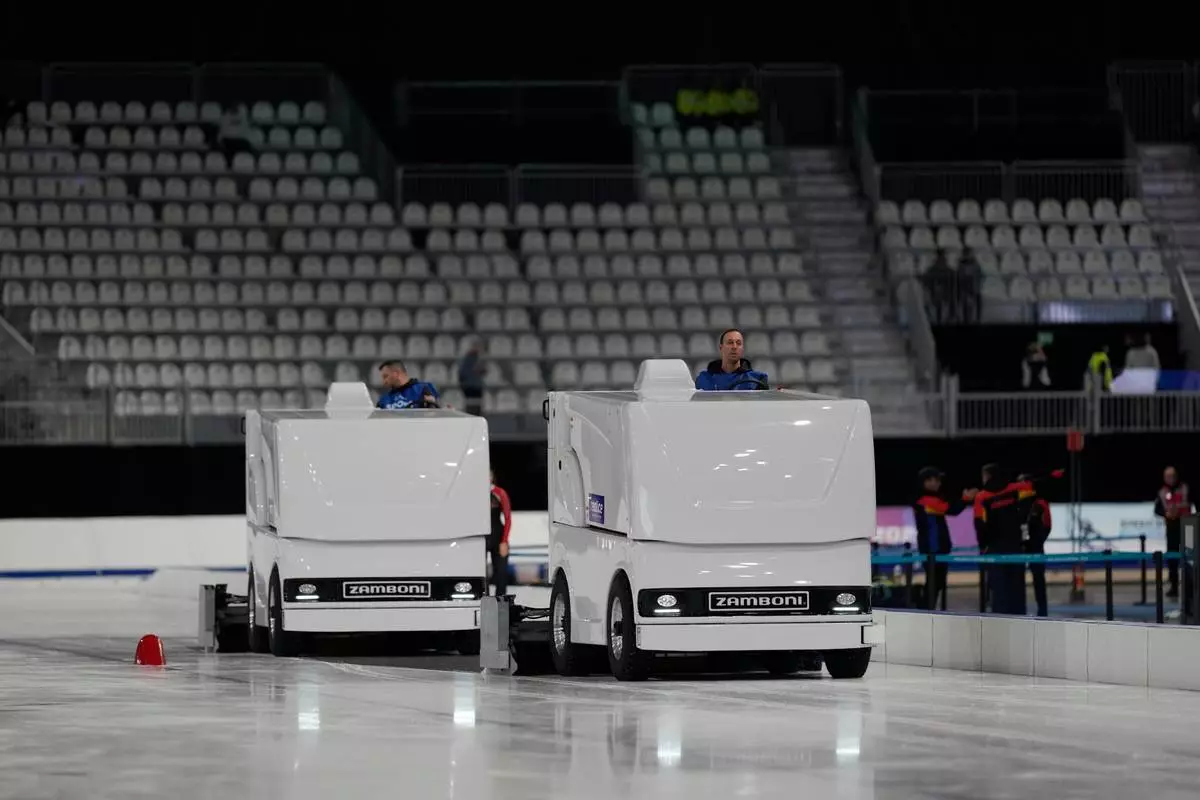
The Zamboni ice resurfacing machine plays a key role in keeping the track clean, cutting off a layer and spraying water to make a new surface.

One challenge is gauging how quickly the water from the resurfacing machine freezes in the temporary rink.

Another is getting the ice to the right thickness so that the Zamboni, weighing in at six tons, doesn’t shift the insulation, rubber tubing or ice itself.

“When you drive that out, if there’s anything moving it will move. We don’t want that,’’ Messer said.

The rink got its first big test on Nov. 29-30 during a Junior World Cup event. In a permanent rink, test events are usually held a year before the Olympics, leaving more time for adjustments. “We have a very small window to learn,’’ Messer acknowledged.

Dutch speedskater Kayo Vos, who won the men’s neo-senior 1,000 meters, said the ice was a little soft — but Messer didn’t seem too concerned.

“We went very modest to start, now we can start to change the temperatures and try to make it faster and still maintain it as a safe ice,’’ he said.

Fine-tuning the air temperature and humidity and ice temperature must be done methodically — taking into account that there will be 6,000 spectators in the venue for each event. The next real test will be on Jan. 31, when the Olympians take to the ice for their first training session.

“Eighty percent of the work is done but the hardest part is the last 20 percent, where we have to try to find the values and the way of running the equipment so all the skaters get the same conditions and all the skaters get the best conditions,’’ Messer said.

AP Winter Olympics: https://apnews.com/hub/milan-cortina-2026-winter-olympics

Serpentines are set on the ice of the stadium where speed skating discipline of the Milan Cortina 2026 Winter Olympics will take place, in Rho, outskirt of Milan, Tuesday, Nov. 11, 2025. (AP Photo/Luca Bruno)

Serpentines are set on the ice of the stadium where speed skating discipline of the Milan Cortina 2026 Winter Olympics will take place, in Rho, outskirt of Milan, Tuesday, Nov. 11, 2025. (AP Photo/Luca Bruno)

Ice Master Mark Messer poses in the stadium where speed skating discipline of the Milan Cortina 2026 Winter Olympics will take place, in Rho, outskirt of Milan, Tuesday, Nov. 11, 2025. (AP Photo/Luca Bruno)

Ice Master Mark Messer poses in the stadium where speed skating discipline of the Milan Cortina 2026 Winter Olympics will take place, in Rho, outskirt of Milan, Tuesday, Nov. 11, 2025. (AP Photo/Luca Bruno)

Workers clean the ice surface during a peed skating Junior World Cup and Olympic test event, in Rho, near Milan, Italy, Saturday, Nov. 29, 2025. (AP Photo/Luca Bruno)

Workers clean the ice surface during a peed skating Junior World Cup and Olympic test event, in Rho, near Milan, Italy, Saturday, Nov. 29, 2025. (AP Photo/Luca Bruno)

Ice Master Mark Messer poses in the stadium where speed skating discipline of the Milan Cortina 2026 Winter Olympics will take place, in Rho, outskirt of Milan, Tuesday, Nov. 11, 2025. (AP Photo/Luca Bruno)

Ice Master Mark Messer poses in the stadium where speed skating discipline of the Milan Cortina 2026 Winter Olympics will take place, in Rho, outskirt of Milan, Tuesday, Nov. 11, 2025. (AP Photo/Luca Bruno)

Ice Master Mark Messer poses in the stadium where speed skating discipline of the Milan Cortina 2026 Winter Olympics will take place, in Rho, outskirt of Milan, Tuesday, Nov. 11, 2025. (AP Photo/Luca Bruno)

Ice Master Mark Messer poses in the stadium where speed skating discipline of the Milan Cortina 2026 Winter Olympics will take place, in Rho, outskirt of Milan, Tuesday, Nov. 11, 2025. (AP Photo/Luca Bruno)

Recommended Articles