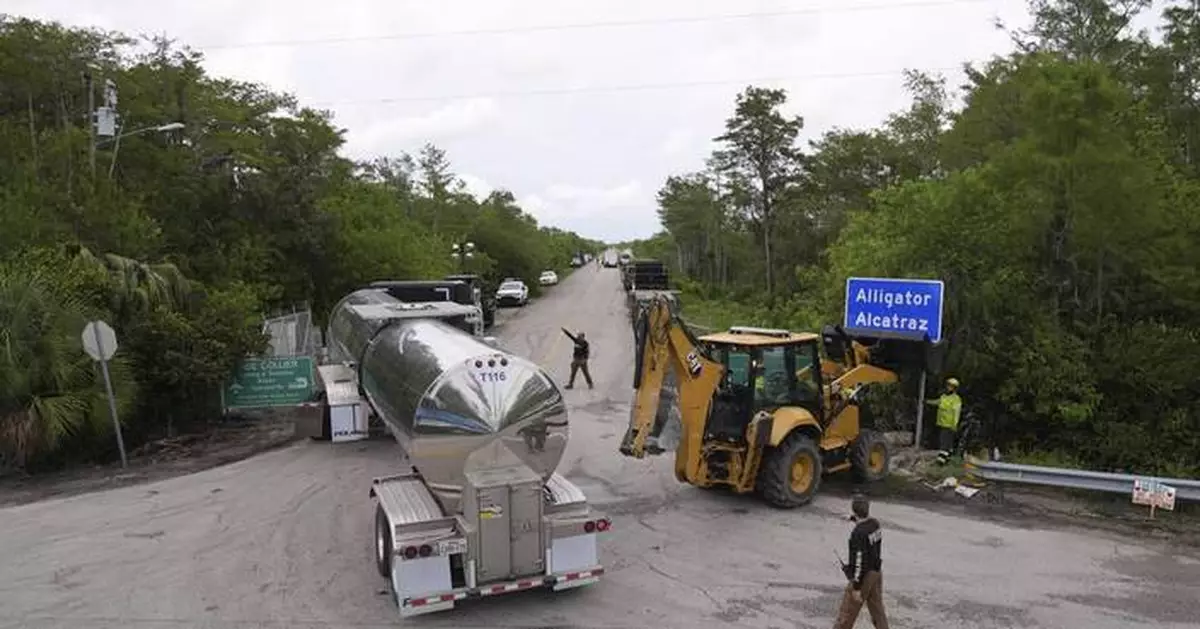
TALLAHASSEE, Fla. (AP) — Florida Gov. Ron DeSantis' administration left many local officials in the dark about the immigration detention center that rose from an isolated airstrip in the Everglades, emails obtained by The Associated Press show, while relying on an executive order to seize the land, hire contractors and bypass laws and regulations.
The emails show that local officials in southwest Florida were still trying to chase down a “rumor” about the sprawling “Alligator Alcatraz” facility planned for their county while state officials were already on the ground and sending vendors through the gates to coordinate construction of the detention center, which was designed to house thousands of migrants and went up in a matter of days.
“Not cool!” one local official told the state agency director spearheading the construction.
The 100-plus emails dated June 21 to July 1, obtained through a public records request, underscore the breakneck speed at which the governor's team built the facility and the extent to which local officials were blindsided by the plans for the compound of makeshift tents and trailers in Collier County, a wealthy, majority-Republican corner of the state that's home to white-sand beaches and the western stretch of the Everglades.
The executive order, originally signed by the Republican governor in 2023 and extended since then, accelerated the project, allowing the state to seize county-owned land and evade rules in what critics have called an abuse of power. The order granted the state sweeping authority to suspend “any statute, rule or order” seen as slowing the response to the immigration “emergency.”
A representative for DeSantis did not immediately respond to a request for comment.
Known as the Dade-Collier Training and Transition Airport, the airstrip is about 45 miles (72 kilometers) west of downtown Miami. It is located within Collier County but is owned and managed by neighboring Miami-Dade County. The AP asked for similar records from Miami-Dade County, where officials said they are still processing the request.
To DeSantis and other state officials, building the facility in the remote Everglades and naming it after a notorious federal prison were meant as deterrents. It’s another sign of how President Donald Trump's administration and his allies are relying on scare tactics to pressure people who are in the country illegally to leave.
Collier County Commissioner Rick LoCastro apparently first heard about the proposal after a concerned resident in another county sent him an email on June 21.
“A citizen is asking about a proposed ‘detention center’ in the Everglades?” LoCastro wrote to County Manager Amy Patterson and other staff. “Never heard of that … Am I missing something?”
“I am unaware of any land use petitions that are proposing a detention center in the Everglades. I’ll check with my intake team, but I don’t believe any such proposal has been received by Zoning,” replied the county's planning and zoning director, Michael Bosi.
Environmental groups have since filed a federal lawsuit, arguing that the state illegally bypassed federal and state laws and county zoning rules in building the facility. The complaint alleges that the detention center went up "without legislative authority, environmental review or compliance with local land use requirements.”
In fact, LoCastro was included on a June 21 email from state officials announcing their intention to buy the airfield. LoCastro sits on the county's governing board but does not lead it, and his district does not include the airstrip. He forwarded the message to the county attorney, saying “Not sure why they would send this to me?”
In the email, Kevin Guthrie, the head of the Florida Division of Emergency Management, which built the detention center, said the state intended to “work collaboratively” with the counties. The message referenced the executive order on illegal immigration, but it did not specify how the state wanted to use the site, other than for “future emergency response, aviation logistics, and staging operations.”
The next day, Collier County's emergency management director, Dan Summers, wrote up a briefing for the county manager and other local officials, including some notes about the “rumor” he had heard about plans for an immigration detention facility at the airfield.
Summers knew the place well, he said, after doing a detailed site survey a few years ago.
“The infrastructure is — well, nothing much but a few equipment barns and a mobile home office … (wet and mosquito-infested)," Summers wrote.
FDEM told Summers that while the agency had surveyed the airstrip, “NO mobilization or action plans are being executed at this time” and all activity was “investigatory," Summers wrote.
By June 23, Summers was racing to prepare a presentation for a meeting of the Board of County Commissioners the next day. He shot off an email to FDEM Director Kevin Guthrie seeking confirmation of basic facts about the airfield and the plans for the detention facility, which Summers understood to be “conceptual” and in “discussion or investigatory stages only.”
“Is it in the plans or is there an actual operation set to open?” Summers asked. “Rumor is operational today… ???”
In fact, the agency was already “on site with our vendors coordinating the construction of the site," FDEM bureau chief Ian Guidicelli responded.
“Not cool! That’s not what was relayed to me last week or over the weekend,” Summers responded, adding that he would have “egg on my face” with the Collier County Sheriff's Office and Board of County Commissioners. "It’s a Collier County site. I am on your team, how about the courtesy of some coordination?”
On the evening of June 23, FDEM officially notified Miami-Dade County it was seizing the county-owned land to build the detention center, under emergency powers granted by the executive order.
Plans for the facility sparked concerns among first responders in Collier County, who questioned which agency would be responsible if an emergency should strike the site.
Discussions on the issue grew tense at times. Local Fire Chief Chris Wolfe wrote to the county's chief of emergency medical services and other officials on June 25: "I am not attempting to argue with you, more simply seeking how we are going to prepare for this that is clearly within the jurisdiction of Collier County."
Summers, the emergency management director, repeatedly reached out to FDEM for guidance, trying to “eliminate some of the confusion” around the site.
As he and other county officials waited for details from Tallahassee, they turned to local news outlets for information, sharing links to stories among themselves.
“Keep them coming,” Summers wrote to county Communications Director John Mullins in response to one news article, “since its crickets from Tally at this point.”
Hoping to manage any blowback to the county's tourism industry, local officials kept close tabs on media coverage of the facility, watching as the news spread rapidly from local newspapers in southwest Florida to national outlets such as The Washington Post and The New York Times and international news sites as far away as Great Britain, Germany and Switzerland.
As questions from reporters and complaints from concerned residents streamed in, local officials lined up legal documentation to show the airfield was not their responsibility.
In an email chain labeled, “Not our circus, not our monkeys...,” County Attorney Jeffrey Klatzkow wrote to the county manager, “My view is we have no interest in this airport parcel, which was acquired by eminent domain by Dade County in 1968.”
Meanwhile, construction at the site plowed ahead, with trucks arriving around the clock carrying portable toilets, asphalt and construction materials. Among the companies that snagged multimillion dollar contracts for the work were those whose owners donated generously to political committees supporting DeSantis and other Republicans.
On July 1, just 10 days after Collier County first got wind of the plans, the state officially opened the facility, welcoming DeSantis, Trump, Homeland Security Secretary Kristi Noem and other state and federal officials for a tour.
A county emergency management staffer fired off an email to Summers, asking to be included on any site visit to the facility.
“Absolutely,” Summers replied. “After the President’s visit and some of the chaos on-site settles-in, we will get you all down there…”
Kate Payne is a corps member for The Associated Press/Report for America Statehouse News Initiative. Report for America is a nonprofit national service program that places journalists in local newsrooms to report on undercovered issues.
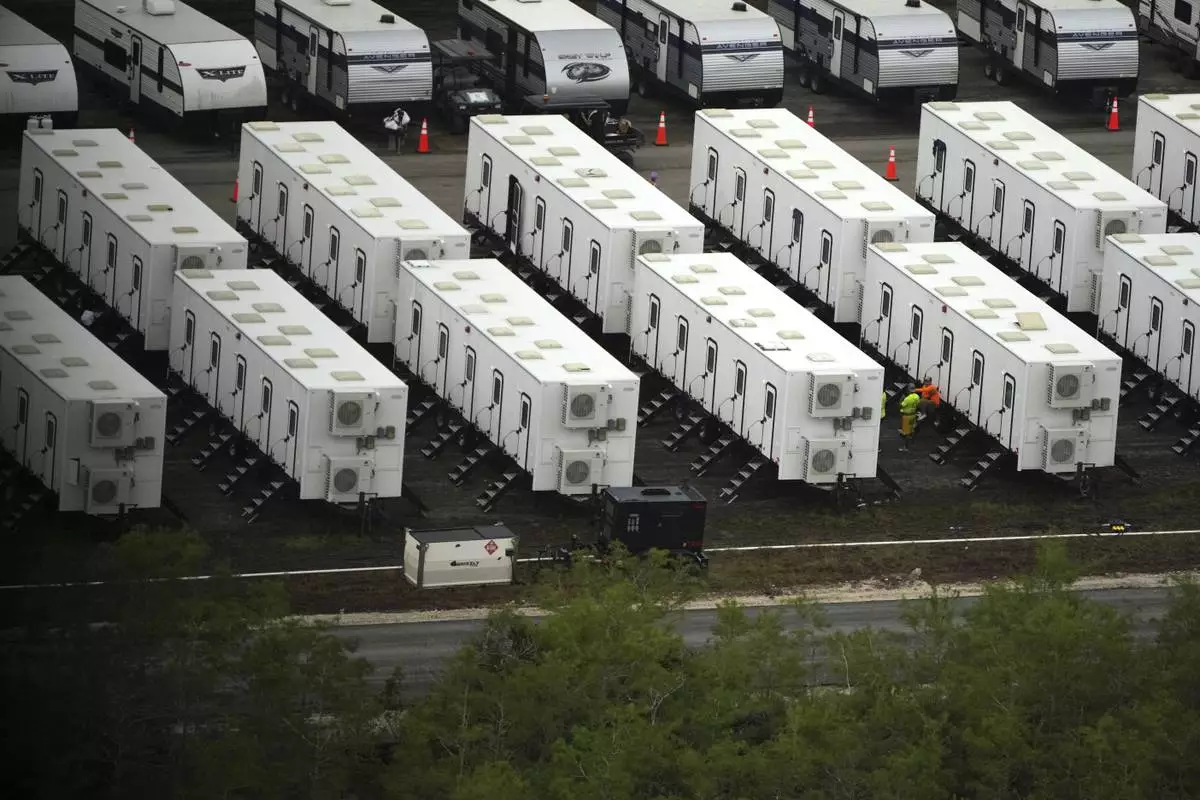
Workers sit alongside trailers as work progresses on a new migrant detention center dubbed "Alligator Alcatraz," at Dade-Collier Training and Transition facility in the Florida Everglades, Friday, July 4, 2025, in Ochopee, Fla. (AP Photo/Rebecca Blackwell)
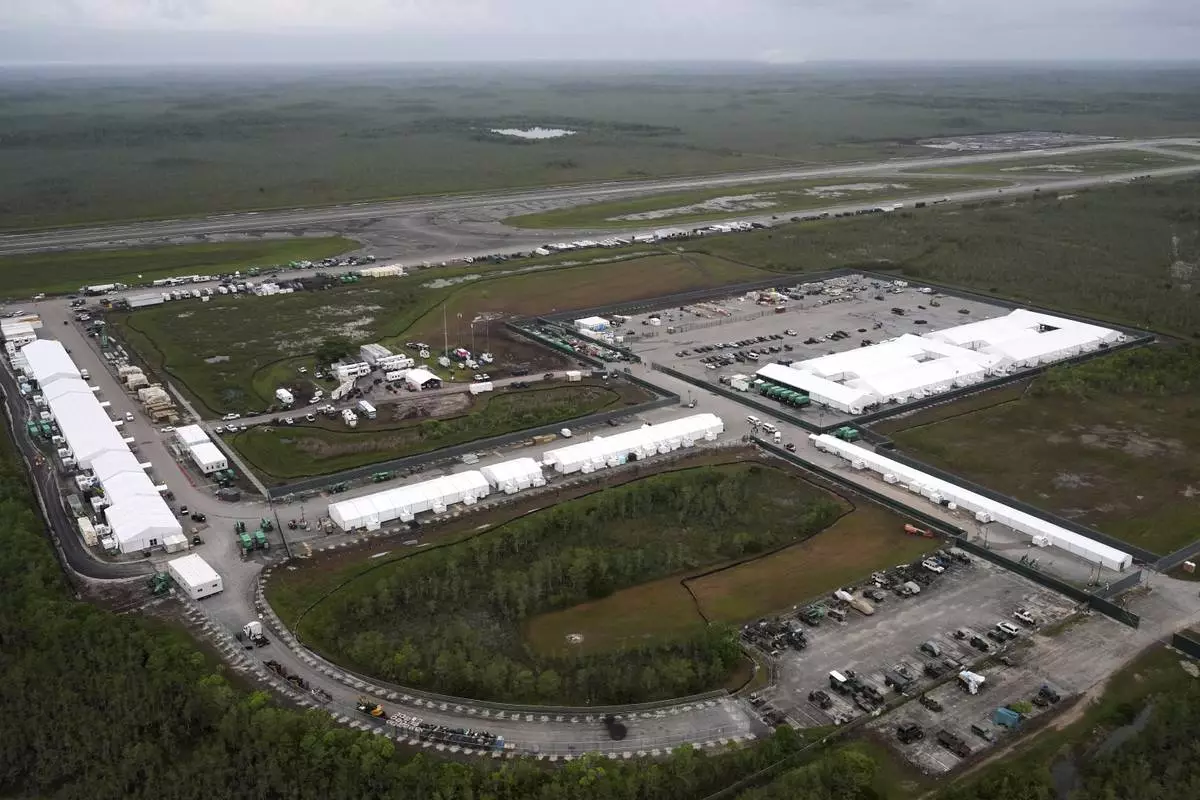
Work progressed on a new migrant detention facility dubbed "Alligator Alcatraz," at Dade-Collier Training and Transition facility in the Florida Everglades, Friday, July 4, 2025, in Ochopee, Fla. (AP Photo/Rebecca Blackwell)
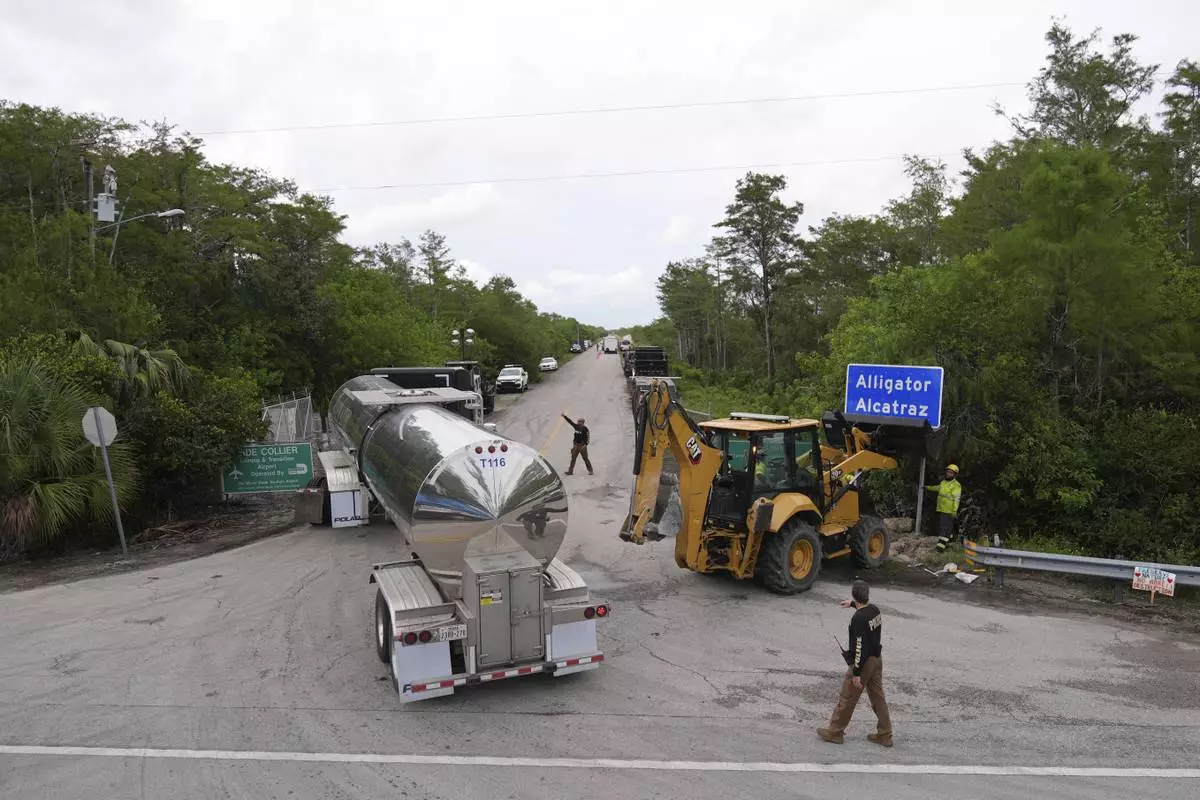
Workers install a sign reading "Alligator Alcatraz" at the entrance to a new migrant detention facility at Dade-Collier Training and Transition facility, Thursday, July 3, 2025, in Ochopee, Fla. (AP Photo/Rebecca Blackwell)