Chinese company UBTech unveiled the world's first humanoid robot that can autonomously change its own batteries in south China's tech hub Shenzhen on Thursday.
This humanoid robot features the world's first hot-swappable autonomous battery replacement system. This technology allows the robot to change its batteries without shutting down or requiring human assistance.
The application of such technology prevents task interruptions due to charging downtime, enabling continuous operation while cutting maintenance labor costs, thus enhancing overall production efficiency.
"Previously, a major drawback of robots was their limited operation hours, often only around four hours. The battery-swapping technology effectively extends the continuous operation time. Otherwise, they have to pause for charging and then come back to continue work, but the production line can't afford to stop. Therefore, this technology makes it possible for robots to work continuously, which means that humanoid robots can be standard equipment on production lines and in factories," said Fan Congming, executive president of the Shenzhen Artificial Intelligence Industry Association.
The application of robots in manufacturing production lines is accelerating the pace of automation upgrade of factories. Since the beginning of this year, several Chinese humanoid robot companies have secured orders from automotive manufacturers, sending more and more robots to work in factories.
The work of robots primarily includes handling and quality inspection in sectors such as automobile manufacturing and electronic manufacturing. Technological breakthroughs in energy solutions facilitate longer and more stable operation for robots, enhancing the safety and reliability of their factory work.
"Companies are now turning to smarter manufacturing process. In industrial production, tasks such as moving, polishing, welding and spraying, along with heavy lifting and palletizing in the automotive industry, are often repetitive and labor-intensive, so we use robots to replace labor force in these work," said Xing Fan, production manager of a robot manufacturing factory in Foshan City.
According to a report on the humanoid robot industry released at the 2024 World AI Conference in Shanghai, China's humanoid robot market scale was approximately 2.76 billion yuan (about 381.28 million U.S. dollars) in 2024, while by 2029, it is expected to expand to 75 billion yuan (about 10.36 billion U.S. dollars).
Industry insiders said that driven by supportive policies, humanoid robots are turning to practical application, with the industry entering a phase of accelerated development. Humanoid robots are expected to first penetrate the manufacturing sector, then gradually expand into the service industry and eventually into households by virtue of price reduction and scale effect.
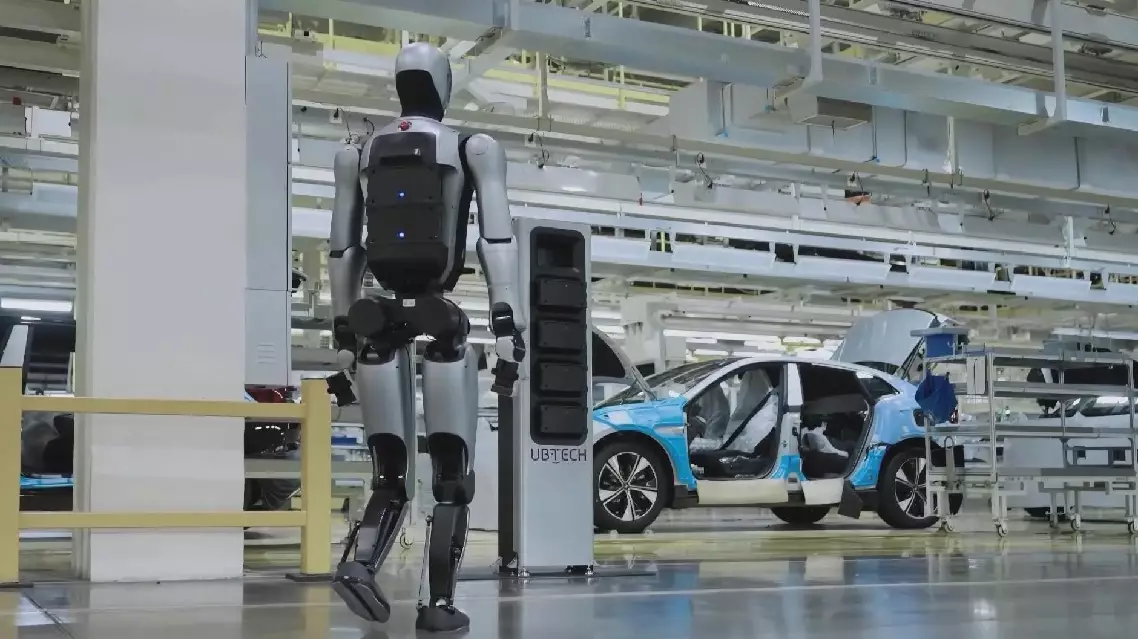
Chinese firm unveils world’s first humanoid robot that can change its own batteries