TOKYO--(BUSINESS WIRE)--Jul 22, 2025--
Kioxia Corporation has expanded its high-capacity KIOXIA LC9 Series enterprise SSD lineup by introducing the industry’s first [1] 245.76 terabyte (TB) [2] NVMe™ SSD in 2.5-inch and EDSFF E3.L form factor. This new capacity and form factor option complements the previously announced 122.88 TB (2.5-inch) model and is purpose-built for the performance and efficiency demands of generative AI environments.
This press release features multimedia. View the full release here: https://www.businesswire.com/news/home/20250721671536/en/
Generative AI places unique demands on storage, including the need to store vast datasets for training large language models (LLMs), and to create embeddings and vector databases that support inference through retrieval augmented generation (RAG). These workloads require storage solutions with exceptional capacity, speed, and efficiency.
Featuring 32-die stack of 2 terabit (Tb) [3] BiCS FLASH™ QLC 3D flash memory with innovative CBA (CMOS directly Bonded to Array) technology, KIOXIA LC9 Series SSDs deliver the speed, scale, and density required to support the next wave of data-centric workloads. This combination of advanced memory architecture and CBA technology enables an 8 TB [3] per small 154 BGA package – also an industry first [1]. This milestone was made possible with Kioxia’s high-precision wafer processing, material design, and wire bonding technologies.
KIOXIA LC9 Series SSDs are well-suited for data lakes, where massive data ingestion and rapid processing are essential. Unlike HDDs, which often bottleneck performance and leave costly GPUs underutilized, KIOXIA LC9 Series SSDs enable dense storage in a compact footprint with greater capacity per watt. By delivering up to 245.76 TB, they can replace multiple power-hungry HDDs, offering superior performance, lower overall power consumption, fewer drive slots used, and more efficient cooling. These features help drive total cost of ownership (TCO) improvements across power, density, and thermal management.
KIOXIA LC9 Series SSDs Features Include:
KIOXIA LC9 Series SSDs are now sampling to select customers and will be featured at the Future of Memory and Storage 2025 conference, taking place August 5 - 7 in Santa Clara.
Notes:
1: As of July 22, 2025, based on Kioxia survey.
2: Definition of SSD capacity: Kioxia Corporation defines a kilobyte (KB) as 1,000 bytes, a megabyte (MB) as 1,000,000 bytes, a gigabyte (GB) as 1,000,000,000 bytes, a terabyte (TB) as 1,000,000,000,000 bytes, and a kibibyte (KiB) is 1,024 bytes. A computer operating system, however, reports storage capacity using powers of 2 for the definition of 1GB = 2^30 bytes = 1,073,741,824 bytes and 1TB = 2^40 bytes = 1,099,511,627,776 bytes and therefore shows less storage capacity. Available storage capacity (including examples of various media files) will vary based on file size, formatting, settings, software and operating system, and/or pre-installed software applications, or media content. Actual formatted capacity may vary.
3: The flash memory capacity is calculated as 1 terabit (1 Tb) = 1,099,511,627,776 (2^40) bits, and 1 terabyte (1 TB) = 1,099,511,627,776 (2^40) bytes.
4: For RocksDB purposes, Kioxia confirmed that the Write Amplification Factor (WAF) is approximately 1.1 when using the FDP function with the plug-in (a function extension program released on the Kioxia GitHub account. https://github.com/kioxia-jp/ufrop ).
5: The KIOXIA LC9 Series SSD supports Leighton-Micali Signature (LMS) algorithm acknowledged by CNSA 2.0 (Commercial National Security Algorithm Suite 2.0) as a digital signature algorithm to prevent firmware tampering in preparation for threats to conventional cryptographic algorithms posed by quantum computers. Advanced Encryption Standard (AES-256) with a key length of 256 bits, which is the data encryption algorithm used in KIOXIA LC9 Series SSD, is also acknowledged by CNSA 2.0.
2.5-inch indicates the form factor of the SSD and not its physical size.
Read and write speed may vary depending on various factors such as host devices, software (drivers, OS etc.), and read/write conditions.
Performance is preliminary and subject to change without notice.
Sanitize Instant Erase (SIE), Self-Encrypting Drive (SED) and FIPS (Federal Information Processing Standards) SED security optional models are available.
Security optional models are not available in all countries due to export and local regulations.
NVMe and NVMe-MI are registered or unregistered trademarks of NVM Express, Inc. in the United States and other countries.
PCIe is a registered trademark of PCI-SIG.
Other company names, product names and service names may be trademarks of third-party companies.
About Kioxia
Kioxia is a world leader in memory solutions, dedicated to the development, production and sale of flash memory and solid-state drives (SSDs). In April 2017, its predecessor Toshiba Memory was spun off from Toshiba Corporation, the company that invented NAND flash memory in 1987. Kioxia is committed to uplifting the world with “memory” by offering products, services and systems that create choice for customers and memory-based value for society. Kioxia's innovative 3D flash memory technology, BiCS FLASH™, is shaping the future of storage in high-density applications, including advanced smartphones, PCs, automotive systems, data centers and generative AI systems.
Customer Inquiries:
Global Sales Offices
Kioxia Corporation
Global Sales Offices
https://www.kioxia.com/en-jp/business/buy/global-sales.html
*Information in this document, including product prices and specifications, content of services and contact information, is correct on the date of the announcement but is subject to change without prior notice.
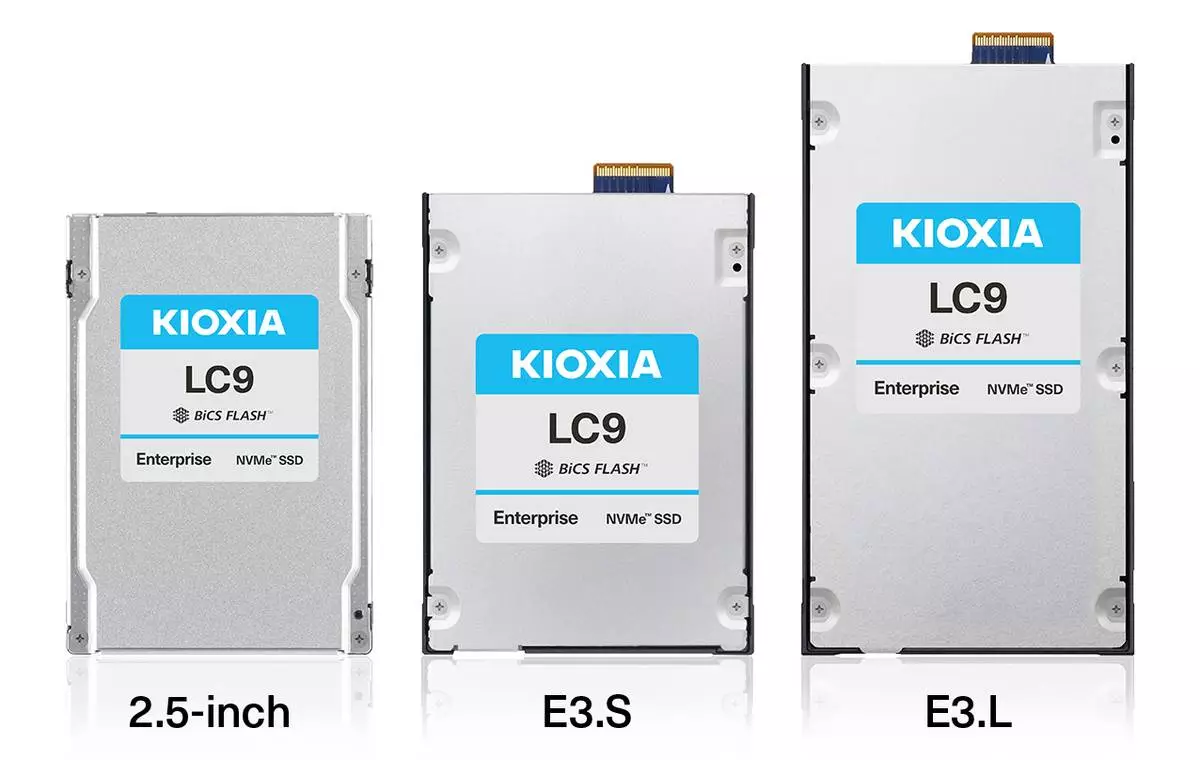
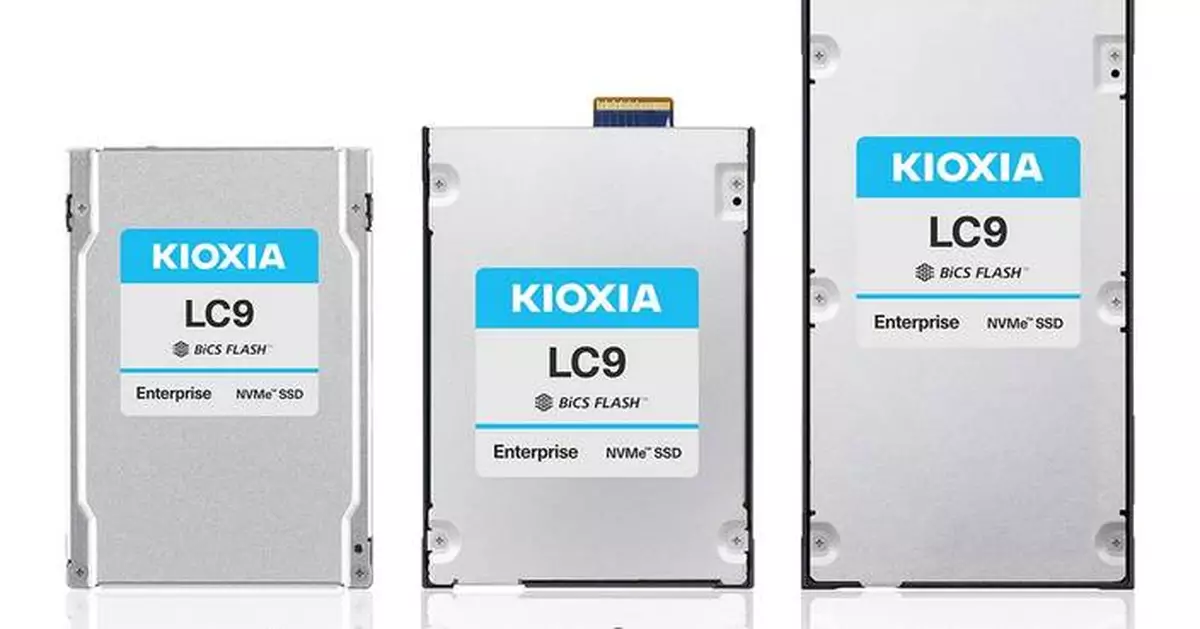
KIOXIA LC9 Series enterprise SSD (form factor: 2.5inch, E3.S, E3.L)