Monetary Authority takes disciplinary actions against three banks for contraventions of Anti-Money Laundering and Counter-Terrorist Financing Ordinance
The following is issued on behalf of the Hong Kong Monetary Authority:
The Hong Kong Monetary Authority (HKMA) announced today (July 22) that it had completed investigations and disciplinary proceedings under the Anti-Money Laundering and Counter-Terrorist Financing Ordinance (Chapter 615 of the Laws of Hong Kong) (AMLO) in relation to three banks: Indian Overseas Bank, Hong Kong Branch (IOBHK), Bank of Communications (Hong Kong) Limited (BCOM(HK)) and Bank of Communications Co., Ltd., Hong Kong Branch (BCOM Hong Kong Branch).
The Monetary Authority (MA) has: (i) reprimanded IOBHK; (ii) ordered IOBHK to conduct a look-back review of past transactions, and develop and implement a remedial plan to address the contraventions; and (iii) imposed a pecuniary penalty of HK$8,500,000 on IOBHK. Separately, the MA has imposed pecuniary penalties of HK$4,000,000 on BCOM(HK) and HK$3,700,000 on BCOM Hong Kong Branch. Details of the disciplinary actions against each of the three banks are set out in the respective Statements of Disciplinary Action attached.
The disciplinary actions (Note) follow investigations by the HKMA into the banks' systems and controls for compliance with the AMLO. The control deficiencies identified related to failures to establish and maintain effective procedures for continuously monitoring business relationships with customers.
There were significant deficiencies in IOBHK's transaction monitoring mechanism and management oversight of the bank's anti-money laundering and counter-financing of terrorism (AML/CFT) controls.
The contraventions of BCOM(HK) and BCOM Hong Kong Branch arose from omissions to load certain types of transactions into the transaction monitoring system shared by the two banks, undermining the system's effectiveness in identifying potentially suspicious activities.
In deciding the disciplinary actions, the MA has taken into account the relevant circumstances and factors, including:
the seriousness of the investigation findings;
the need to send a clear deterrent message to the three banks and the industry about the importance of having effective controls and procedures to address money laundering and terrorist financing risks;
where applicable, the remedial measures taken by the banks to address the deficiencies identified; and
the three banks have no previous disciplinary record in relation to the AMLO and co-operated with the HKMA during the investigations and enforcement proceedings.
The Executive Director (Enforcement and AML) of the HKMA, Mr Raymond Chan,said, "Effective transaction monitoring enables timely identification and reporting of suspicious transactions and thus is an essential component of banks' AML/CFT controls. Bank management should ensure that proper transaction monitoring systems and processes are in place and any identified deficiencies are addressed promptly."
Relevant links:
Statement of Disciplinary Action (IOBHK)
Statement of Disciplinary Action (BCOM(HK))
Statement of Disciplinary Action (BCOM Hong Kong Branch)
Note: The disciplinary actions are taken under section 21 of the AMLO. The AMLO imposes customer due diligence and record-keeping requirements on specified financial institutions, including authorized institutions, and designated non-financial businesses and professions. The MA is the relevant authority for authorized institutions under the AMLO.

Source: AI-found images
Nominations open for Anti-rodent Partner Awards 2026
The Food and Environmental Hygiene Department (FEHD) announced today (January 12) the launch of the Anti-rodent Partner Awards 2026, with nominations open from now until February 11.
To raise public awareness of environmental hygiene and encourage people to work together to cultivate good habits for a rodent-free environment, the FEHD launched the Anti-rodent Charter (the Charter) in December 2024. Property management companies, owners' corporations and residents' organisations of private residential premises were invited to participate and jointly create a rodent-free environment. To date, over 680 organisations and groups have signed the Charter, becoming Anti-rodent Partners of the FEHD.
The Anti-rodent Partner Awards 2026 aims to encourage residential premises to establish long-term anti-rodent mechanisms; enhance residents' attention to and engagement in environmental hygiene; and promote experience sharing and interaction among communities. The FEHD hopes that by commending proactive organisations and groups, more stakeholders will be motivated to engage in rodent prevention and control work; cultivate good habits of maintaining environmental hygiene; achieve the ultimate goal of "rodent eradication for all, building a rodent-free community"; and create a healthier, safer and more liveable environment for the public.
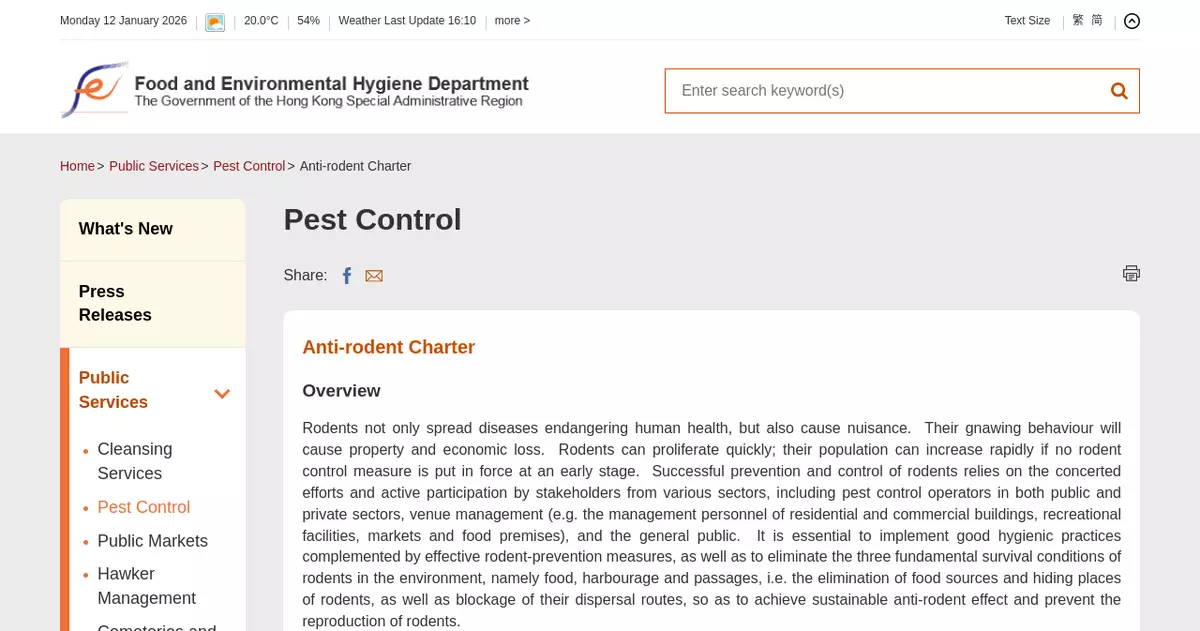
All Anti-rodent Partners who have signed the Charter are eligible for nomination. Details of the activity and application methods have been uploaded to the Charter's website (www.fehd.gov.hk/english/pestcontrol/anti_rodent_charter.html).
An online briefing session will be held on January 16 (Friday) to introduce the details of the activity to Anti-rodent Partners. Interested organisations or groups may register by emailing anti_rodentcharter@fehd.gov.hk.
An FEHD spokesman emphasised that effective rodent prevention and control hinges on the co-operation of government departments, relevant sectors, stakeholders, as well as members of the public to bolster anti-rodent efforts in their respective areas. Members of the public should maintain good environmental hygiene and eliminate the three fundamental survival conditions of rodents, namely food, harbourage and passages, i.e. the elimination of the food sources and hiding places of rodents as well as blockage of their dispersal routes.
The FEHD appeals to residential estates, property management companies and residents' organisations that have not yet signed the Charter to sign it and become Anti-rodent Partners, taking concrete actions to contribute to rodent prevention and control efforts, and jointly create a more liveable environment.
Source: AI-found images