HONG KONG (AP) — A Hong Kong judge on Wednesday ruled to strike down regulations criminalizing the use of bathrooms designated for the opposite sex, ruling in favor of transgender individuals' rights to access public toilets matching their identity.
Judge Russell Coleman approved the judicial review of K, who was born a woman and identifies as a man, saying the regulations contravene an article of the city's mini-constitution that stipulates all residents should be equal before the law.
But he suspended the declaration to strike down the regulations for a year to allow the government “to consider whether it wishes to implement a way to deal with the contravention.”
He said in the judgment that the regulations and “drawing the line of a person's biological sex at birth create a disproportionate and unnecessary intrusion into the privacy and equality rights."
The ruling marks another step forward in recognizing the rights of LGBTQ+ people in the Chinese financial hub. In recent years, the government has revised policies following activists’ wins in legal challenges.
Currently, only children under 5 years old accompanied by an opposite sex adult can enter a public washroom designated for the opposite sex. Those violating the rule face a fine of up to 2,000 Hong Kong dollars (about $255).
K launched a legal challenge in 2022, seeking to expand the exemption to pre-operative transgender people who have been diagnosed with gender dysphoria and have a medical need to undergo the process of living in their identified gender. He argued that his constitutional rights were infringed by the prohibition against him using public toilets allocated for men, the court heard.
The Environment and Ecology Bureau said in an emailed statement that the government will carefully study the judgment and consult the Department of Justice on the appropriate follow-up action.
Quarks, a group serving transgender youth in Hong Kong, welcomed the ruling, urging officials to take immediate action to rectify what it called long-standing discrimination in the system.
“The ruling is not just an affirmation of transgender rights legally but also a big step forward for Hong Kong's overall human rights development,” it said on Instagram.
In 2023, Hong Kong's top court ruled that full sex reassignment surgery should not be a prerequisite for transgender people to have their gender changed on their official identity cards.
The next year, the government revised its policy to allow people who have not completed full gender-affirmation surgery to change their genders on ID cards as long as they fulfill certain conditions. The conditions include the removal of breasts for transgender men, the removal of the penis and testes for transgender women, and having undergone continuous hormonal treatment for at least two years before applying.
Applicants also have to continue their hormonal treatment and submit blood test reports for random checks upon the government’s request.
In April, activist Henry Tse, who won the legal battle in 2023 and received his new ID card reflecting his gender change last year, lodged a fresh legal challenge over the new requirements.

A security guard stands outside of Hong Kong's High Court in Admiralty, Hong Kong Wednesday, July 23, 2025. (AP Photo/Kanis Leung)
WASHINGTON (AP) — U.S. applications for unemployment benefits rose last week before Iran, Israel and the U.S. announced a two-week ceasefire deal that injected a degree of optimism into a still-clouded global economic picture.
The number of Americans applying for jobless aid for the week ending April 4 jumped by 16,000 to 219,000 from the previous week’s 203,000, the Labor Department reported Thursday. That’s more than the 210,000 new filings analysts surveyed by the data firm FactSet were expecting but within the range of the past several years.
Filings for unemployment benefits are considered representative of U.S. layoffs and are close to a real-time indicator of the health of the job market.
Tuesday night’s ceasefire announcement sent oil prices plummeting to $95 a barrel, though they jumped back up near $100 early Thursday over skepticism about the durability of the deal after Israel launched a wave of attacks on Lebanon and Iran re-closed the crucial Strait of Hormuz, where 20% of the world’s oil passes.
Financial markets also retreated Thursday following big gains a day earlier.
A barrel of U.S. crude had reached $112 dollars before the ceasefire was announced, up from about $67 in the days leading up to the conflict. Even with Wednesday’s big decline, businesses and consumers are still saddled with higher energy costs as the price of oil and gas remain elevated.
This comes at a time when U.S. inflation was already above the Federal Reserve’s 2% target, further diminishing the chances of an interest rate cut by central bank officials any time soon. The government issues its March consumer prices report on Friday.
Also Thursday, in a report delayed due to the federal shutdown, government data showed that a key inflation gauge remained elevated in February, even before the U.S. and Israel launched attacks on Iran.
Fed officials voted to raise the rate three times to close 2025 out of concern for a weakening job market but have held off lowering rates further this year.
The Labor Department reported last week that U.S. employers added an unexpectedly strong 178,000 new jobs in March, nudging the unemployment rate back down to 4.3%. That followed a surprisingly large loss of 92,000 jobs in February. Revisions also have trimmed 69,000 jobs from December and January payrolls, a sign that the labor market remains under strain.
A number of high-profile companies have cut jobs recently, including the software maker Oracle, which according to media reports cut thousands of workers last week. The Wall Street Journal reported Wednesday that The Walt Disney Co. is preparing to cull 1,000 positions from its workforce.
Others that have recently announced job cuts include Morgan Stanley,Block, UPSand Amazon.
Weekly jobless aid applications have stabilized in a range mostly between 200,000 and 250,000 since the U.S. economy emerged from the pandemic recession. However, hiring began slowing about two years ago and tapered further in 2025 due to President Donald Trump’s erratic tariff rollouts, his purge of the federal workforce and the lingering effects of high interest rates meant to control inflation.
Employers added fewer than 200,000 jobs last year, compared with about 1.5 million in 2024, according to the data firm FactSet.
The American labor market appears stuck in what economists call a “low-hire, low-fire” state that has kept the unemployment rate historically low, but has left those out of work struggling to find a new job.
The Labor Department’s report Thursday showed that the four-week moving average of jobless claims, which evens out some of the weekly volatility, rose by 1,500 to 209,500.
The total number of Americans filing for unemployment benefits for the previous week ending March 28 fell by 38,000 to 1.79 million, the fewest in nearly two years.
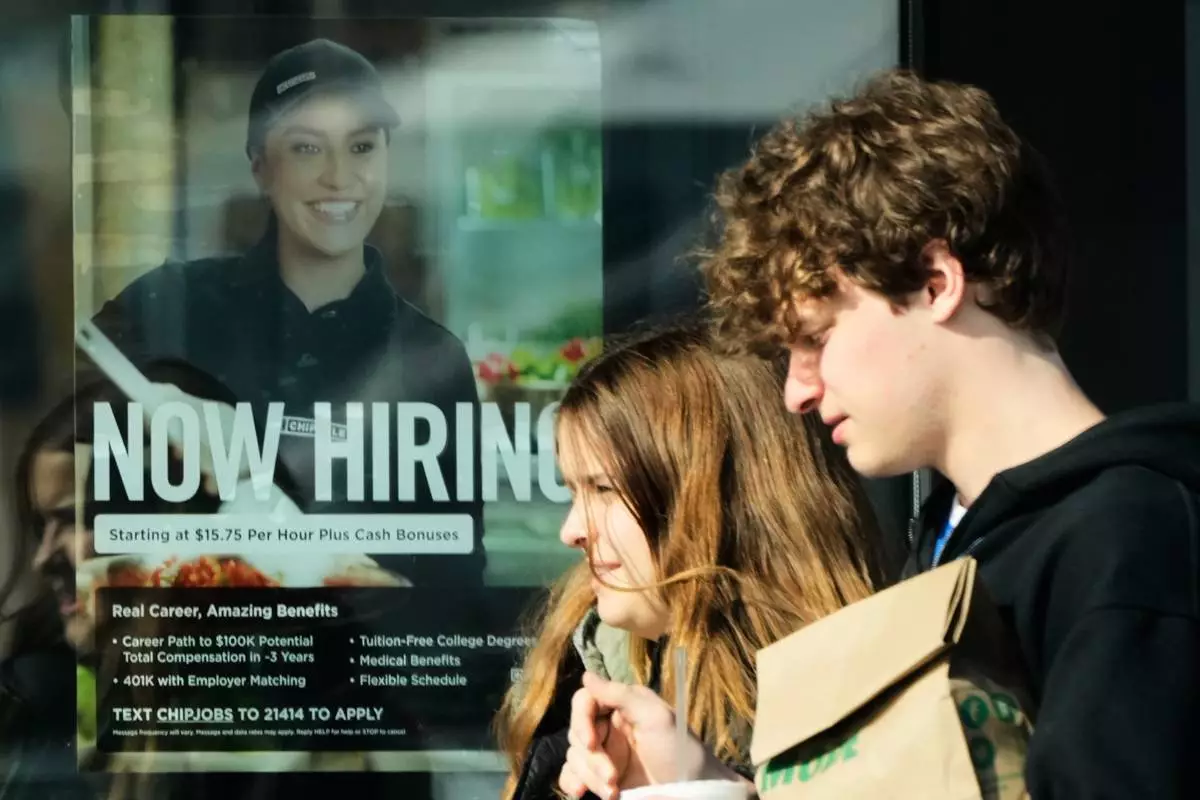
A hiring sign is displayed at a restaurant, in Niles, Ill., Tuesday, April 7, 2026. (AP Photo/Nam Y. Huh)