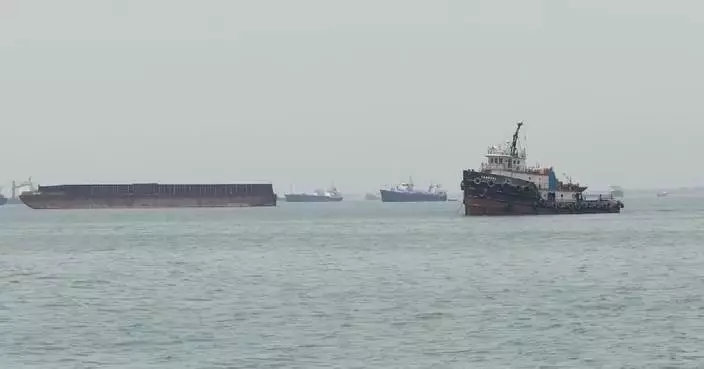
The Port of Hamburg, Germany's largest port and a crucial European sea-rail transportation hub, has witnessed continuously expanding trade volumes with China over the past five decades, said the port's marketing chief.
Hamburg Port has long served as a microcosm of China-EU economic cooperation. Now, about 30 percent of the port's cargo originate from and go to China, which makes the country the top trading partner of the port for many consecutive years, according to Axel Mattern, CEO of Hamburg Port Marketing.
"A significant portion of cargo handled at the Port of Hamburg -- accounting for 30 percent of its total volume -- either originates from or is destined for China. This makes Hamburg's connection with China and Chinese ports absolutely vital. We maintain extremely close exchanges with China, which has remained Hamburg Port's largest trading partner for many consecutive years," said Mattern.
Data from Hamburg Port Marketing shows the port handled 597,000 TEUs of China-bound containers in Q1 2025, an 11.3-percent year-on-year increase. In 2024, China accounted for 2.2 million TEUs, or about 30 percent of the port's total throughput.
Beyond growing volumes, China-Europe goods transiting Hamburg have diversified, including consumer products, chemicals, and machinery equipment.
"We have signed various cooperation memorandums with our Chinese partners. Hamburg Port maintains long-term, close collaborations with Shanghai Port and Shenzhen Port. Additionally, we operate large-scale offices in Shanghai, Ningbo, Tianjin, and Qingdao. Hamburg Port remains committed to fostering professional exchange, which is why we have established diverse partnerships, including technical exchanges, port operations, and crucially, in the fields of digitalization and green sustainability initiatives," said Mattern.
He emphasized Hamburg's role as Europe's gateway, where Chinese goods are distributed across the continent, reflecting tight economic bonds between China, Germany and the rest of Europe.
"We have been actively participating in the Belt and Road Initiative (BRI) for many years, with particular focus on the rail connections between China and the Port of Hamburg. Moreover, we view this as a partnership -- one that is open and collaborative," he said.
As a vital China-Europe trade nexus, Hamburg Port continues deepening bilateral exchanges in goods and personnel. The port authorities pledged to further enhance economic cooperation under the BRI framework.
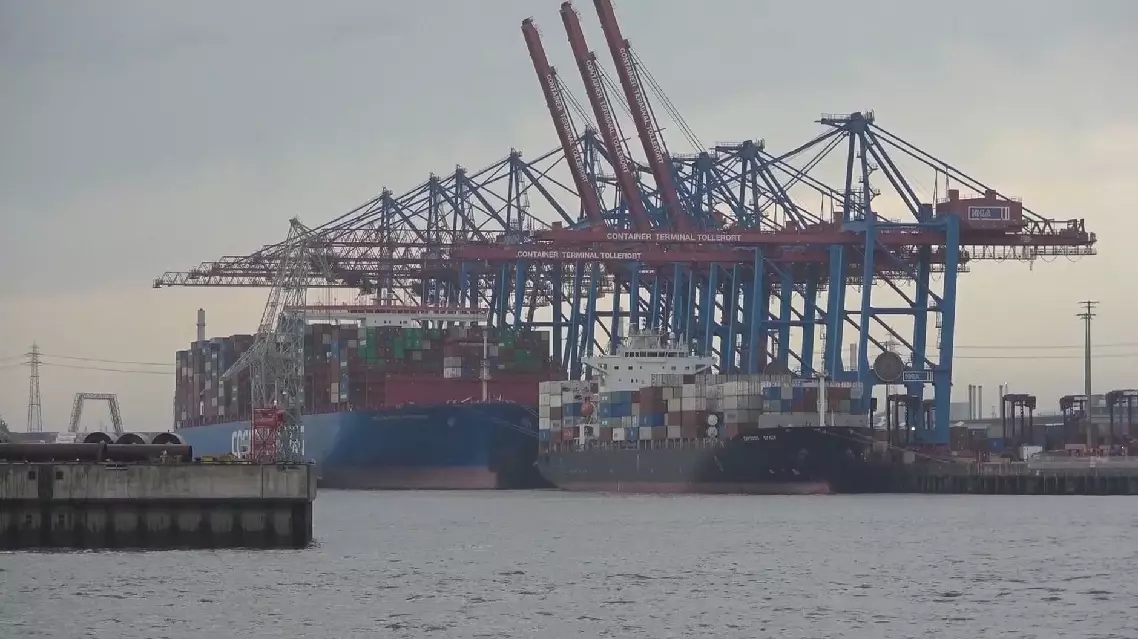
Connection with China crucial for Port of Hamburg: marketing CEO
China and Kyrgyzstan are broadening their cooperation and deepening their economic ties to transform a relationship traditionally built on trade and infrastructure into a future-focused partnership that embraces emerging technologies.
Bilateral trade has surged from 53 million U.S. dollars when the two countries established diplomatic relations in 1992 to 27.2 billion dollars in 2025, an increase of more than 400 folds.
"The two countries signed agreement on Comprehensive Strategic Partnership for the New Era. Both sides are trying to find a new model to make a breakthrough in their traditional cooperation, almost in every field," said Xu Wenhong, deputy secretary-general of the One Belt One Road Center at the Chinese Academy of Social Sciences.
Infrastructure and connectivity have emerged as major pillars of cooperation. New roads and border crossings are improving links between the two countries.
"In the past, transporting a truckload of goods from Kyrgyzstan to China or vise versa could take about a week. And now, it takes only one or two days to deliver the cargo," said Hou Huxiang, general manager of Kyrgyzstan Office at the China Road and Bridge Corporation.
The long-awaited China-Kyrgyzstan-Uzbekistan railway is moving from years of planning into construction. For Kyrgyzstan, which has no direct access to the sea, experts said these expanding transport links could be transformative to give the country new routes to regional and international markets and help it move beyond the limitations of being landlocked.
"Now, Kyrgyzstan is becoming a land-linked country. Its agricultural products, mineral products, all these things can be shipped out," said Xu.
Beyond traditional sectors, China and Kyrgyzstan are exploring cooperation in the digital economy and frontier technologies, including artificial intelligence, in line with broader regional efforts to expand access to technological development.
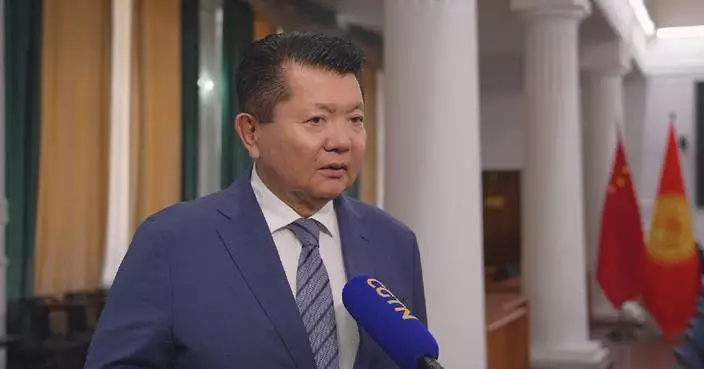
Temir Sariyev, chairman of the Chamber of Commerce and Industry of the Kyrgyz Republic, highlighted the importance of education and talent development as cooperation moves into high-tech areas.
"We need to encourage more students to study in China, as China is a global leader in science and technology, industry, artificial intelligence, and digital technology," said Sariyev.
From infrastructure and trade to agriculture and artificial intelligence, China and Kyrgyzstan are broadening cooperation across both established and emerging sectors. That growing partnership also reflects the broader spirit of the Shanghai Cooperation Organization to promote shared development, respect each country's own development path, and pursue practical cooperation that can create opportunities for countries across the region.

China, Kyrgyzstan expand trade, cooperation