Major foreign-invested projects in China have gained speed in implementation as policy measures introduced early this year gradually take effect.
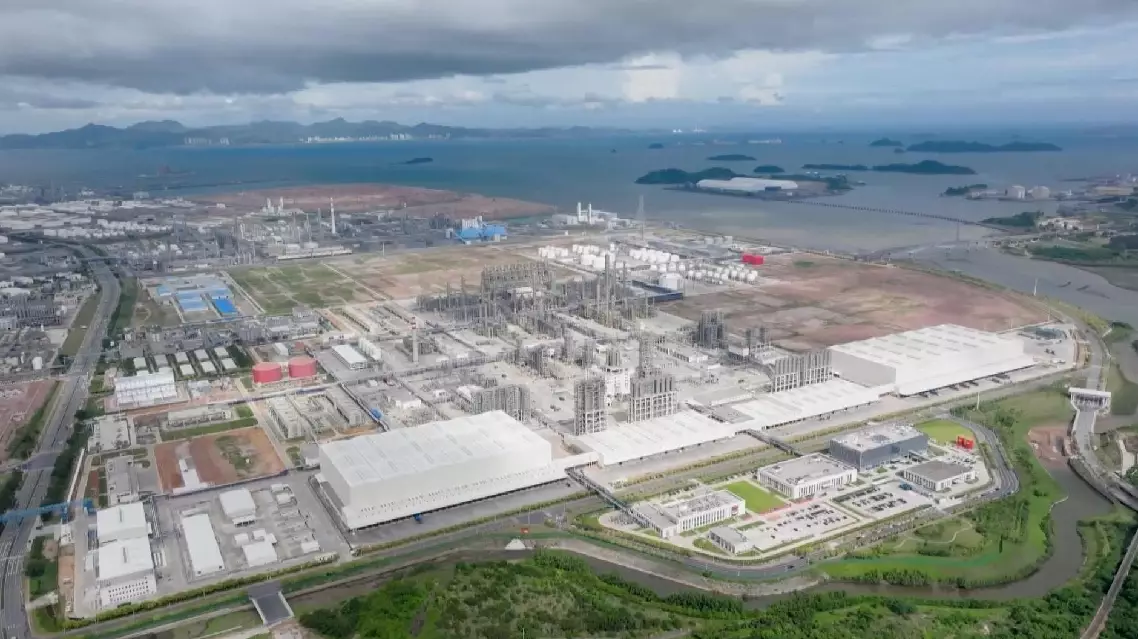
In Huizhou City of South China's Guangdong Province, ExxonMobil's mega ethylene project officially started operation this month.
As the first major petrochemical project constructed solely by a U.S. company in China, the project, with a total investment of 10 billion U.S. dollars, will help the Guangdong-Hong Kong-Macao Greater Bay Area become a global petrochemical industry power house, said Li Xingjun, chairman of Exxon-Mobil (Huizhou) Chemical Co Ltd.
"We can see a solid foundation for manufacturing industry here, a complete industrial chain and a high degree of market openness. In the future, we will jointly promote the upgrading of the industrial chain in the Guangdong-Hong Kong-Macao Greater Bay Area and boost the development of the mid-to-high-end value chain of China's petrochemical industry," Li said.
In Qingdao City of east China's Shandong Province, Japanese motor manufacturer Nidec has just inaugurated its new industrial park this month.
The new park, the biggest one Nidec has in China, spans an area equivalent to 15 football fields and is capable of delivering 18 million motors and over 20 million electronic inverters per year.
In north China's Tianjin Municipality, Danish pharmaceutical giant Novo Nordisk signed a memorandum of cooperation early this month to initiate an 800-million-yuan (about 111.9 million U.S. dollars) project to expand the quality-control laboratory at its Tianjin production facility.
Located in the Tianjin Economic-Technological Development Area, the Novo Nordisk Tianjin production site is one of the company's strategic global manufacturing hubs, employing approximately 1,800 people.
The facility commenced construction on a sterile production expansion project valued at approximately four billion yuan in March 2024.
Analysts said the quality and structure of the foreign investment in China has been improved as a series of policy measures to stabilize foreign investment take effect.
The number of newly established foreign-invested enterprises in China rose by 11.7 percent year-on-year to 30,014 in the first half of 2025, according to the Ministry of Commerce.
In the same period, investment in the manufacturing sector reached 109.06 billion yuan, while high-tech industries attracted 127.87 billion yuan.
Major foreign-invested projects in China gaining speed in implementation
Major foreign-invested projects in China gaining speed in implementation
Major foreign-invested projects in China gaining speed in implementation