UNITED NATIONS (AP) — Body
The U.N. General Assembly brought high-level officials together Monday to promote a two-state solution to the decades-old Israel-Palestinian conflict that would place their peoples side by side, living in peace in independent nations.
Israel and its close ally the United States are boycotting the two-day meeting, co-chaired by the foreign ministers of France and Saudi Arabia. Israel’s government opposes a two-state solution, and the United States has called the meeting “counterproductive” to its efforts to end the war in Gaza.
France and Saudi Arabia want the meeting to put a spotlight on the two-state solution, which they view as the only viable road map to peace, and to start addressing the steps to get there.
U.N. Secretary-General António Guterres told ministers and diplomats at the opening of the meeting that a two-state solution is further away than ever before, pointing to “the obliteration of Gaza that has unfolded before the eyes of the world” and Israel's threatened annexation of the West Bank — the key parts that could make up a Palestinian state.
“Because of the grim realities, we must do even more to realize the two-state solution,” he said.
Palestinian Prime Minister Mohammed Mustafa called for all countries who haven't yet recognized statehood to do so “without delay,” welcoming France’s recent decision to do so in September.
“The path to peace begins by recognizing the state of Palestine and preserving it from destruction,” Mustafa told minsters and diplomats at the start of the gathering.
The meeting was postponed from late June and downgraded from a four-day meeting of world leaders amid surging tensions in the Middle East, including the 12-day Israel-Iran war, and the war in Gaza.
French Foreign Minister Jean-Noël Barrot said that “this must be a turning point and a transformational juncture for the implementation of the two-state solution. We must work on the ways and means to go from the end of the war in Gaza to the end of the Israeli-Palestinian conflict."
His co-chair, Saudi Foreign Minister Prince Faisal bin Farhan, called the meeting a “historic stage” not only to end the deadly, nearly two-year war but to also “settle the international atmosphere towards a two-state solution.”
Here’s what’s useful to know about the upcoming gathering.
The concept of dividing the Holy Land goes back decades.
When the British mandate over Palestine ended, the U.N. partition plan in 1947 envisioned dividing the territory into Jewish and Arab states. Israel accepted the plan, but upon Israel's declaration of independence the following year, its Arab neighbors declared war and the plan was never implemented. Under a 1949 armistice, Jordan held control over the West Bank and east Jerusalem, and Egypt over Gaza.
Israel captured the West Bank, east Jerusalem and Gaza in the 1967 Mideast war. The Palestinians seek those lands for a future independent state alongside Israel, and this idea of a two-state solution based on Israel’s pre-1967 boundaries has been the basis of peace talks dating back to the 1990s.
The two-state solution has wide international support. The logic behind it is that the populations of Israel, east Jerusalem, the West Bank and Gaza are divided equally between Jews and Palestinians.
The establishment of an independent Palestinian state would leave Israel as a democratic country with a solid Jewish majority and grant the Palestinians their dream of self-determination.
France and Saudi Arabia have said they want to put a spotlight on the two-state solution as the only viable path to peace in the Middle East — and they want to see a road map with specific steps, first ending the war in Gaza.
The co-chairs said in a document sent to U.N. members in May that the primary goal of the meeting is to identify actions by “all relevant actors” to implement the two-state solution — and “to urgently mobilize the necessary efforts and resources to achieve this aim, through concrete and time-bound commitments.”
Saudi diplomat Manal Radwan, who led the country’s delegation to the preparatory conference, said that the meeting must “chart a course for action, not reflection.” It must be “anchored in a credible and irreversible political plan that addresses the root cause of the conflict and offers a real path to peace, dignity and mutual security,” she said.
French President Emmanuel Macron has pushed for a broader movement toward a two-state solution in parallel with a recognition of Israel’s right to defend itself. He announced late Thursday that France will officially recognize a Palestinian state at the annual gathering of world leaders at the U.N. General Assembly in late September.
About 145 countries have recognized a Palestinian state. But Macron’s announcement, before Monday’s meeting and amid increasing global anger over desperately hungry people in Gaza starting to die from starvation, makes France the most important Western power to do so.
Israeli Prime Minister Benjamin Netanyahu rejects the two-state solution on both nationalistic and security grounds.
Netanyahu’s religious and nationalist base views the West Bank as the biblical and historical homeland of the Jewish people, while Israeli Jews overwhelmingly consider Jerusalem their eternal capital. The city’s eastern side is home to Judaism’s holiest site, along with major Christian and Muslim holy places.
Hard-line Israelis like Netanyahu believe the Palestinians don’t want peace, citing the second Palestinian uprising of the early 2000s, and more recently the Hamas takeover of Gaza two years after Israel withdrew from the territory in 2005. The Hamas takeover led to five wars, including the current and ongoing 21-month conflict.
At the same time, Israel also opposes a one-state solution in which Jews could lose their majority. Netanyahu's preference seems to be the status quo, where Israel maintains overall control, and Israelis have fuller rights than Palestinians, Israel deepens its control by expanding settlements, and the Palestinian Authority has limited autonomy in pockets of the West Bank.
Netanyahu condemned Macron’s announcement of Palestinian recognition, saying it “rewards terror and risks creating another Iranian proxy, just as Gaza became."
The Palestinians, who label the current arrangement “apartheid,” accuse Israel of undermining repeated peace initiatives by deepening settlement construction in the West Bank and threatening annexation. That would harm the prospect of a contiguous Palestinian state and their prospects for independence.
Ahmed Majdalani, a member of the PLO Executive Committee and close associate of Palestinian President Mahmoud Abbas, said the meeting will serve as preparation for a presidential summit expected in September. It will take place either in France or at the U.N. on the sidelines of the high-level meeting, U.N. diplomats said.
Majdalani said that the Palestinians have several goals, first a “serious international political process leading to the establishment of a Palestinian state.”
The Palestinians also want additional international recognition of their state by major countries, including the United Kingdom. But expect that to happen in September, not at Monday’s meeting, Majdalani said. And he said that they want economic and financial support for the Palestinian Authority and international support for the reconstruction and recovery of the Gaza Strip.
All 193 U.N. member nations have been invited to attend the meeting and a French diplomat said that about 40 ministers were expected. The United States and Israel are the only countries who are boycotting.
The co-chairs have circulated an outcome document which could be adopted, and there could be some announcements of intentions to recognize a Palestinian state. But with Israel and the United States boycotting, there is no prospect of a breakthrough and the resumption of long-stalled negotiations between Israel and the Palestinians on an end to their conflict.
Guterres urged participants after the meeting was announced “to keep the two-state solution alive.” And he said that the international community must not only support a solution where independent Palestinian states and Israel live side-by-side in peace but “materialize the conditions to make it happen.”
Josef Federman reported from Jerusalem. Angela Charlton in Paris, and Farnoush Amiri at the United Nations, contributed to this report.

French President Emmanuel Macron arrives to the Bastille Day military parade on the Champs-Elysees avenue, in Paris, Monday, July 14, 2025. (Mohammed Badra/Pool Photo via AP)
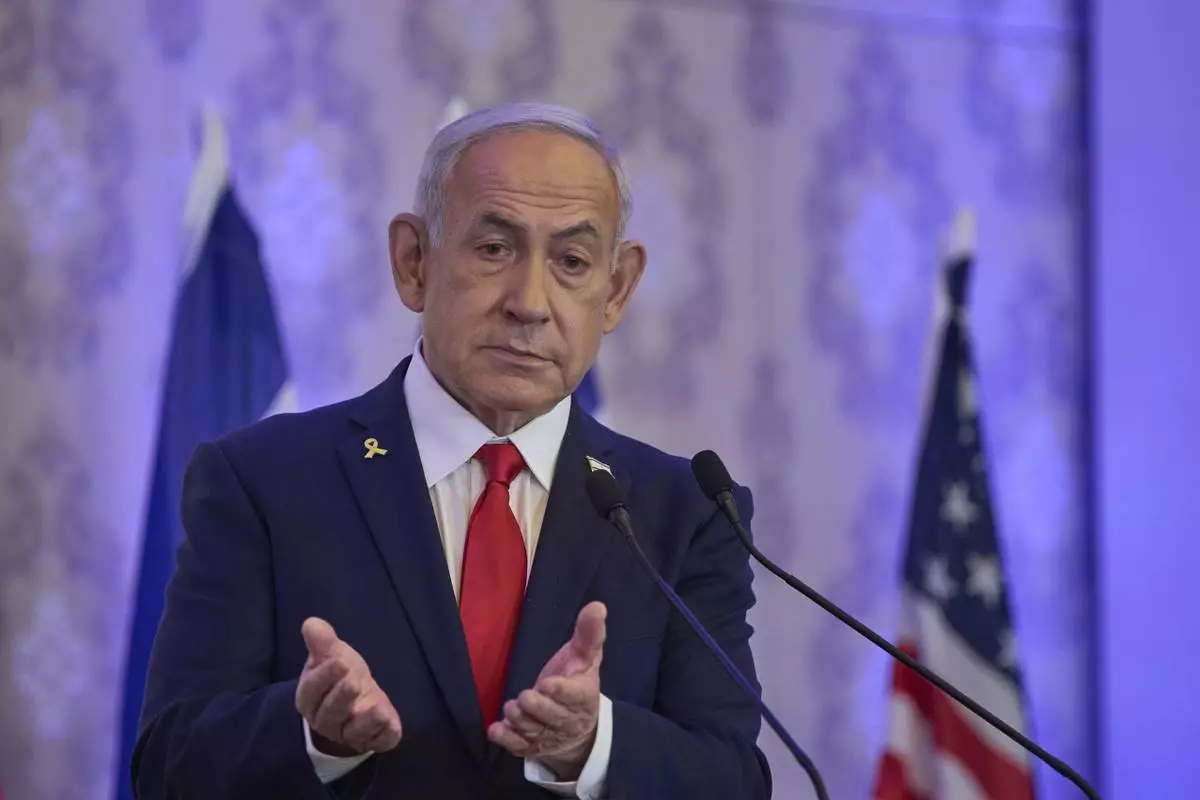
Israeli Prime Minister Benjamin Netanyahu speaks to the audience at a conference in Jerusalem, Sunday, July 27, 2025. (AP Photo/Ohad Zwigenberg)
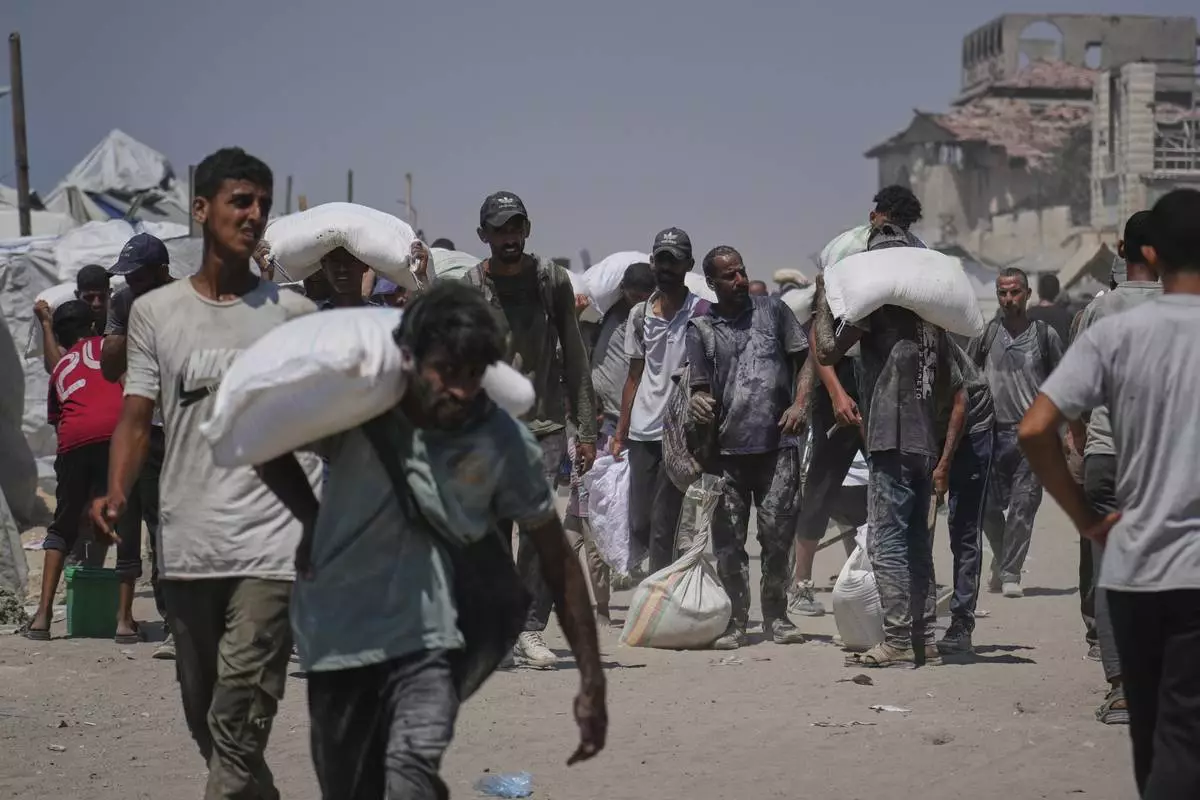
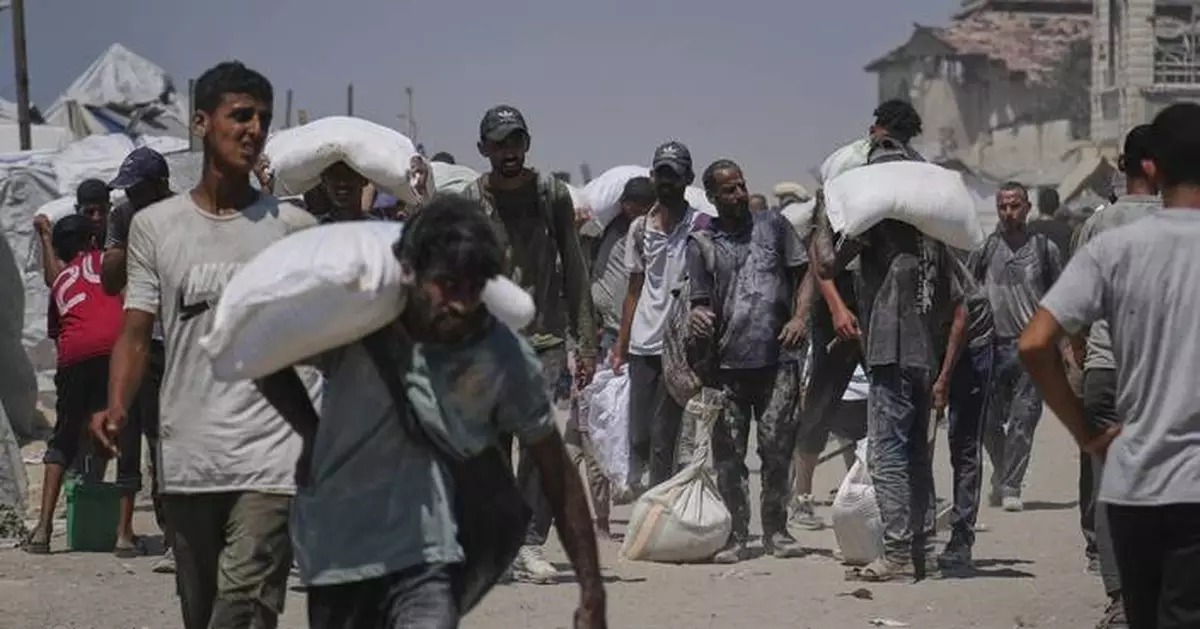
Palestinians carry sacks of flour unloaded from a humanitarian aid convoy that reached Gaza City from the northern Gaza Strip, Sunday, July 27, 2025. (AP Photo/Abdel Kareem Hana)