
SHANGHAI, July 28, 2025 /PRNewswire/ -- The multicenter, randomized controlled trial (RCT) results of the PANVIS-A® NeuroInterventional Robotic System—led by Professor Liu Jianmin (Changhai Hospital) in collaboration with Professor Sun Jun (Wenzhou Central Hospital), Professor Chen Wenhuo (Zhangzhou Municipal Hospital of Fujian Province), and Professor Cheng Guangsen (Zhuhai People's Hospital)—have been officially published in the Journal of NeuroInterventional Surgery (JNIS). This milestone marks the first time a China-developed vascular-interventional robot has gained recognition from a premier international neurointerventional journal.
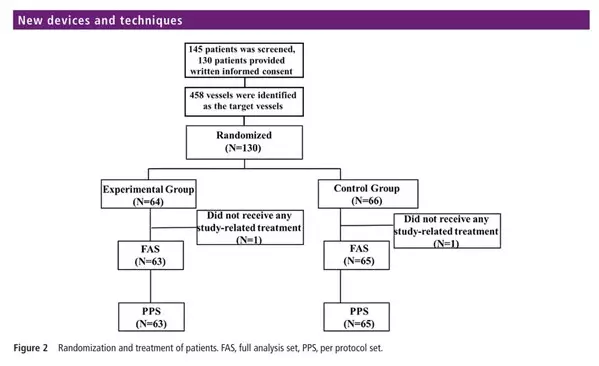
Registered as NCT05778214, the trial was designed and executed in strict accordance with regulatory guidelines and Good Clinical Practice (GCP). The prospective, multicenter, non-inferiority RCT enrolled 128 patients undergoing diagnostic cerebral angiography (63 randomized to robot assistance, 65 to conventional manual operation). Results demonstrate that PANVIS-A® is both safe and effective, cutting the primary operator's radiation exposure by 96% while maintaining procedural performance—offering a revolutionary safeguard for physician occupational health. The system received NMPA market authorization on 23 August 2024.
01 Background: A long-awaited breakthrough for neuro-interventional robotics
Traditional neurovascular procedures rely entirely on manual manipulation, exposing operators to chronic radiation and limiting precision. Although robotic systems have entered cardiovascular interventions, neuro-intervention imposes far greater demands—intricate anatomy, tortuous vessels, and operative paths exceeding 70 cm from femoral access to intracranial targets.
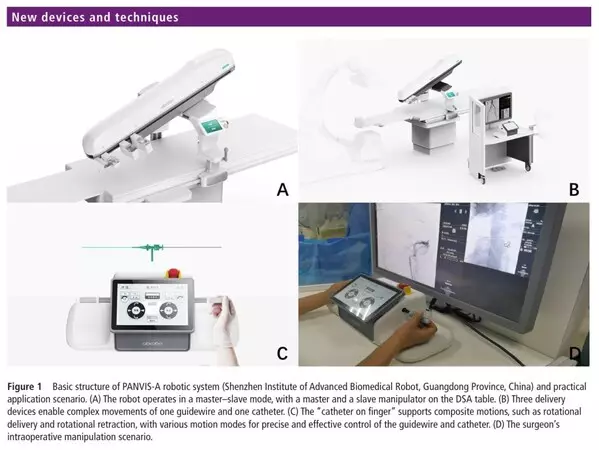
To address this, Shenzhen Institute of Advanced Biomedical Robot Co., Ltd. (abrobo) joined forces with leading clinicians to create PANVIS-A®. The platform features the proprietary PANVIS COF® (Catheter On Finger) fingertip-catheter interface, which replicates combined guidewire rotation and catheter advancement in an intuitive manner. A multi-instrument collaborative drive enables sub-millimetric control over long cerebral trajectories, covering the entire workflow from sheath insertion to final angiographic runs and setting a new benchmark for neuro-interventional robotics.
02 Study Design: Rigorous multicenter RCT
Prospective, multicenter, randomized, non-inferiority trial. Planned enrollment: 130 patients; actual: 128 (robot 63, manual 65). Allocation ratio 1:1.
03 Key Findings: Three major breakthroughs
1. Safety & efficacy non-inferior to manual approach
- Clinical success: 100% in both groups; non-inferiority confirmed (95 % CI lower bound –5.75 %, above –10 % margin).
- Technical success: successful super-selective cannulation of all target vessels in both arms, validating adaptability to complex neuro-anatomy.
2. Radiation exposure to physician reduced by 96 %
- Primary-operator dose: robot 1.67 ± 3.49 μSv vs. manual 43.63 ± 38.95 μSv (P < 0.001).
3. Efficiency & patient experience Balance operational efficiency with a good patient experience
- Setup time longer in robot arm (34.59 ± 10.43 min vs. 24.44 ± 13.97 min) but did not compromise overall patient experience.
- No significant differences in puncture-to-catheter-removal time, target-vessel selection time, or fluoroscopy time (P > 0.05).
- Patient radiation dose and contrast volume comparable, ruling out "Trading patient risks for doctors' protection" concerns.
04 Technical Innovations
Master–slave architecture: master console outside radiation field, slave unit on angiography table—precision without exposure.
Horizontal control layout: parallel joysticks reproduce in-plane guidewire–catheter geometry, shortening learning curve.
PANVIS COF® fingertip interface: fingertip micro-motion replicates combined guidewire rotation and catheter advancement.
Dual-grip delivery: biomimetic thumb–index pinch-and-roll for independent or synchronous guidewire/catheter control.
Multi-instrument synergy: simultaneous guidewire and catheter manipulation for cooperative motion.
Broad compatibility: supports 5F angiographic catheters, 6F guiding catheters, and 0.035ʺ guidewires commonly used in practice.
05 Future Outlook: From diagnostics to full neuro-interventional therapy
This study provides high-level evidence that PANVIS-A® can dramatically lower physician radiation exposure without compromising safety or efficiency, paving the way for standardized, intelligent neuro-intervention.
To address current limitations (slightly longer setup, modest sample size), abrobo® Innovations has already:
- Introduced integrated sterile consumables to cut setup to < 10 min.
- Upgraded the delivery system for stenting and thrombectomy.
Guided by the "in-use, in-development, in-research" roadmap and agile iteration, next-generation PANVIS STAR® has completed its first-in-human study and is entering regulatory submission.
Continuous iteration positions PANVIS-A® to become the "standard equipment" in neuro-intervention, propelling China from an "interventional giant" to an "interventional powerhouse" and offering a China-devised solution to neuro-interventionalists worldwide—advancing global health together.
About JNIS
Launched in 2009, the Journal of NeuroInterventional Surgery (JNIS) is the official journal of the Society of NeuroInterventional Surgery (SNIS) and is published by BMJ. With an impact factor of 4.8 and a JCR Q1 ranking, JNIS sets the gold standard for peer-reviewed research in ischemic stroke, aneurysms, neuro-oncology, and related fields, providing authoritative, evidence-based guidance to clinicians and researchers worldwide.
** The press release content is from PR Newswire. Bastille Post is not involved in its creation. **
Interventional Robot's RCT Research Published in JNIS, a Leading Journal in Neurointervention!
Interventional Robot's RCT Research Published in JNIS, a Leading Journal in Neurointervention!

Interventional Robot's RCT Research Published in JNIS, a Leading Journal in Neurointervention!