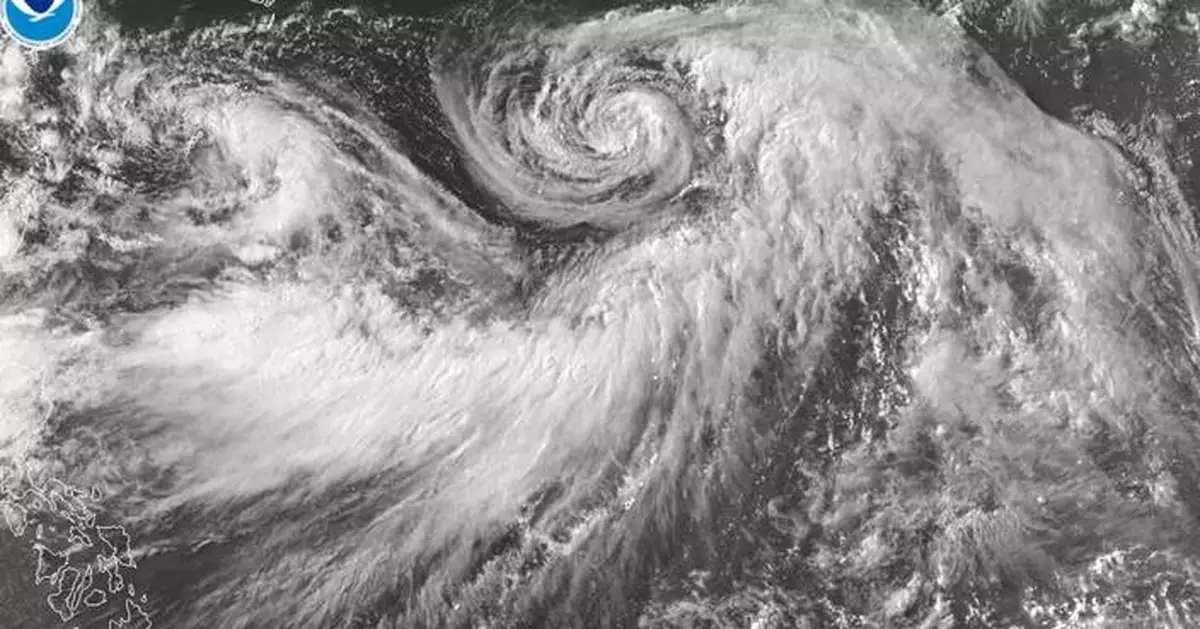
HONOLULU (AP) — Two tropical cyclones were swirling across the ocean southeast of Hawaii after developing on Monday but were not expected to cause any issues for the islands.
Hurricane Iona is the first named storm of the hurricane season in the central Pacific and emerged Sunday from a tropical depression to become a Category 1 hurricane in roughly a day. It was trekking west over warm, open waters.
“It’s pretty high confidence that it’s not going to have any direct impacts on the islands,” said Derek Wroe with the National Weather Service in Honolulu.
The hurricane is centered well south of Hawaii and an indirect impact will be downward pressure winds from the hurricane, creating dry and breezy conditions.
“There’s a lot of upward motion in the hurricane and then there’s usually compensating downward motion,” Wroe said. “That should be the case here as well. So it will be dry, it will be breezy.”
Those were the conditions that were prevalent when Hurricane Dora also passed well south of the islands in August 2023, and the associated winds led to the conditions that exacerbated the deadliest fire in the U.S. in over a century.
The blaze raced through the historic town of Lahaina and resulted in the deaths of 102 people.
He said there are concerns that conditions with Hurricane Iona could be at or near red flag criteria.
“That said … wouldn’t be anything close to what we saw during that time with Hurricane Dora. The situation is just not that strong,” he said.
The pressure gradient created by Hurricane Dora created gusts that clocked in at 50 mph (80 kph) in central Maui and well over 60 mph (96 kph) on the Big Island. There were no instruments in West Maui two years ago to measure wind.
“We don’t expect anything even close to that,” he said, with possible localized gusts of over 40 mph (64 kph) with winds running around 20 mph (32 kph).
On Monday, Iona was about 810 miles (1,303 kilometers) southeast of Honolulu, the U.S. National Hurricane Center in Miami said. No coastal watches or warnings were in effect. Iona is expected to strengthen and become a major hurricane Tuesday before weakening around the middle of the week.
The hurricane has maximum sustained winds of about 85 mph (137 kph). It was moving in a generally westward direction at about 13 mph (21 kph).
A second weather system also formed. Tropical Storm Keli had maximum sustained winds of 40 mph (65 kph).
It was about 1,030 miles (1,658 kilometers) southeast of Honolulu and was moving west at about 12 mph (19 kph). It may strengthen over the next day but, like Iona, should lose power around the middle of the week.
Wroe said he didn’t expect any direct impact from this storm on Hawaii either.
The administrator of the Hawaii Emergency Management Agency on Monday hosted a statewide conference call with all counties, during which the National Weather Service provided an assessment and status of the storms.
“All counties are monitoring,” agency spokesperson Kiele Amundson said in an email.
Another indirect impact from these storms could be swells, but Wroe said they are relatively small and moving westward and won’t create anything significant.
However, a large swell is headed toward Hawaii after being generated several hundred miles east of New Zealand.
It’s expected to arrive in Hawaii about Thursday, about the same time the storms pass the state.
“People might wrongly attribute the swell energy to be from these tropical systems, but they’re actually not,” he said.
He anticipates high surf advisory to be issued for the south shores of the Hawaiian Islands, with a surf of 10 feet (3 meters) or higher.
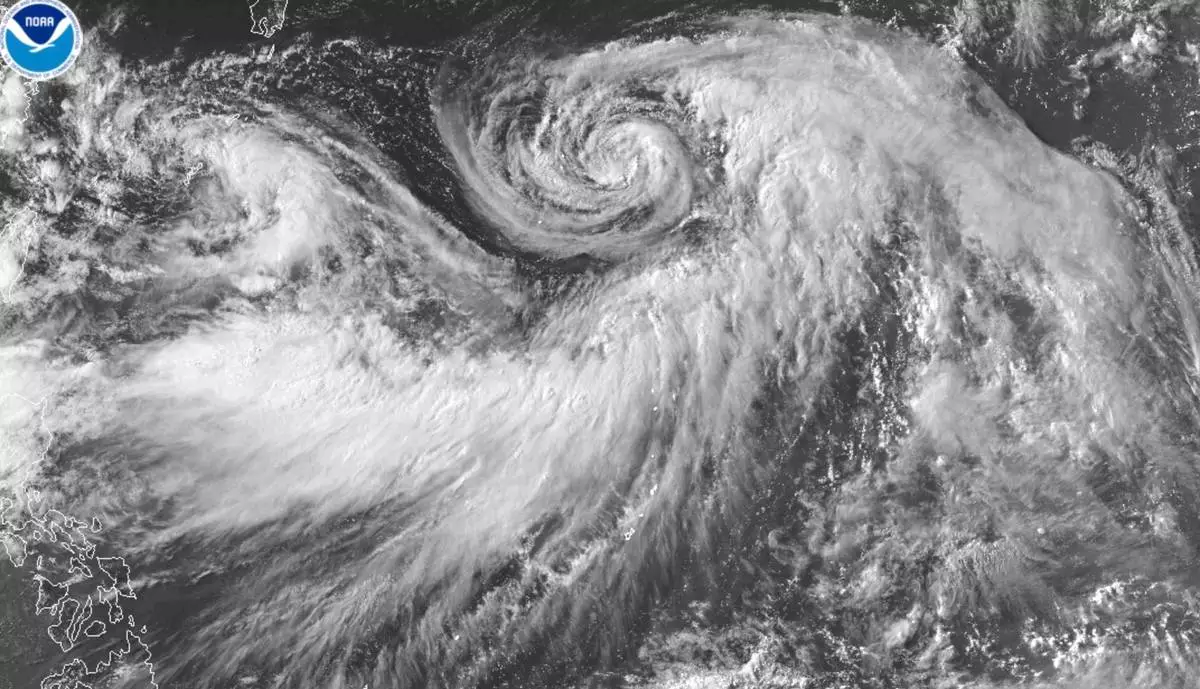
This satellite image provided by the National Oceanic and Atmospheric Administration (NOAA) shows Hurricane Iona forming in the central Pacific Ocean, Monday, July 28, 2025. (NOAA via AP)
WASHINGTON (AP) — President Donald Trump is meeting with oil executives at the White House on Friday in hopes of securing $100 billion in investments to revive Venezuela’s ability to fully tap into its expansive reserves of petroleum — a plan that rides on their comfort in making commitments in a country plagued by instability, inflation and uncertainty.
Since the U.S. military raid to capture former Venezuelan leader Nicolás Maduro on Saturday, Trump has quickly pivoted to portraying the move as a newfound economic opportunity for the U.S., seizing tankers carrying Venezuelan oil, saying the U.S. is taking over the sales of 30 million to 50 million barrels of previously sanctioned Venezuelan oil and will be controlling sales worldwide indefinitely.
On Friday, U.S. forces seized their fifth tanker over the past month that has been linked to Venezuelan oil. The action reflected the determination of the U.S. to fully control the exporting, refining and production of Venezuelan petroleum, a sign of the Trump administration's plans for ongoing involvement in the sector as it seeks commitments from private companies.
It's all part of a broader push by Trump to keep gasoline prices low. At a time when many Americans are concerned about affordability, the incursion in Venezuela melds Trump’s assertive use of presidential powers with an optical spectacle meant to convince Americans that he can bring down energy prices.
The meeting, set for 2:30 p.m. EST, will be open to the news media, according to an update to the president's daily schedule. “At least 100 Billion Dollars will be invested by BIG OIL, all of whom I will be meeting with today at The White House,” Trump said Friday in a pre-dawn social media post.
Trump is set to meet with executives from 17 oil companies, according to the White House. Among the companies attending are Chevron, which still operates in Venezuela, and ExxonMobil and ConocoPhillips, which both had oil projects in the country that were lost as part of a 2007 nationalization of private businesses under Maduro’s predecessor, Hugo Chávez.
The president is meeting with a wide swath of domestic and international companies with interests ranging from construction to the commodity markets. Other companies slated to be at the meeting include Halliburton, Valero, Marathon, Shell, Singapore-based Trafigura, Italy-based Eni and Spain-based Repsol.
Large U.S. oil companies have so far largely refrained from affirming investments in Venezuela as contracts and guarantees need to be in place. Trump has suggested on social media that America would help to backstop any investments.
Venezuela’s oil production has slumped below one million barrels a day. Part of Trump's challenge to turn that around will be to convince oil companies that his administration has a stable relationship with Venezuela’s interim President Delcy Rodríguez, as well as protections for companies entering the market.
Secretary of State Marco Rubio, Energy Secretary Chris Wright and Interior Secretary Doug Burgum are slated to attend the oil executives meeting, according to the White House.
Meanwhile, the United States and Venezuelan governments said Friday they were exploring the possibility of r estoring diplomatic relations between the two countries, and that a delegation from the Trump administration arrived to the South American nation on Friday.
The small team of U.S. diplomats and diplomatic security officials traveled to Venezuela to make a preliminary assessment about the potential re-opening of the U.S. Embassy in Caracas, the State Department said in a statement.
Trump also announced on Friday he’d meet with President Gustavo Petro in early February, but called on the Colombian leader to make quick progress on stemming flow of cocaine into the U.S.
Trump, following the ouster of Maduro, had made vague threats to take similar action against Petro. Trump abruptly changed his tone Wednesday about his Colombian counterpart after a friendly phone call in which he invited Petro to visit the White House.
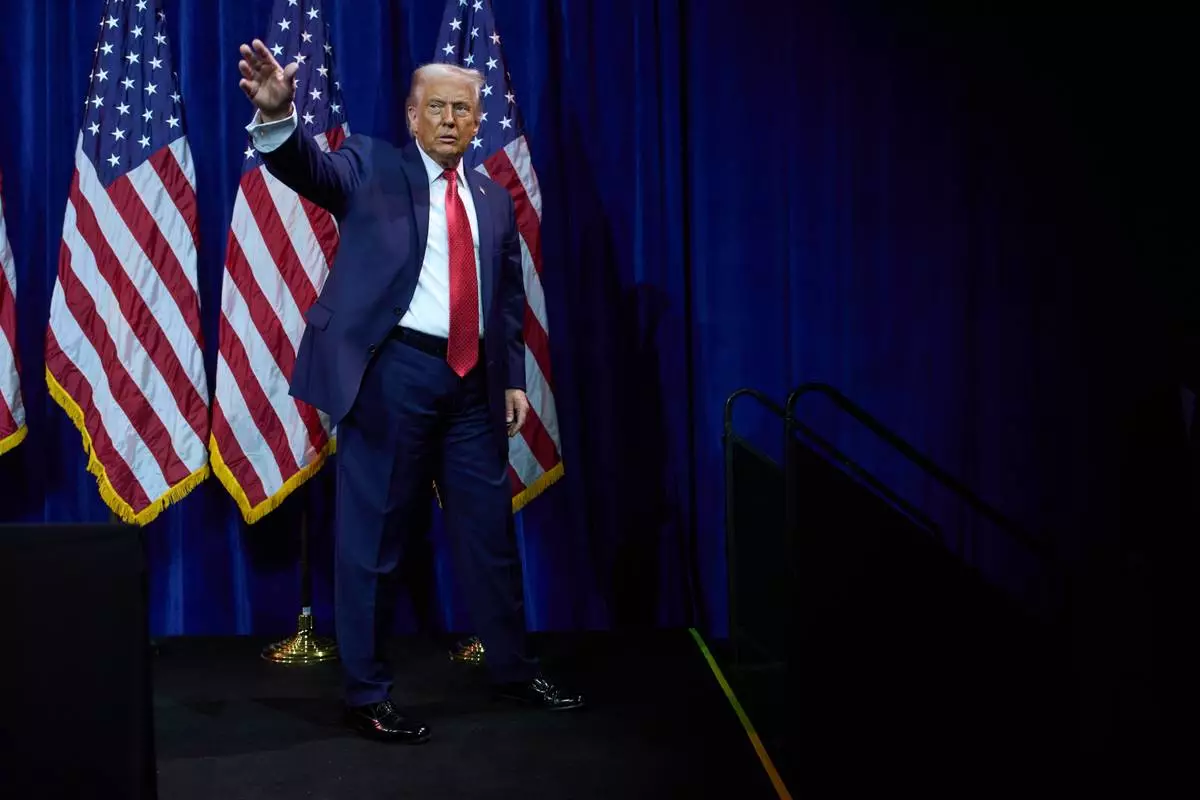
President Donald Trump waves as he walks off stage after speaking to House Republican lawmakers during their annual policy retreat, Tuesday, Jan. 6, 2026, in Washington. (AP Photo/Evan Vucci)