UNITED NATIONS (AP) — The threat from Islamic State and al-Qaida extremists and their affiliates is most intense in parts of Africa, and risks are growing in Syria, which both groups view as a “a strategic base for external operations,” U.N. experts said in a new report.
Their report to the U.N. Security Council circulated Wednesday said West Africa's al-Qaida-linked Jama’at Nasr al-Islam wal-Muslimin group, known as JNIM, and East Africa's al-Qaida-linked al-Shabab have continued to increase the territory under their control.
The experts monitoring sanctions against the two groups said “the organization’s pivot towards parts of Africa continued" partly because of Islamic State losses in the Middle East due to counterterrorism pressures. There are also “increasing concerns about foreign terrorist fighters returning to Central Asia and Afghanistan, aiming to undermine regional security,” they said.
The Islamic State also continues to represent “the most significant threat” to Europe and the Americas, the experts said, often by individuals radicalized via social media and encrypted messaging platforms by its Afghanistan-based Khorasan group.
In the United States, the experts said several alleged terrorist attack plots were “largely motivated by the Gaza and Israel conflict,” or by individuals radicalized by IS, also known as ISIL.
They pointed to an American who pledged support to IS and drove into a crowd in New Orleans on Jan. 1, killing 14 people in the deadliest attack by al-Qaida or the Islamic State in the U.S. since 2016. In addition, they said, “Authorities disrupted attacks, including an ISIL-inspired plot to conduct a mass shooting at a military base in Michigan,” and the IS Khorasan affiliate issued warnings of plots targeting Americans.
In Africa’s Sahel region, the experts said, JNIM expanded its area of operations, operating “with relative freedom” in northern Mali and most of Burkina Faso. There was also a resurgence of activity by the Islamic State in the Greater Sahara, “particularly along the Niger and Nigeria border, where the group was seeking to entrench itself.”
“JNIM reached a new level of operational capability to conduct complex attacks with drones, improvised explosive devices and large numbers of fighters against well-defended barracks,” the experts said.
In East Africa, they said, “al-Shabab maintained its resilience, intensifying operations in southern and central Somalia” and continuing its ties with Yemen’s Houthi rebels. The two groups have reportedly exchanged weapons and the Houthis have trained al-Shabab fighters, they said.
Syria, the experts said, remains “in a volatile and precarious phase,” six months after the ouster of President Bashar Assad, with unnamed countries warning of growing risks posed by both IS and al-Qaida.
“Member states estimated that more than 5,000 foreign terrorist fighters were involved in the military operation in which Damascus was taken on Dec. 8,” the experts’ 27-page report said.
Syria’s new interim President Ahmad Al-Sharaa led the rebel group Hayat Tahrir al-Sham, or HTS, once an al-Qaida affiliate that later split from it. He has promised that the country will transition to a system that includes Syria’s mosaic of religious and ethnic groups under fair elections, but skeptics question whether that will actually happen.
The experts expressed concern at the Syrian military’s announcement of several senior appointments including “prominent Syrian armed faction leaders” and six positions for foreigners — three with the rank of brigadier general and three with the rank of colonel.
“The ideological affiliation of many of these individuals was unknown, although several were likely to hold violent extremist views and external ambitions," the report said.
As for financing, the experts said the HTS takeover in Syria was considered to pose financial problems for the Islamic State and likely to lead to a decline in its revenues.
Salaries for Islamic State fighters were reduced to $50-$70 per month and $35 per family, “lower than ever, and not paid regularly, suggesting financial difficulties,” said the experts, who did not give previous salaries or family payments.
They said both al-Qaida and the Islamic State vary methods to obtain money according to locations and their ability to exploit resources, tax local communities, kidnap for ransom and exploit businesses.
While the extremist groups predominantly move money through cash transfers and informal money transfer systems known as hawalas, the experts said the Islamic State has increasingly used female couriers and hawala systems where data is stored in the cloud to avoid detection, and “safe drop boxes” where money is deposited at exchange offices and can only be retrieved with a password or code.

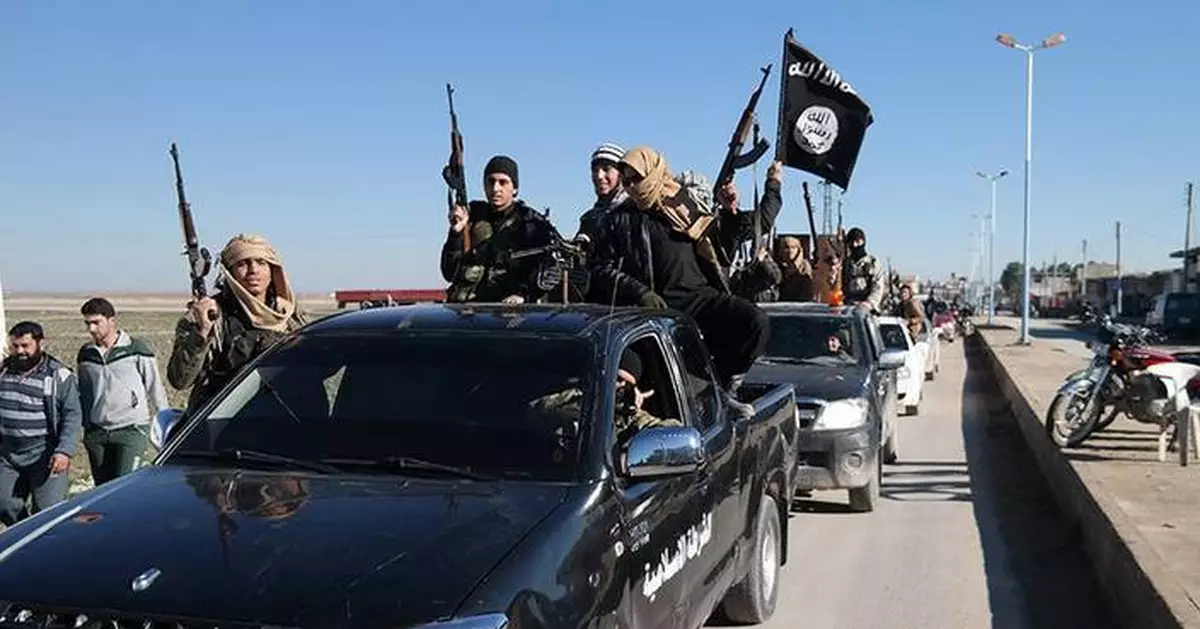
FILE - In this file photo released on May 4, 2015, by a militant website, which has been verified and is consistent with other AP reporting, Islamic State militants drive in a convoy through Tel Abyad, northeast Syria. (Militant website via AP, File)