WASHINGTON (AP) — Appellate court judges expressed broad skepticism Thursday over President Donald Trump’s legal rationale for his most expansive round of tariffs.
Members of the 11-judge panel of the U.S. Court of Appeals for the Federal Circuit in Washington appeared unconvinced by the Trump administration’s insistence that the president could impose tariffs without congressional approval, and it hammered its invocation of the International Emergency Economic Powers Act to do so.
“IEEPA doesn’t even mention the word ‘tariffs’ anywhere,” Circuit Judge Jimmie Reyna said, in a sign of the panel’s incredulity to a government attorney’s arguments.
Brett Shumate, the attorney representing the Trump administration, acknowledged in the 99-minute hearing “no president has ever read IEEPA this way” but contended it was nonetheless lawful.
The 1977 law, signed by President Jimmy Carter, allows the president to seize assets and block transactions during a national emergency. It was first used during the Iran hostage crisis and has since been invoked for a range of global unrest, from the 9/11 attacks to the Syrian civil war.
Trump says the country’s trade deficit is so serious that it likewise qualifies for the law’s protection.
In sharp exchanges with Shumate, appellate judges questioned that contention, asking whether the law extended to tariffs at all and, if so, whether the levies matched the threat the administration identified.
“If the president says there’s a problem with our military readiness,” Chief Circuit Judge Kimberly Moore posited, “and he puts a 20% tax on coffee, that doesn’t seem to necessarily deal with (it).”
Shumate said Congress' passage of IEEPA gave the president “broad and flexible” power to respond to an emergency, but that “the president is not asking for unbounded authority.”
But an attorney for the plaintiffs, Neal Katyal, characterized Trump's maneuver as a “breathtaking” power grab that amounted to saying “the president can do whatever he wants, whenever he wants, for as long as he wants so long as he declares an emergency.”
No ruling was issued from the bench. Regardless of what decision the judges’ deliberations bring, the case is widely expected to reach the U.S. Supreme Court.
Trump weighed in on the case on his Truth Social platform, posting: “To all of my great lawyers who have fought so hard to save our Country, good luck in America’s big case today. If our Country was not able to protect itself by using TARIFFS AGAINST TARIFFS, WE WOULD BE “DEAD,” WITH NO CHANCE OF SURVIVAL OR SUCCESS. Thank you for your attention to this matter!''
In filings in the case, the Trump administration insists that “a national emergency exists” necessitating its trade policy. A three-judge panel of the U.S. Court of International Trade, a specialized federal court in New York, was unconvinced, however, ruling in May that Trump exceeded his powers.
The issue now rests with the appeals judges.
The challenge strikes at just one batch of import taxes from an administration that has unleashed a bevy of them and could be poised to unveil more on Friday.
The case centers on Trump's so-called “Liberation Day” tariffs of April 2 that imposed new levies on nearly every country. But it doesn't cover other tariffs, including those on foreign steel, aluminum and autos, nor ones imposed on China during Trump's first term, and continued by President Joe Biden.
The case is one of at least seven lawsuits charging that Trump overstepped his authority through the use of tariffs on other nations. The plaintiffs include 12 U.S. states and five businesses, including a wine importer, a company selling pipes and plumbing goods, and a maker of fishing gear.
The U.S. Constitution gives Congress the authority to impose taxes — including tariffs — but over decades, lawmakers have ceded power over trade policy to the White House.
Trump has made the most of the power vacuum, raising the average U.S. tariff to more than 18%, the highest rate since 1934, according to the Budget Lab at Yale University.
The attorney general for one of the states suing Trump sounded confident after the hearing, arguing that the judges “didn’t buy’’ the Trump administration’s arguments. “You would definitely rather be in our shoes going forward,’’ Oregon Attorney General Dan Rayfield said.
Rayfield said that Trump’s tariffs — which are paid by importers in the United States who often try to pass along the higher costs to their customers — amount to one of the largest tax increases in American history. “This was done all by one human being sitting in the Oval Office,” he said.
Sedensky reported from New York
__
This story has been corrected to fix the spelling of the surname of the attorney representing the Trump administration. His surname is Shumate, not Schumate.
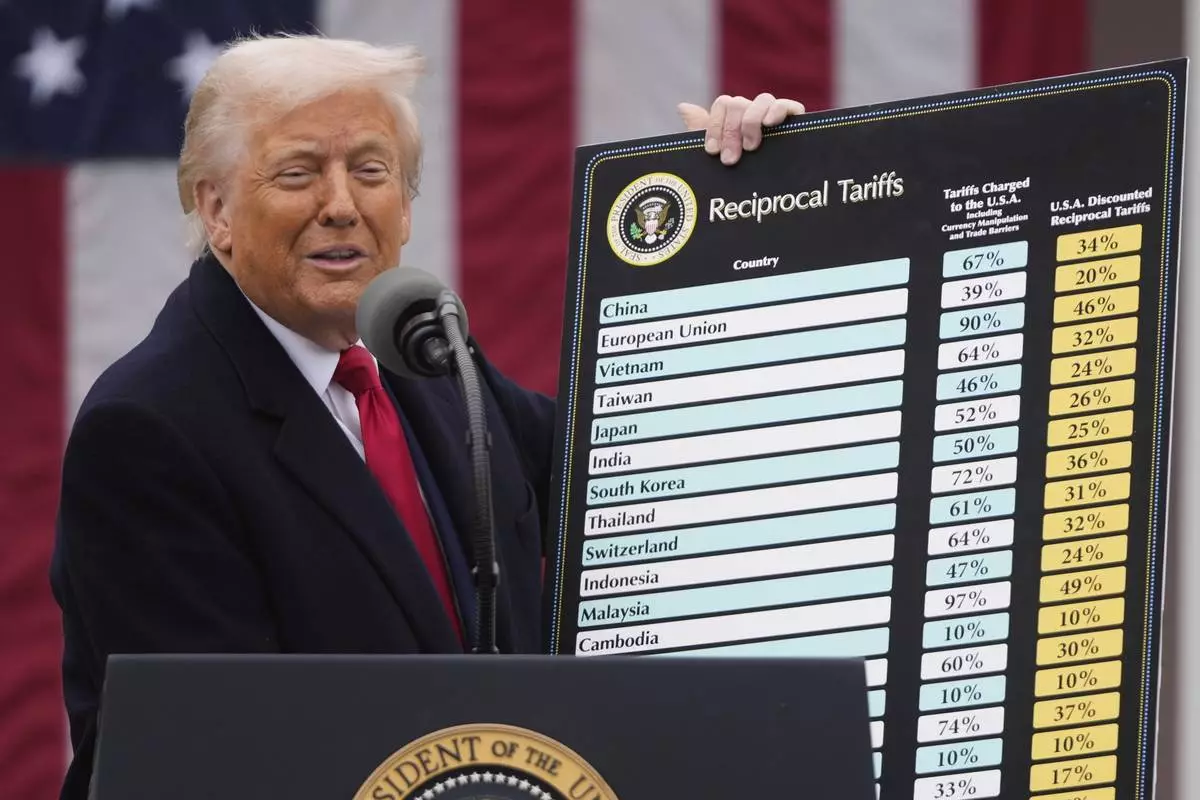
FILE - President Donald Trump speaks during an event to announce new tariffs in the Rose Garden at the White House, on April 2, 2025, in Washington. (AP Photo/Mark Schiefelbein, File)
FILE - President Donald Trump listens during a news conference with India's Prime Minister Narendra Modi in the East Room of the White House, Feb. 13, 2025, in Washington. (Photo/Alex Brandon, File)