Employers and employees should make work arrangements in times of rainstorm warnings
The Labour Department (LD) today (August 2) reminded employers to make prior work arrangements for employees during and after rainstorm warnings and extreme conditions as early as possible, including arrangements on reporting for duty, release from work, resumption of work and remote work (if applicable). These arrangements not only can ensure the safety of employees and smooth operation of organisations, but also are conducive to maintaining good labour-management relations.
"Employers should make prior work arrangements and contingency measures for staff which are reasonably practicable. In drawing up and implementing the work arrangements, employers should give prime consideration to employees' safety and the feasibility of employees travelling to and from their workplaces. Employers should also give consideration as much as possible to the different situations faced by individual employees, such as their place of residence and the road and traffic conditions in the vicinity, and adopt a sympathetic and flexible approach with due regard to their actual difficulties and needs," an LD spokesman said.
To avoid misunderstandings, disputes and confusion, employers should consult and engage employees when drawing up the arrangements and make appropriate updates or amendments based on the experience of each occasion and the needs of both employers and employees as well as the actual situations. The work arrangements should cover the following matters:
* arrangements in respect of reporting for duty;
* arrangements in respect of early release from work;
* arrangements in respect of resumption of work (e.g. the number of hours within which employees should resume duty after the warning concerned is cancelled or extreme conditions come to an end, when safety and traffic conditions allow);
* arrangements in respect of remote work such as work from home (if applicable) (e.g. duty and work arrangements during and after rainstorm warnings and extreme conditions);
* arrangements regarding working hours, wages and allowances (e.g. calculation of wages and allowances in respect of reporting for duty and absence); and
* special arrangements in respect of staff required to report for duty in times of adverse weather or extreme conditions.
"Employers should conduct a timely and realistic assessment of whether there is any need for requiring staff to report for duty at workplaces when rainstorm warning or extreme conditions are in force. In making the assessment, employers should take into account the safety of employees, the business nature, operational needs and urgency of service, with due regard to the manpower requirements, staffing establishment and individual situations of employees, and keep the number of staff at workplaces to the minimum as far as possible," the spokesman added.
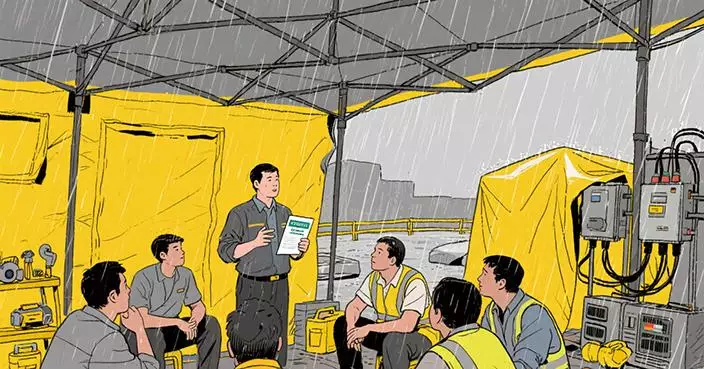
If a Red or Black Rainstorm Warning Signal is issued during working hours, employees working indoors should continue to work as usual unless it is dangerous to do so. Supervisors of employees working outdoors or in exposed areas should suspend outdoor duties as soon as practicable. They should arrange for their employees to take shelter temporarily and resume duty only when weather conditions permit. If the Black Rainstorm Warning Signal is still in force by the end of working hours, employees should stay in a safe place until the heavy rain has passed. A suitable area in the workplace should be made available by employers as temporary shelter for employees.
If the Government makes an extreme conditions announcement, apart from those required by employers to report for duty at workplaces, employees are advised to stay in the place they are currently in or in safe places when extreme conditions are in force, instead of heading for work. Employees who have already reported for duty at workplaces could continue to work as usual in a safe manner. If the workplaces are in danger, employers should release staff from work early under feasible conditions and in a safe manner or make available a safe place as temporary shelter for employees. If the working time ends while extreme conditions are still in force, employers can release employees from workplaces in a safe manner or provide a suitable area as temporary shelter for those still at workplaces.
If it is necessary for employees to report for duty at workplaces under adverse weather or extreme conditions, employers should discuss and agree with them in advance the duty arrangements and contingency measures. If public transport services are suspended or limited when the Black Rainstorm Warning Signal or extreme conditions are in force, employers should provide safe transport services for employees travelling to and from workplaces, or grant them an extra travelling allowance.
The spokesman reminded employers to observe the statutory liabilities and requirements under the Employment Ordinance, Occupational Safety and Health Ordinance, Factories and Industrial Undertakings Ordinance, Employees' Compensation Ordinance and Minimum Wage Ordinance.
"As natural calamities cannot be avoided, for employees who are not able to report for duty or resume work on time due to adverse weather or extreme conditions, employers should neither deduct their wages, good attendance bonuses or allowances, nor reduce employees' entitlement to annual leave, statutory holidays or rest days under the Employment Ordinance, or ask for additional hours of work from employees to compensate for the loss of working hours when they are unable to report for duty," he said.
Employers should note that they have an obligation to provide and maintain a safe working environment for their employees under the Occupational Safety and Health Ordinance. If employees are required to work in times of tropical cyclone warnings, rainstorm warnings or extreme conditions, employers should ensure that the risks at work are reduced as far as reasonably practicable. Moreover, under the Employees' Compensation Ordinance, employers are liable to pay compensation for injuries or deaths incurred when employees are travelling by a direct route from their residence to their workplace, or from their workplace back to their residence after work, four hours before or after working hours on a day when Tropical Cyclone Warning Signal No. 8 or higher, a Red or Black Rainstorm Warning Signal or extreme conditions are in force.
The LD has published the "Code of Practice in Times of Adverse Weather and 'Extreme Conditions'", which provides the major principles, reference guidelines and information on relevant legislation on making work arrangements for the reference of employers and employees. The booklet can be obtained from branch offices of the Labour Relations Division or downloaded from the department's webpage (www.labour.gov.hk/eng/public/wcp/Rainstorm.pdf).
Source: AI-found images