Thailand-Cambodia border clashes, though currently paused, continue to reverberate in Thailand's Surin Province, where elephants and the local tourism industry are bearing the brunt of the unrest.
The fighting, which erupted last Thursday as soldiers exchanged gunfire over border disputes, resulted in over 30 fatalities, over 100,000 evacuations, and an eventual agreement on an "immediate and unconditional ceasefire."
After intense clashes, the ceasefire, negotiated in Malaysia by Cambodian Prime Minister Hun Manet, acting Thai Prime Minister Phumtham Wechayachai, and hosted by Malaysian Prime Minister Anwar Ibrahim, took effect on July 28, 2025.
Despite this truce, the impact of the conflict lingers, particularly on the region's iconic elephants. These gentle giants, sensitive to sound and vibrations, suffered from the repeated artillery blasts and rumble of military vehicles.
"She is like a member of my family. I have been with her since she was a baby. When the blasts were close, she would get shocked. Her eyes would weep. She reacted like humans," said Chattri Salangam, a mahout.
Known across Thailand as the "Land of Elephants," Surin has for generations built its identity around these gentle creatures.
"Elephants are the magnet that attracts tourism to the province of Surin, making it well-known around the world. All festivals and events in Surin include elephants. We have the largest population of captive elephants in the world, it's a highlight and an important attraction," said Vorapot Saendee, an assistant at the Tourism Development Office.
Beyond cultural significance, elephants are a pillar of Surin's economy. Cultural tourism centered on elephant camps, riding trails, and performances supports thousands of local families. Now, with the region deemed unstable, tourism has vanished.
"This has impacted local incomes, especially those of villagers. The number of tourists have decreased, as many have canceled their trips due to safety concerns," said Vorapot Saendee.
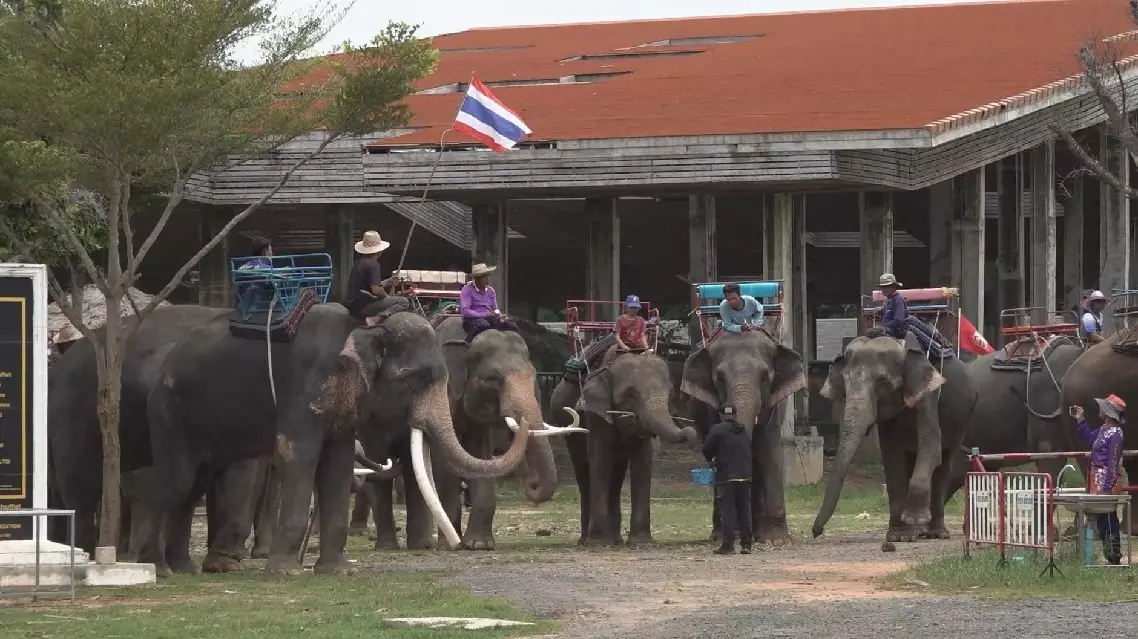
Cambodia-Thailand border tensions strain local livelihoods, tourism in Surin
A group of experts said they are expecting China's economy to post steady growth in 2026 despite an increasingly uncertain global situation that posts challenges to the country's development.
The experts made the remarks in a recent interview with China Global Television Network in south China's tech hub Shenzhen, Guangdong Province.
An official for Qianhai, a special economic zone that has become a critical growth engine for south China's Guangdong-Hong Kong-Macao Greater Bay Area city cluster, said that like other major economies around the world, China is also facing increasing challenges, but he believes the country will post steady growth in 2026.
"I mean [for] other major economies right now, they [are] kind of also facing a bit of challenges. Geopolitical risks are rising. Trade war [has] not yet completely ended. But having said that, I think [for] China, there is also a domestic-oriented economy. You know that 80 percent -- more than 80 percent -- is still domestic demand. And also we start to see some kind of, particularly in the areas like the new industries, but even in some kind of the broad-based industry, we still see the manufacturing investments keep rising despite the uncertainties, despite all these various kinds of pressures. I expect China's economy still going to remain kind of a stable piece of growth. [The growth rate of] four point five to five percent, I think, is still going to be quite achievable for the next twelve months or so," said Qu Hongbin, chief economist for Qianhai authority.
Greg Smith, chairman at AustCham South China, an institute for promoting Australia-China commercial relationship, said China's resilient partnerships with other countries around the world can help the country navigate through the uncertain global landscape.
"I think that you'd be a very brave person to bet against the Chinese economy. It's been resilient over a long period and it's gone through some fairly strong headwinds and come out with still the flag waving. Taking some of the issues that you're talking about with tariffs and the geopolitics that's in place, there's resilience in the partnership [which] is what all the countries are looking for in their trades. So the stronger relationships that you have, I think that's going to really be the bedrock to making sure that we do hit the 4.5 [growth] rate. I think all the countries around the world are looking for trusted partners to be able to work and trade with," said Smith.
Sunny Tan, chairman at the Hong Kong Productivity Council (HKPC), said he believes the rest of the world wants to be part of China's economic growth.
"I would say that China has a very, very good number -- achievable number. And I can see the big market by itself, the resilience, and also [it] is really providing a certainty in the time of uncertainty. Our country can continue to grow as planned. At the same time we can see very good interest from around the world, who wants to be part of this growth, and be wanting [who wants this growth] to be in China," Tan said.
Qin Youming, founder and CEO of Manifold Tech, a startup based in Shenzhen, said the entrepreneurs still see opportunities in globalization and companies should be quick in adapting themselves to the changing environment to survive.
"For market wise, we still see there are opportunities in globalization even though there are a lot of geopolitical matters going on. But the uniqueness of the Greater Bay Area, I think, is still unmatched, like the talents we can find here, the craftsmanship, the well experienced engineers here, is [are] still unmatched. I think even though there's uncertainty around the world, the business has to grow globally. Anyone who can adapt [themselves to] this quickly can survive," he said.

Experts expect China's economy to continue growing amid uncertainties in global landscape