A young man is leading an environmental mission in one of the most remote corners of southwest China's Xizang Autonomous Region as he is using livestock waste to heal the grasslands and boost local incomes.
On the windswept grasslands of northern Xizang, the sight is familiar: piles of dried yak dung stacked along walls, used as fuel for cooking, and surviving long, frigid winters.
But to one young man, the dung has untapped potential.
Tsering Migyur launched his business in 2017 by doing something few imagined: collecting livestock waste across the plateau and turning it into organic fertilizer.
At first, his work had met setbacks in two aspects – not knowing how to ferment or process it into fertilizer and the second was tradition as many elders saw dung as a blessing and when people asking to buy it, it felt like they were asking to take away their good fortune.
He went door to door, explaining how selling the dung could generate income without losing that sense of connection to the land.
Today, over 20 collection stations across Nagqu -- a major prefecture in the northern part of Xizang -- form part of his network.
Some herding families can earn between 1,400 to 2,000 U.S. dollars a year, just from selling dung.
Many who once hesitated now call him directly, asking him to come and collect it.
"Times have changed. Since he built the factory, we can sell our yak and sheep dung. It brings in extra income, and now we eagerly await his arrival", said Chosying Woeser, a herdsman, in referring to Migyur.
Migyur's growing business has also created dozens of local jobs, from collection site managers to drivers and factory workers.
"The factory covers 13,000 square meters. This spring, we collected over 4,000 cubic meters of yak and sheep dung in total. Right now, we're working with the Chinese Academy of Environmental Sciences to experiment with new fertilizer formulas," he said.
Born and raised on the plateau, Migyur has an ambition that goes beyond business.
He has been working with scientists to use these fertilizers for ecological restoration, trying to bring grass back to degraded lands and heal the fragile highland ecosystem.
Now, as the Xizang Autonomous Region marks the 60th anniversary of its founding, Migyur is working on two new ideas as a heartfelt tribute, where tradition meets sustainability.
"We throw prayer flags into the wind during festivals. I'm thinking of developing biodegradable ones made from yak dung, so they won't pollute the grasslands. I'm also working on a fertilizer that wraps grass seeds inside, so when drones spread it, the seeds can germinate with the rains," he said.
On the Roof of the World, transformation doesn't always come in big, flashy breakthroughs.
Sometimes, it begins with the smallest things, the things others leave behind.
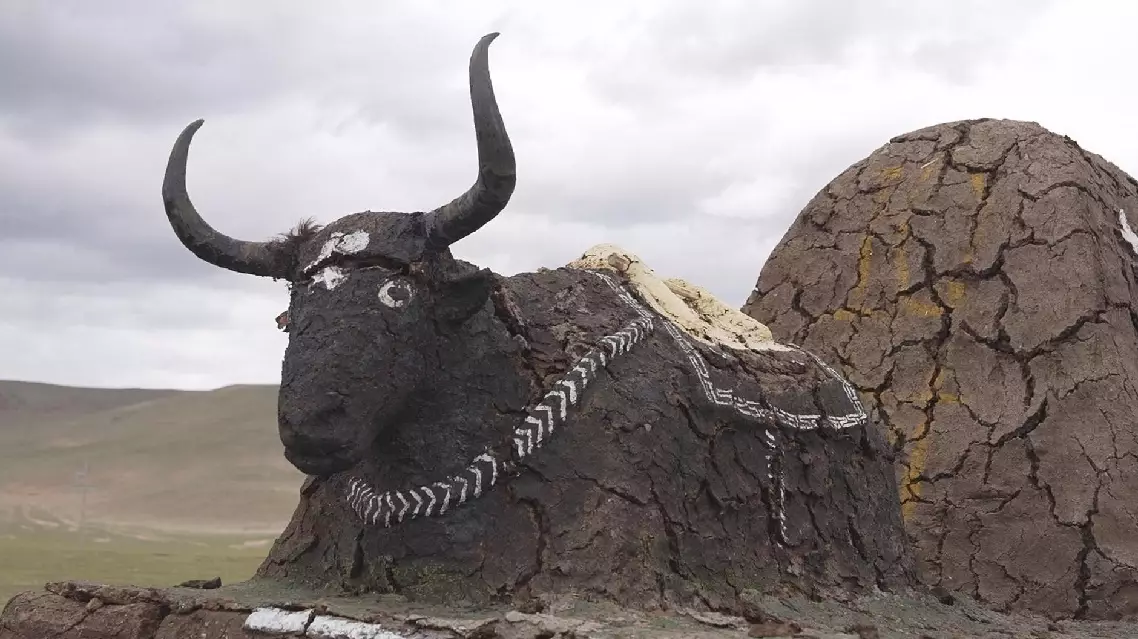
Young entrepreneur turns animal dung into fertilizer to revive Xizang's grasslands