HIROSHIMA, Japan (AP) — Eighty years after the atomic bombings of Hiroshima and Nagasaki, many of the remaining Japanese survivors are increasingly frustrated by growing nuclear threats and the acceptance of nuclear weapons by global leaders.
The U.S. attacks on Hiroshima on Aug. 6, 1945, and three days later on Nagasaki killed more than 200,000 people by the end of that year. Others survived but with radiation illness.
Click to Gallery
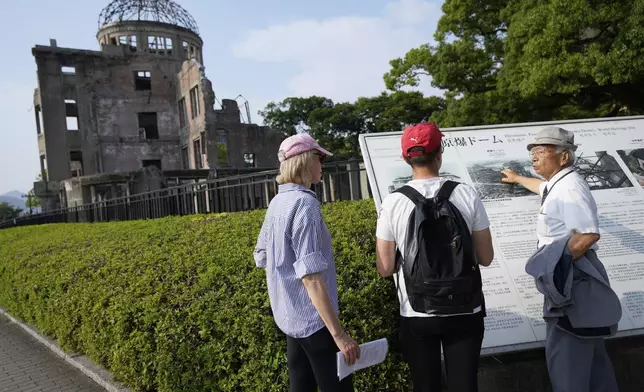
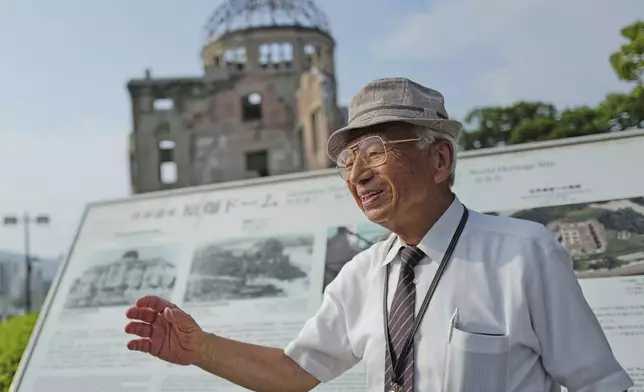
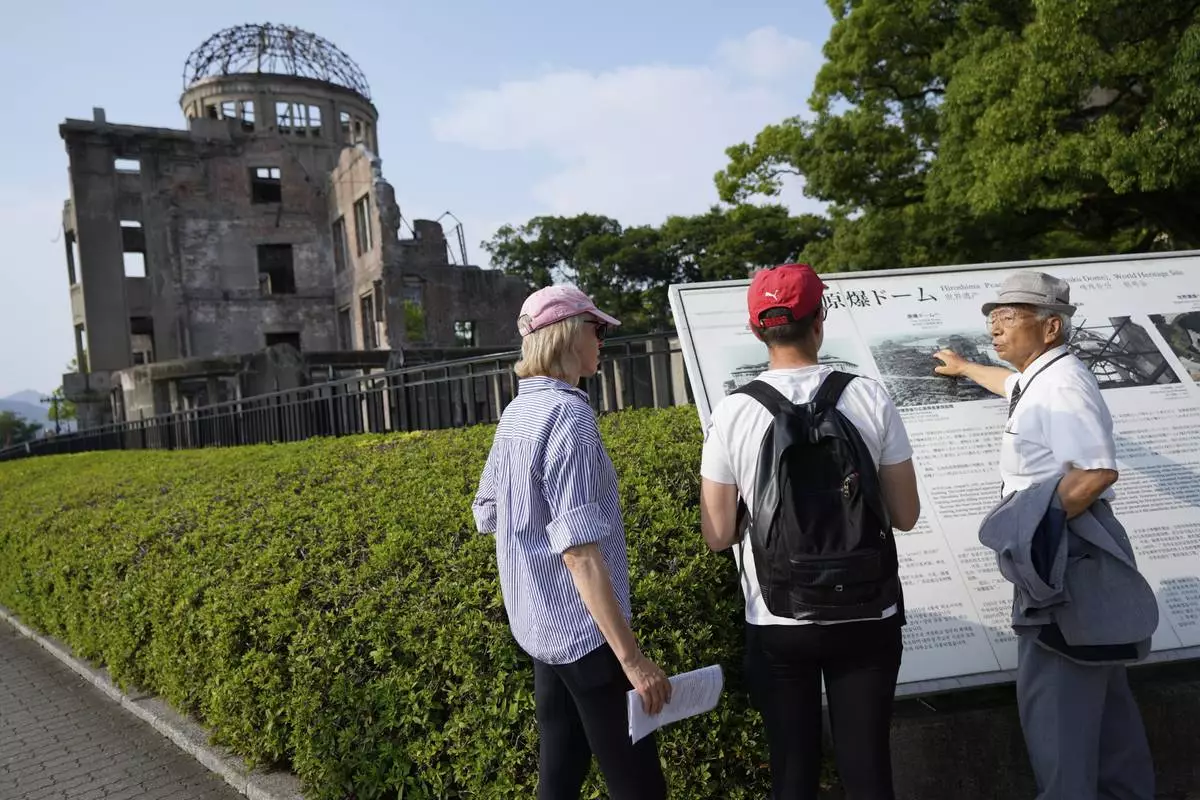
Kunihio Iida, atomic bomb survivor and a volunteer guide the iconic exhibition hall best known as the Atomic Bomb Dome speaks in English to foreign visitors on Wednesday, July 9, 2025, in Hiroshima, western Japan. (AP Photo/Eugene Hoshiko)
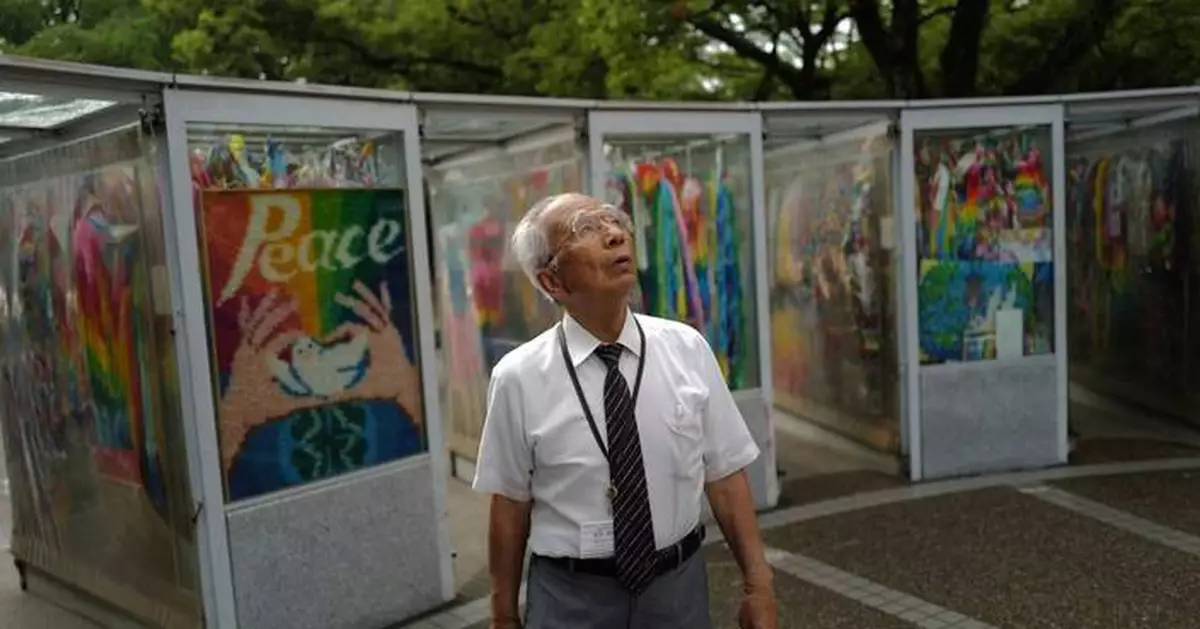
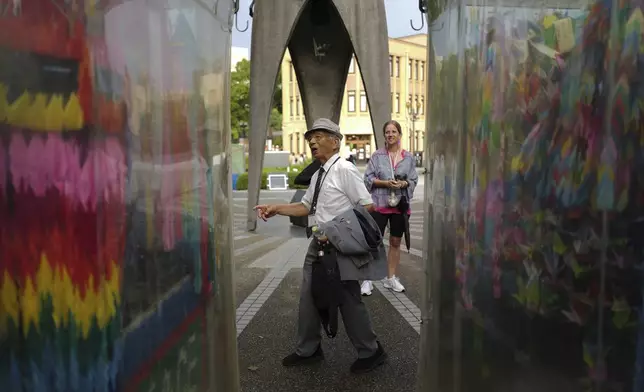
Kunihio Iida, atomic bomb survivor and a volunteer guide speaks in English to foreign visitors in front of the Children's Peace Monument where the place where people offer paper cranes to honor the victims of the 1945 atomic bomb on Wednesday, July 9, 2025, in Hiroshima, western Japan. (AP Photo/Eugene Hoshiko)
Kunihio Iida, atomic bomb survivor and a volunteer guide speaks in English to foreign visitors at the Children's Peace Monument where the place where people offer paper cranes to honor the victims of the 1945 atomic bomb on Wednesday, July 9, 2025, in Hiroshima, western Japan. (AP Photo/Eugene Hoshiko)
Kunihio Iida, atomic bomb survivor and a volunteer guide the iconic exhibition hall best known as the Atomic Bomb Dome speaks in English to foreign visitors on Wednesday, July 9, 2025, in Hiroshima, western Japan. (AP Photo/Eugene Hoshiko)
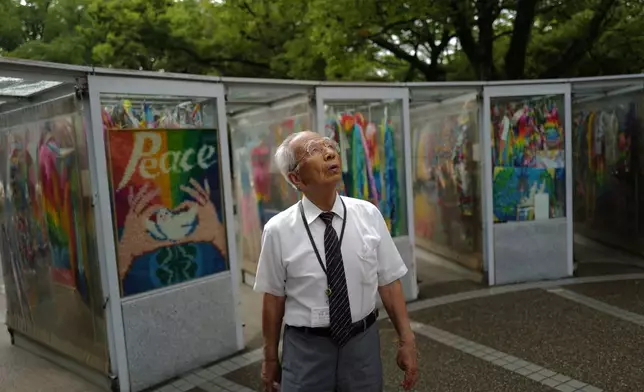
Kunihio Iida, atomic bomb survivor and a volunteer guide speaks in English to foreign visitors looks app the sky in front of the Children's Peace Monument where the place where people offer paper cranes to honor the victims of the 1945 atomic bomb on Wednesday, July 9, 2025, in Hiroshima, western Japan. (AP Photo/Eugene Hoshiko)
About 100,000 survivors are still alive. Many hid their experiences to protect themselves and their families from discrimination that still exists. Others couldn’t talk about what happened because of the trauma they suffered.
Some of the aging survivors have begun to speak out late in their lives, hoping to encourage others to push for the end of nuclear weapons.
Despite numerous health issues, survivor Kunihiko Iida, 83, has devoted his retirement years to telling his story as a way to advocate for nuclear disarmament.
He volunteers as a guide at Hiroshima's Peace Memorial Park. He wants to raise awareness among foreigners because he feels their understanding of the bombings is lacking.
It took him 60 years to be able to talk about his ordeal in public.
When the U.S. dropped a uranium bomb on Hiroshima, Iida was 900 meters (yards) away from the hypocenter, at a house where his mother grew up.
He was 3 years old. He remembers the intensity of the blast. It was as if he was thrown out of a building. He found himself alone underneath the debris, bleeding from shards of broken glass all over his body.
“Mommy, help!” he tried to scream, but his voice didn’t come out. Eventually he was rescued by his grandfather.
Within a month, his 25-year-old mother and 4-year-old sister died after developing nosebleeds, skin problems and fatigue. Iida had similar radiation effects through elementary school, though he gradually regained his health.
He was almost 60 when he finally visited the peace park at the hypocenter, the first time since the bombing, asked by his aging aunt to keep her company.
After he decided to start telling his story, it wasn’t easy. Overwhelmed by emotion, it took him a few years before he could speak in public.
In June, he met with students in Paris, London and Warsaw on a government-commissioned peace program. Despite his worries about how his calls for nuclear abolishment would be perceived in nuclear-armed states like Britain and France, he received applause and handshakes.
Iida says he tries to get students to imagine the aftermath of a nuclear attack, how it would destroy both sides and leave behind highly radioactive contamination.
“The only path to peace is nuclear weapons' abolishment. There is no other way,” Iida said.
Fumiko Doi, 86, would not have survived the atomic bombing on Nagasaki if a train she was on had been on time. The train was scheduled to arrive at Urakami station around 11 a.m., just when the bomb was dropped above a nearby cathedral.
With the delay, the train was 5 kilometers (3 miles) away. Through the windows, Doi, then 6, saw the flash. She covered her eyes and bent over as shards of broken windows rained down. Nearby passengers covered her for protection.
People on the street had their hair burnt. Their faces were charcoal black and their clothes were in pieces, she said.
Doi told her children of the experience in writing, but long hid her status as a survivor because of fear of discrimination.
Doi married another survivor. She worried their four children would suffer from radiation effects. Her mother and two of her three brothers died of cancer, and two sisters have struggled with their health.
Her father, a local official, was mobilized to collect bodies and soon developed radiation symptoms. He later became a teacher and described what he'd seen, his sorrow and pain in poetry, a teary Doi explained.
Doi began speaking out after seeing the 2011 Fukushima Daiichi nuclear disaster following a strong earthquake and tsunami, which caused radioactive contamination.
She travels from her home in Fukuoka to join anti-war rallies, and speaks out against atomic weapons.
“Some people have forgotten about the atomic bombings ... That’s sad," she said, noting that some countries still possess and develop nuclear weapons more powerful than those used 80 years ago.
“If one hits Japan, we will be destroyed. If more are used around the world, that’s the end of the Earth,” she said. ”That’s why I grab every chance to speak out.”
After the 2023 Hiroshima G7 meeting of global leaders and the Nobel Peace Prize awarded to the grassroots survivors’ group Nihon Hidankyo last year, visitors to Hiroshima and Nagasaki peace museums have soared, with about one third of them coming from abroad.
On a recent day, most of the visitors at the Hiroshima peace park were non-Japanese. Samantha Anne, an American, said she wanted her children to understand the bombing.
“It’s a reminder of how much devastation one decision can make,” Anne said.
Katsumi Takahashi, a 74-year-old volunteer specializing in guided walks of the area, welcomes foreign visitors but worries about Japanese youth ignoring their own history.
On his way home, Iida, the survivor and guide, stopped by a monument dedicated to the children killed. Millions of colorful paper cranes, known as the symbol of peace, hung nearby, sent from around the world.
Even a brief encounter with a survivor made the tragedy more real, Melanie Gringoire, a French visitor, said after Iida's visit. “It’s like sharing a little piece of history.”
Associated Press video journalists Mayuko Ono and Ayaka McGill contributed to this report.
Kunihio Iida, atomic bomb survivor and a volunteer guide the iconic exhibition hall best known as the Atomic Bomb Dome speaks in English to foreign visitors on Wednesday, July 9, 2025, in Hiroshima, western Japan. (AP Photo/Eugene Hoshiko)
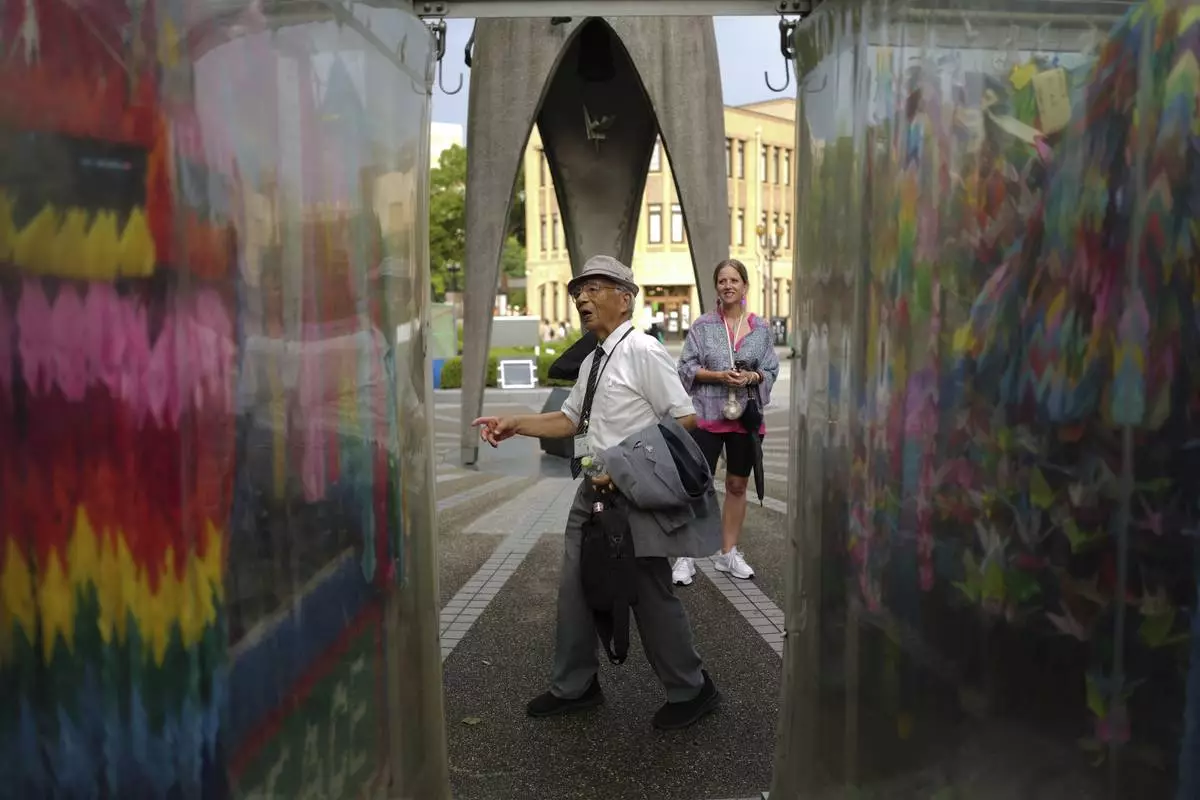
Kunihio Iida, atomic bomb survivor and a volunteer guide speaks in English to foreign visitors in front of the Children's Peace Monument where the place where people offer paper cranes to honor the victims of the 1945 atomic bomb on Wednesday, July 9, 2025, in Hiroshima, western Japan. (AP Photo/Eugene Hoshiko)

Kunihio Iida, atomic bomb survivor and a volunteer guide speaks in English to foreign visitors at the Children's Peace Monument where the place where people offer paper cranes to honor the victims of the 1945 atomic bomb on Wednesday, July 9, 2025, in Hiroshima, western Japan. (AP Photo/Eugene Hoshiko)
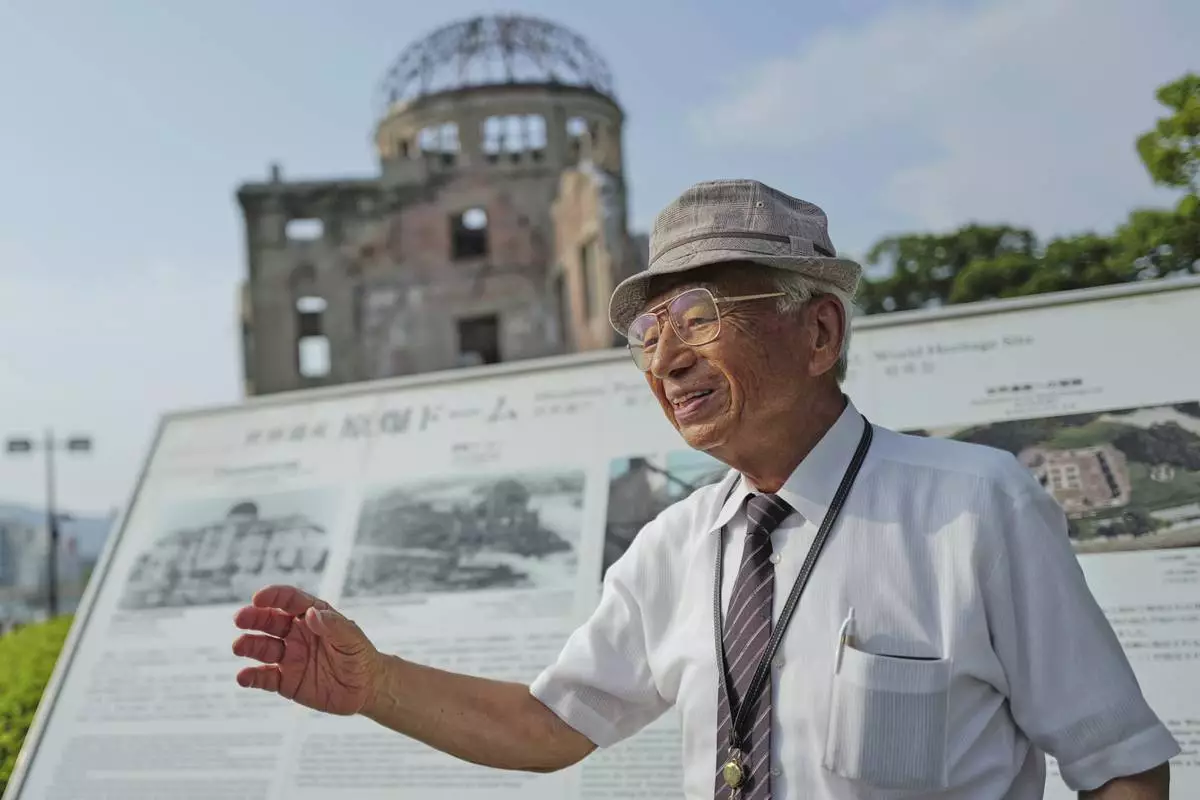
Kunihio Iida, atomic bomb survivor and a volunteer guide the iconic exhibition hall best known as the Atomic Bomb Dome speaks in English to foreign visitors on Wednesday, July 9, 2025, in Hiroshima, western Japan. (AP Photo/Eugene Hoshiko)
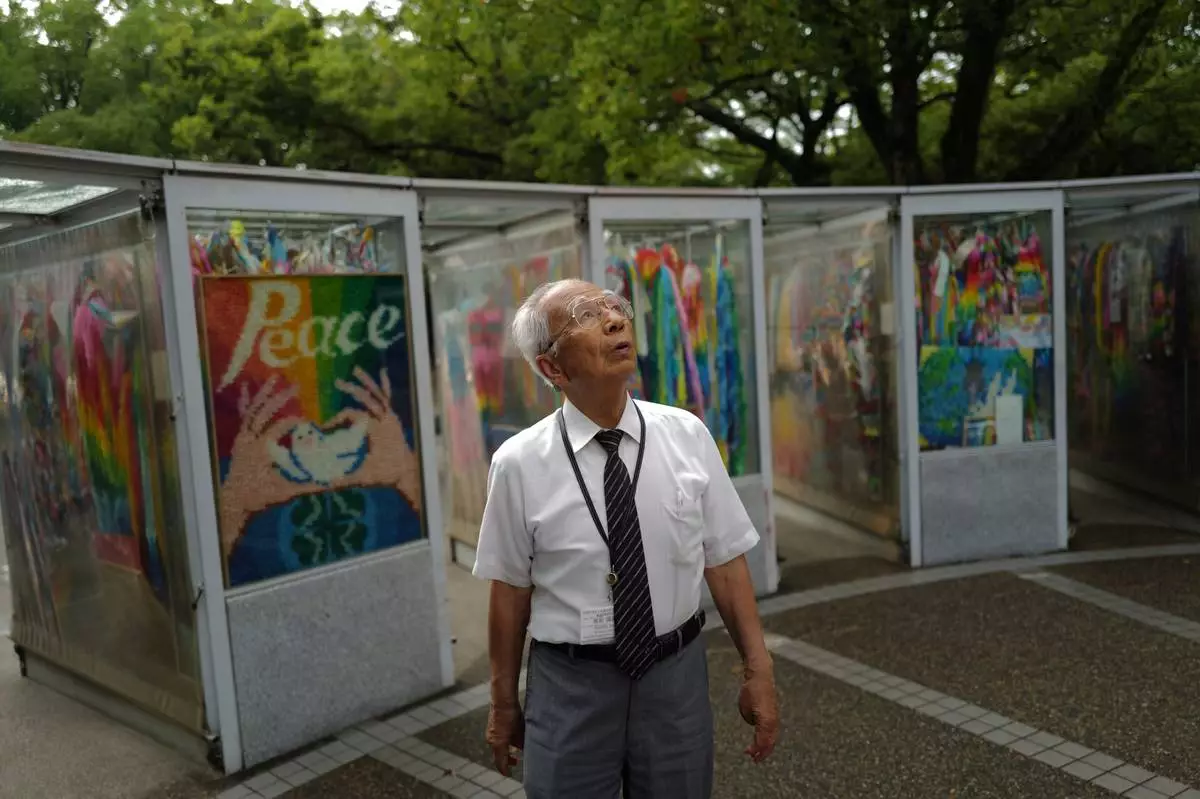
Kunihio Iida, atomic bomb survivor and a volunteer guide speaks in English to foreign visitors looks app the sky in front of the Children's Peace Monument where the place where people offer paper cranes to honor the victims of the 1945 atomic bomb on Wednesday, July 9, 2025, in Hiroshima, western Japan. (AP Photo/Eugene Hoshiko)
For a state that’s home to Hollywood, there isn’t much star power in California’s gubernatorial race. It’s a somewhat different story in Los Angeles, where a reality television personality is running for mayor as the city prepares to host the Olympics.
More primaries are being held on Tuesday as well. Democrats are banking on a rare chance to regain ground in Iowa, a rural state that has repeatedly eluded them in recent years. Republicans, meanwhile, are grappling with a New Jersey congressman whose unexplained absence could put their already slim majority at risk.
— California: Voters are weighing in on who should lead the nation’s most populous state, where there is no clear leader among candidates vying to advance in the race to succeed Democratic Gov. Gavin Newsom. Plus, U.S. House races are on the ballot, along with the Los Angeles mayor’s race.
— New Mexico: Contests in the state include primaries for congressional seats, a U.S. Senate seat and a long list of statewide offices, but the governor’s race is the main attraction. Former Interior Secretary Deb Haaland is running for the Democratic nomination, which could put her on a historic path for Native American leaders.
— New Jersey: One of this year’s most closely watched House midterms will take place in the battleground district represented by Rep. Tom Kean Jr., who has drawn public scrutiny and concern after missing more than 100 House votes due to an undisclosed medical issue. Voters are deciding which Democrat will run against him in November.
— Read more about races in Iowa, Montana and South Dakota.
Here's the latest:
Republican Spencer Pratt is dismissing Nithya Raman’s campaign as “weak” and effectively over. The only real race, he says, is between him and Democratic incumbent Karen Bass.
Raman, a former Bass ally and progressive city council member, is challenging the mayor from the left.
In a social media video posted Monday, Pratt says Raman hasn’t gotten anything done during her six years in city leadership. He calls a vote for Raman a waste.
“At this point, it’s me and Karen,” Pratt says.
President Donald Trump on Tuesday urged his followers to vote for Hilton, a former Fox News TV host and British political adviser.
“He will work with me and the Federal Government, the money will flow because I have confidence in him (but not any of the others!), and we will MAKE CALIFORNIA GREAT AGAIN!” Trump wrote on Truth Social.
Meanwhile, Vice President J.D. Vance called Hilton a “good guy” and encouraged Californians to vote for him.
“California is such a beautiful state--it just needs better political leadership!” Vance wrote on X.
Nithya Raman was once an ally to Bass, but she filed to challenge her as mayor just hours before the filing deadline. Raman described the city as “at a breaking point.”
She has promised to speed up housing construction, bring back entertainment industry jobs and improve services in a city known for dirty streets and buckled pavement.
Raman hasn’t drawn as much national chatter as Pratt, a former reality television star whose supporters have tried to boost his candidacy with AI-generated videos.
Last week, Raman took a shot at that tactic with her own video showing her flanked by supporters. “No AI was used in the making of this video,” it said.
The nation’s most populous state is dominated by Democrats, but some are unsure of who to vote for.
“I’m kind of pinching my nose and voting this go-around rather than being excited,” said Colin Culver, a 21-year-old San Diego resident who ultimately voted for Tom Steyer.
It’s been a chaotic campaign, particularly when former Rep. Eric Swalwell dropped out of the race after being accused of sexual assault.
Paul Mitchell, a Democratic strategist tracking ballot returns, said some voters “are holding onto the ballot because they have seen this kind of topsy-turvy governor’s race,” and “they’re waiting to make sure they’re making the right choice.”
Two Democrats are seeking their party’s nomination to replace Gov. Michelle Lujan Grisham, a term-limited Democrat who will leave office at the end of 2026. Sam Bregman, an Albuquerque-based district attorney, is campaigning on his law enforcement record and promises to stand up to the Trump administration.
Former congresswoman and U.S. Interior Secretary Deb Haaland has emphasized her ancestral roots in the state and experience working in the nation’s capital.
Haaland leads Bregman in fundraising by a wide margin, but the primary has become increasingly combative. Bregman’s campaign has seized on the fact that Haaland has declined multiple opportunities to debate him. Meanwhile Haaland’s campaign has cast Bregman as out of touch with everyday New Mexicans, highlighting his personal wealth.
By any measure, Bass’ first term has been challenging. The worst wildfire in city history began while she was traveling with a presidential delegation in Ghana. Homelessness continues to be a challenge.
“I haven’ always got it right,” Bass says.
But now she wants a second term, which would allow her to keep leading the city of 4 million people as it hosts the Olympics in 2028.
Bass is facing challenges from the left and the right. Progressive city council member Nithya Raman and Republican reality television personality Spencer Pratt are among the 14 names on the ballot.
With so many candidates, no one is likely to get a majority of the vote on Tuesday, meaning the election would be settled by a November runoff between the top two.
One of the most closely watched House races in this year’s midterms is unfolding in the New Jersey district represented by Rep. Tom Kean Jr., who’s been absent from votes for nearly three months.
Kean is running unopposed in the Republican primary, where he’s has Trump’s support. But his absence because of an undisclosed personal medical issue has generated outsized interest in the contest.
Kean is seeking a third term.
Republican Rep. Tom Kean Jr. is running unopposed in the primary for New Jersey’s 7th congressional district on Tuesday. But he’s facing growing scrutiny for an unexplained medical absence that has stretched for more than three months, causing him to miss more than 100 votes in Congress.
Trump weighed in on social media late Monday, saying Kean was “working tirelessly” to support the MAGA agenda.
Though Kean isn’t facing any GOP competition today, he’s seeking reelection this fall in one of the few genuinely competitive congressional districts left on the map. Several Democrats vying to take him on in the general election have made his absence — and the lack of clarity surrounding it — a central part of their message.
Every two years, the attention of the nation’s political class is riveted on a Democratic-leaning congressional district in California’s Central Valley. Republican Rep. David Valadao has been able to fend off repeated Democratic challengers, except in 2018, when he barely lost. But he ran again two years later and reclaimed the seat.
Democrats redrew the district to make it even tougher for Valadao. They recruited a moderate who represents the area in the state capital, Assemblywoman Jasmeet Bains, to run against him. But she’s had to battle a more liberal rival, political science professor and school board member Randy Villegas. The primary will determine Valadao’s next opponent.
That means all candidates are on the same ballot, regardless of their party affiliation. California has used that system for more than a decade.
It’s occasionally resulted in two candidates from the same party competing against each other in a general election. That happened most notably in U.S. Senate races in 2016 and 2018, when two Democrats faced off.
In the governor’s race, though, one Republican and one Democrat have always advanced to November. Democrats had feared a lockout this year given their large field of candidates. But those worries have diminished in the race’s closing weeks.
A Democrat has held the governor’s office since 2011, when Jerry Brown took over from Republican Arnold Schwarzenegger.
Democrats have also had a firm grip on the state Legislature.
Republicans Steve Hilton and Chad Bianco say that means Democrats are to blame for the state’s expensive gas and housing, its homelessness crisis and a slew of other problems. Both have pledged to reduce regulations and taxes.
Hilton has President Donald Trump’s backing. That could help him in the primary but hurt him in the general election in the heavily Democratic state.
Holding on to Iowa is a big part of the GOP’s plan to keep its U.S. Senate majority.
A super PAC affiliated with Senate Republicans has pledged $29 million to help ensure the seat stays in GOP hands.
That means all candidates are on the same ballot, regardless of their party affiliation. California has used that system for more than a decade.
It has occasionally resulted in two candidates from the same party competing against each other in a general election. That happened most notably in U.S. Senate races in 2016 and 2018, when two Democrats faced off.
In the governor’s race, though, one Republican and one Democrat have always advanced to November. Democrats had feared a lockout this year, given their large field of candidates. But those worries have diminished in the race’s closing weeks.
The candidates are U.S. Rep. Randy Feenstra, state Rep. Eddie Andrews, businessman and former conservative political director Zach Lahn, former state Rep. Brad Sherman and former director of the state Department of Administrative Services Adam Steen.
If no candidate earns at least 35% of Republican primary voters, the nominee would be selected at a contested state party convention.
Trump endorsed Feenstra on Friday, saying on social media that “Randy is MAGA all the way!”
The generational fighting that has been ripping through the Democratic Party continues in California’s primaries.
In the Los Angeles-area’s 32nd District, 42-year-old lawyer Jake Levine is challenging Brad Sherman, 71, a 15-term member of the House of Representatives.
And in the 7th District near Sacramento, 40-year-old city councilwoman Mai Vang is challenging Doris Matsui, 81, who has held the seat since her husband, a congressman himself for decades, died in 2005.
Tom Steyer, the former hedge fund manager turned climate activist, spent nearly $200 million of his money on advertising alone.
The billionaire’s ad campaign was the most expensive in the country by far this election cycle. The data comes from advertising tracker AdImpact.
Steyer’s rivals in the governor’s race and his critics have accused him of trying to buy the election.
But he’s defended his spending, saying he is fighting against powerful corporate interests that are driving up the price of living in the state. Pacific Gas & Electric, a major California utility, is among the corporations and business interests funding anti-Steyer ads.
“I’m only working for the people of California,” Steyer said last week.
They are former mayor of fast-growing Rio Rancho Gregg Hull, cannabis business owner Duke Rodriguez and public relations professional Doug Turner.
While Hull and Turner have not aligned their campaigns with the MAGA movement, Rodriguez was recently served a cease-and-desist letter from a law firm representing Trump for “deceptive use” of the president’s image in campaign materials. That contest's winner faces an uphill battle to win in a state where a Republican has not been elected to statewide office in 10 years.

A sign directs voters to a polling place for the New Jersey primary election in Cherry Hill township, N.J., Tuesday, June 2, 2026. (AP Photo/Matt Rourke)
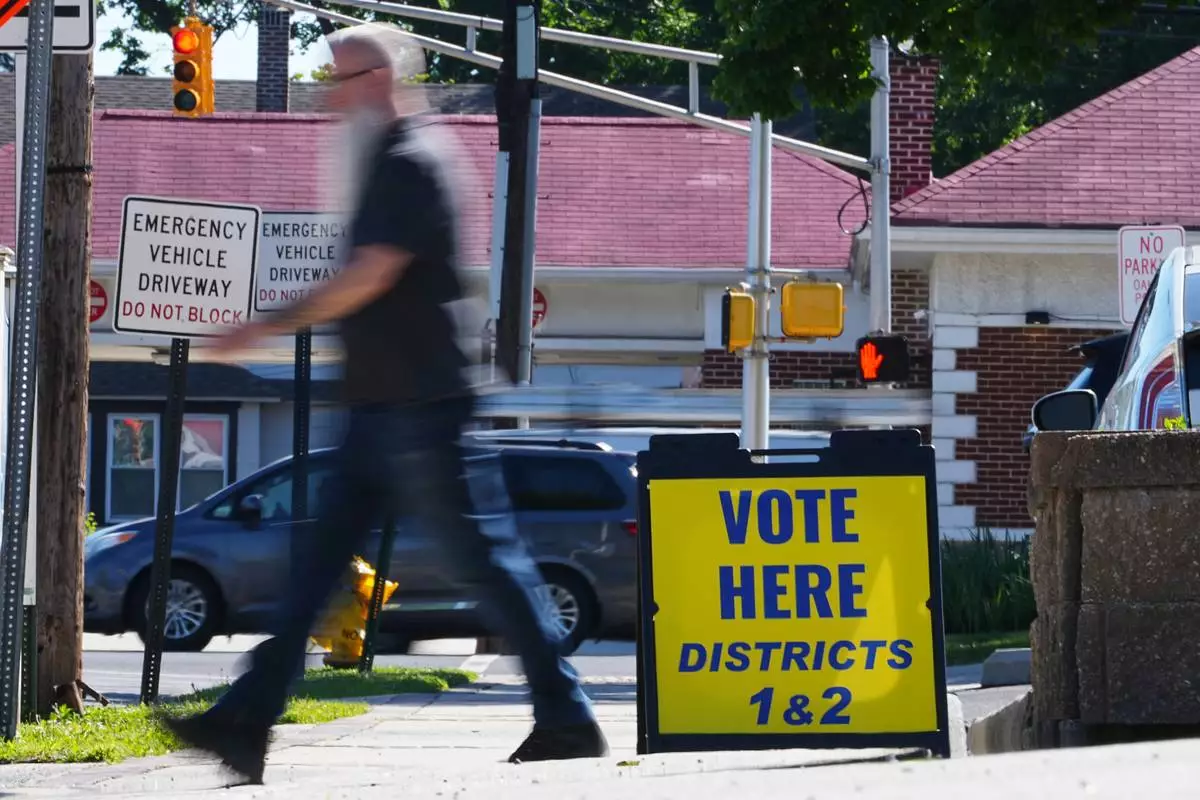
A person walks from a polling place for the New Jersey primary election in Oaklyn, N.J., Tuesday, June 2, 2026. (AP Photo/Matt Rourke)