Skip to Content Facebook Feature Image

Public Urged to Stay Vigilant Against Melioidosis After Recent Storms and Heavy Rain

HK

Public Urged to Stay Vigilant Against Melioidosis After Recent Storms and Heavy Rain
HK

HK

Public Urged to Stay Vigilant Against Melioidosis After Recent Storms and Heavy Rain

2025-08-05 12:08 Last Updated At:12:18

CHP appeals for heightened vigilance against melioidosis infection following adverse weather conditions

The Centre for Health Protection (CHP) of the Department of Health (DH) today (August 5) appealed to members of the public for heightened vigilance against melioidosis infection following adverse weather conditions and urged them to maintain personal and environmental hygiene. The CHP also specifically reminded high-risk groups, including the elderly and people with underlying diseases, to avoid contact with soil or muddy water after typhoons or storms with a view to lowering infection risk.

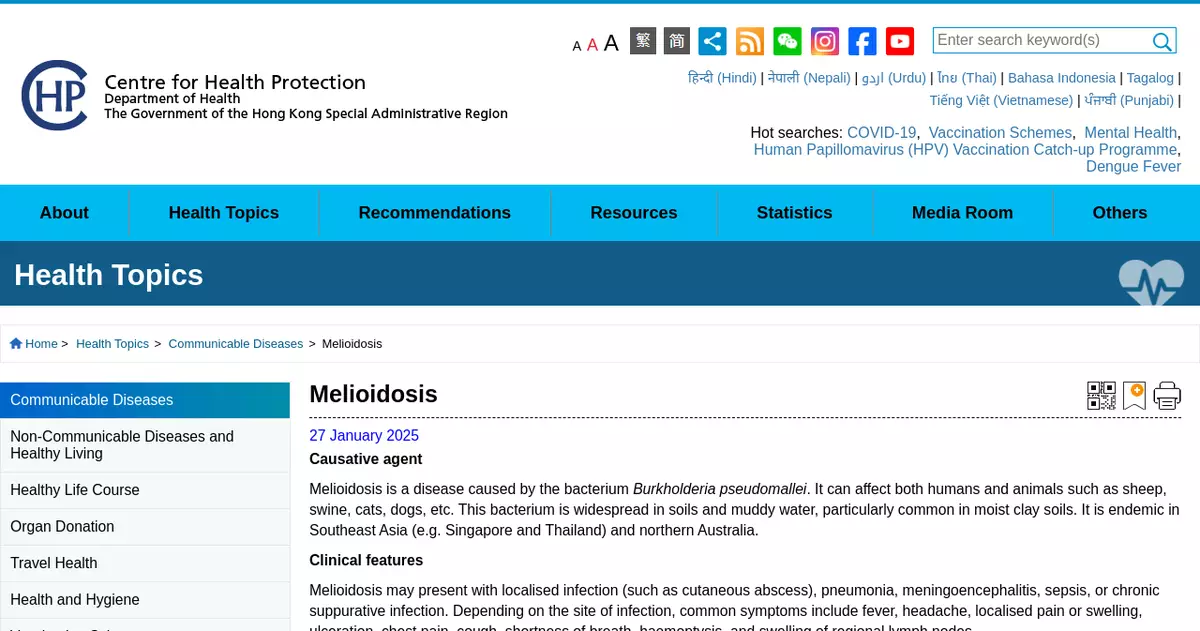
Melioidosis is a disease caused by the bacterium Burkholderia pseudomallei. Burkholderia pseudomallei is widespread in soil and muddy water, particularly common in moist clay soil. Humans can become infected through contact with contaminated soil and surface water (especially through skin abrasions/wounds); inhalation of contaminated dust/water droplets; and ingestion of contaminated water. Those with underlying diseases or immunosuppression have higher risks of contracting the disease.

According to overseas literature and local data, Burkholderia pseudomallei in the soil and muddy water may be exposed to the ground after typhoons or storms, and the bacteria would spread more easily with strong wind and storms. As such, infection cases are more common after typhoons or storms.

In view of the recent disturbance caused by typhoon andconsecutive days of torrential rain, the CHP again reminded members of the public, in particular high-risk groups such as those with underlying diseases, to avoid contact with soil or muddy water as far as practicable, to prevent melioidosis infection.

Melioidosis is an endemic disease in Hong Kong and human infection cases have been recorded in Hong Kong each year. As of yesterday (August 4), eight melioidosis infection cases have been recorded in Hong Kong this year. In 2024, 23 melioidosis cases were recorded. In light of the cluster of melioidosis cases recorded in Sham Shui Po in 2022, the CHP and the Water Supplies Department have implemented a series of precautionary and monitoring measures, including the installation of high efficiency particulate air filters at the ventilators of all fresh water service reservoirs in Hong Kong, enhancing residual chlorine levels in drinking water, continual monitoring of residual chlorine level of fresh water in service reservoirs and consumers' taps, as well as health education and surveillance of infection cases. No abnormalities were detected from all surveillance results so far, including those conducted after typhoons and heavy rain, while the drinking water quality monitoring results have consistently been in compliance with the Hong Kong Drinking Water Standards.

A spokesman for the CHP explained that person-to-person transmission andanimal-to-human transmission are rare but may occur through contact with the blood or body fluids of an infected person. Melioidosis may present with localised infection (such as cutaneous abscess), pneumonia, meningoencephalitis, sepsis, or chronic suppurative infection. Depending on the site of infection, common symptoms of melioidosis include fever, headache, localised pain or swelling, ulceration, chest pain, cough, haemoptysis, and swelling of regional lymph nodes. The CHP appealed again to members of the public to seek medical advice if they develop symptoms, in particular people with diabetes or other immunocompromised conditions, in order to receive appropriate medical diagnosis and treatment.

The CHP reminded members of the public to take the following preventive measures against infection:
  • Avoid contact with contaminated soil;
  • Wear appropriate protective clothing or footwear when participating in activities with possible contact with soil or water, e.g. usinggloves and wearing boots;
  • If exposure to contaminated water or soil is inevitable, high-risk individuals should wear a mask, gloves and boots;
  • Wash or shower after exposure to contaminated water or soil;
  • Always clean any wounds as soon as possible and cover any cuts or grazes with waterproof dressings;
  • Wash hands with liquid soap and water after handling soilor gardening;
  • Observe food hygiene and avoid drinking raw water; and
  • Travellers can contract the disease through outdoor water sports. Risk of infection can be minimised by avoiding exposure to water sources (such as rivers, ponds or lakes) that might be contaminated.
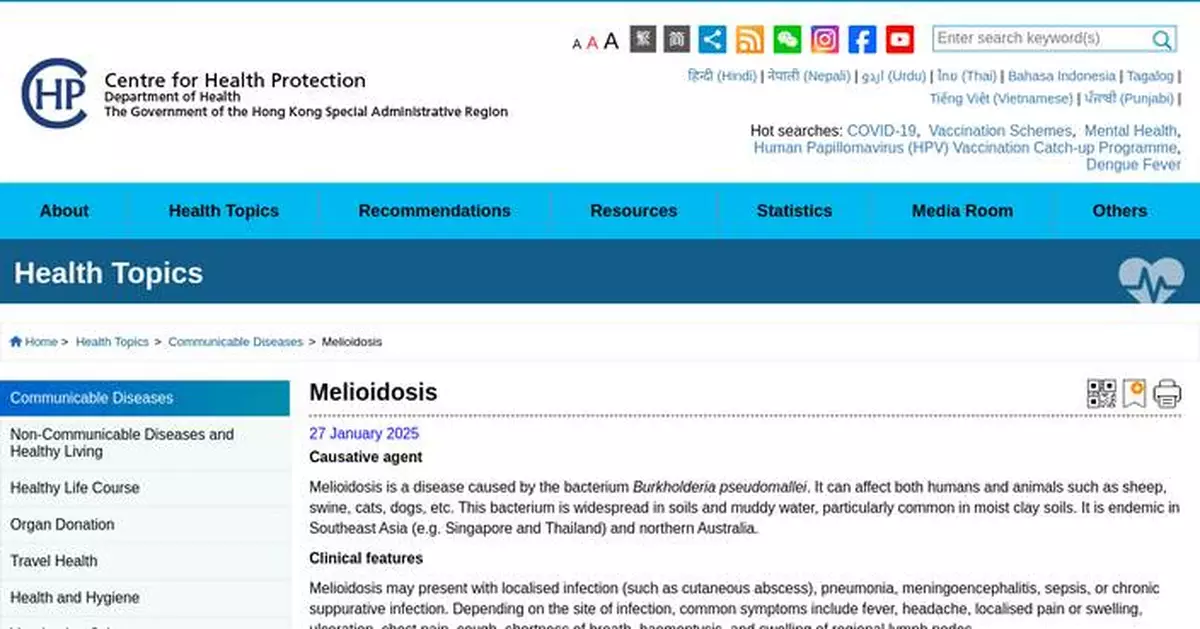
  • For more information on melioidosis, please visit the website of the CHPwww.chp.gov.hk/en/healthtopics/content/24/101110.html.

    Source: AI-found images
    Source: AI-found images

    Companies Registry releases statistics for 2025

    According to the statistics released by the Companies Registry today (January 16), a total of 195,343 local companies and re-domiciled companies were newly registered in 2025. By the end of 2025, the total number of local companies and re-domiciled companies registered under the Companies Ordinance increased by 96,609 compared to 2024, reaching 1,557,103, which was an all-time high figure.

    In 2025, 1,532 non-Hong Kong companies that had newly established a place of business in Hong Kong were registered under the Companies Ordinance. By the end of 2025, the total number of registered non-Hong Kong companies was 15,586, up 3 per cent compared to 2024.

    The company re-domiciliation regime, implemented since May 23, 2025, has received a positive market response. By the end of 2025, the Registry had received over 420 enquiries and 30 applications. Among these, six non-Hong Kong corporations incorporated in Luxembourg, the Cayman Islands or Bermuda, including an insurance company, have been successfully re-domiciled to Hong Kong. The regime provides a simple and cost-effective pathway for non-Hong Kong incorporated companies to re-domicile to Hong Kong by eliminating the need for complicated and costly judicial procedures while preserving a company's legal identity. It ensures seamless business continuity and strengthens the competitiveness of Hong Kong as a global business and financial hub.

    In 2025, the number of charges on properties of companies received for registration was 12,912, which was 6.4 per cent up from 12,137 in 2024. The number of notifications of payments and releases received for registration increased by 14.2 per cent, from 18,201 in 2024 to 20,789 in 2025.

    In 2025, a total of 180 prospectuses were registered while the figure recorded in 2024 was 157.

    In 2025, the total number of documents delivered for registration increased by 7 per cent to 3,360,723, compared to 3,139,906 in 2024.

    In 2025, a total of 5,229,202 searches of document image records were conducted using the Registry's electronic search services, an increase of 0.7 per cent from 5,194,865 in 2024.

    On the registration of limited partnership funds (LPFs), a total of 389 LPFs were newly registered in 2025. By the end of 2025, the total number of LPFs increased by 35.1 per cent compared to the end of 2024, to 1,347.

    For open-ended fund companies (OFCs), 210 OFCs were newly incorporated in 2025. By the end of 2025, the total number of OFCs increased by 43.2 per cent compared to the end of 2024, to 676.

    As regards the licensing of trust or company service providers under the Anti-Money Laundering and Counter-Terrorist Financing Ordinance, a total of 760 new licences were granted by the Registry in 2025. By the end of 2025, the total number of licensees was 7,220.

    Turning to the licensing of money lenders, 155 new licences were granted by the Licensing Court in 2025. By the end of 2025, the total number of licensed money lenders was 2,015.

    For details of the statistics, please visit the "Statistics" section of the Registry's website (www.cr.gov.hk).

    Source: AI-found images

    Source: AI-found images

    Recommended Articles