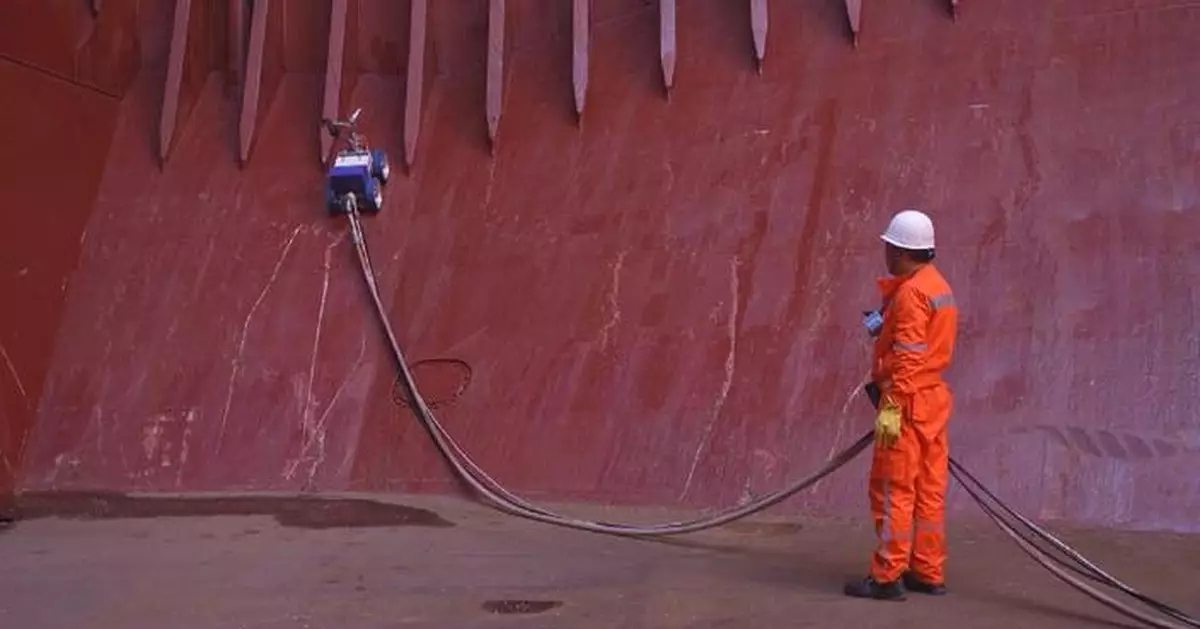
A cabin-cleaning robot, independently developed by Chinese engineers, is now offering a faster, safer and more efficient solution for cleaning bulk carriers, transforming the traditionally labor-intensive process of ship cleaning.
Bulk carriers usually transport a wide range of commodities, from coal and grain to iron ore and fertilizer. When switching cargo types, these ships must be thoroughly cleaned to prevent cross-contamination. Now, a homegrown technological breakthrough is revolutionizing this critical task.
Recently, at the Qingdao Port in east China's Shandong Province, a 220-meter-long bulk carrier with seven cargo holds - each spanning about 3,300 square meters - was cleaned using this robotic system, replacing traditional manual labor.
The robot, a product of indigenous research and development, is a technological marvel. Equipped with remote control, permanent magnetic adhesion, curved-surface mobility, and high-low pressure water jet systems, it can adapt to various ship designs and efficiently clean complex interior surfaces.
Previously, cleaning such a large vessel would require three to five crew members working for three to four days, often in dangerous high-altitude conditions.
With the cabin-cleaning robot, only one or two workers are needed to supervise the operation -- eliminating the risks of working at height while significantly reducing labor and time.
"Such a tiny robot can clean over 900 square meters per hour. It takes only three hours for it to clean a single cargo hold, and just 24 hours to clean an entire bulk carrier of over 220 meters long. Compared to traditional manual cleaning, it not only significantly improves cleaning efficiency, but also greatly reduces labor costs," said Tan Long, a researcher from China COSCO Shipping (Qingdao) Company.
Despite the massive scale of cargo holds, the robot is capable of handling both the cabin floor and walls with ease. Researchers say the secret to its ability to "climb walls and walk on ceilings" lies in its "feet".
"This is the key to our cabin-cleaning robot's ability to 'climb walls and walk on ceilings' inside the ship's hold. It is equipped with a curved permanent magnet that firmly adheres to the cargo hold's walls, enabling the robot to navigate over internal and external corners exceeding 120 degrees and overcome obstacles up to 40 millimeters high, ensuring completion of high-altitude cleaning tasks," Tan said.
Looking ahead, the research team plans to integrate smart navigation and real-time path planning technologies into the robot. This upgrade will allow the robot to autonomously adjust its route based on the ship's complex internal environment, optimizing cleaning efficiency and ensuring complete coverage.
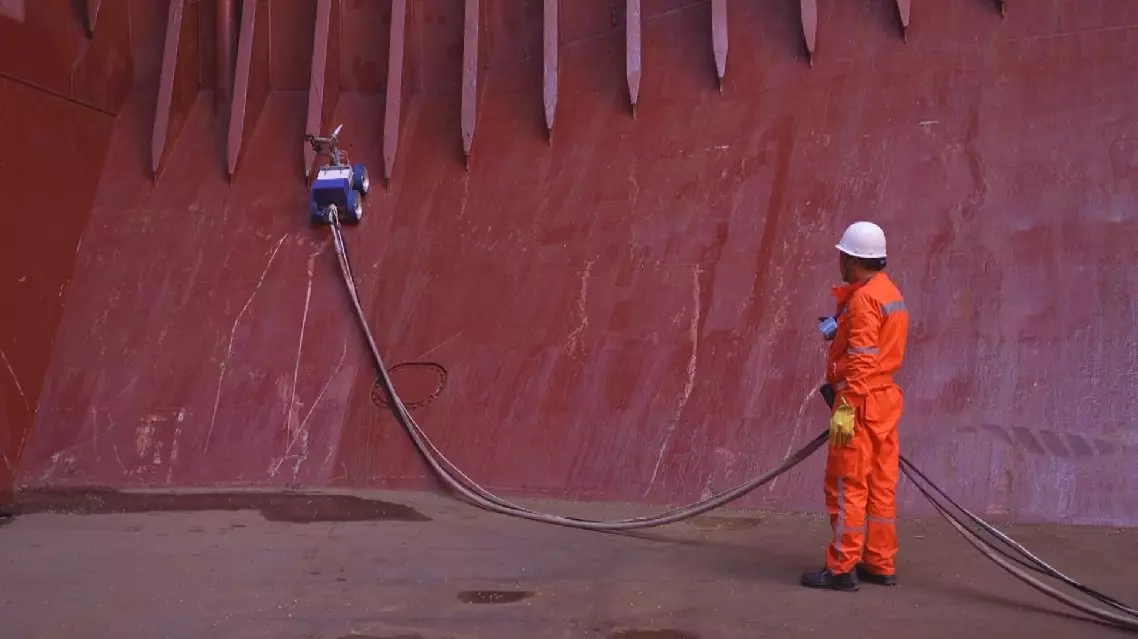
China-developed cabin-cleaning robot revolutionizes ship maintenance