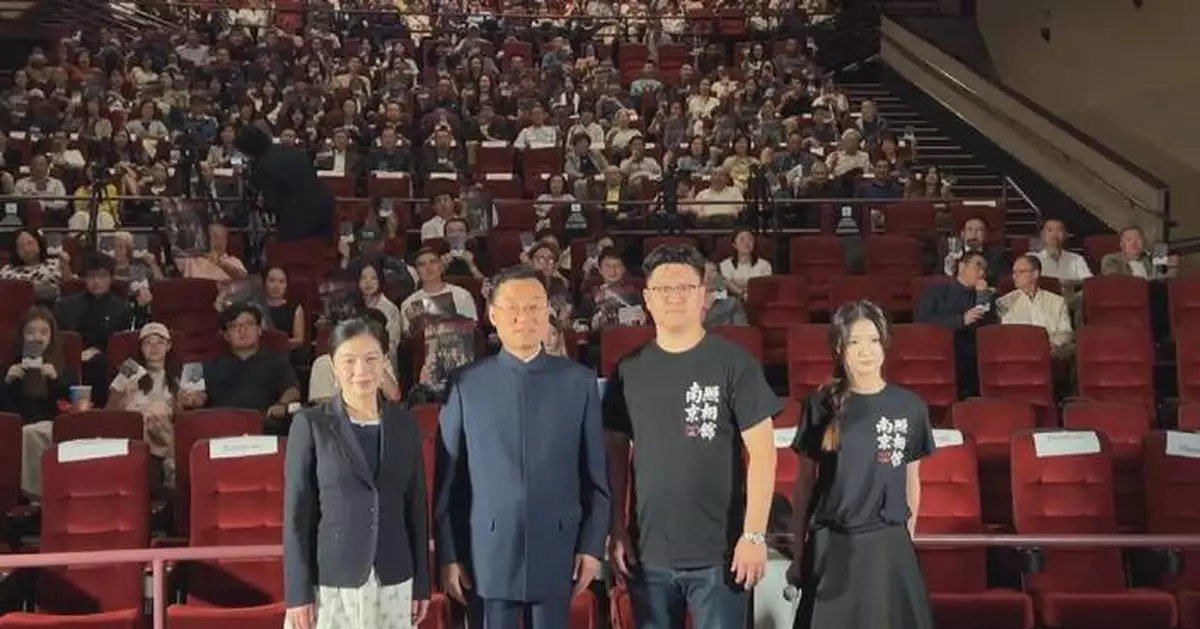
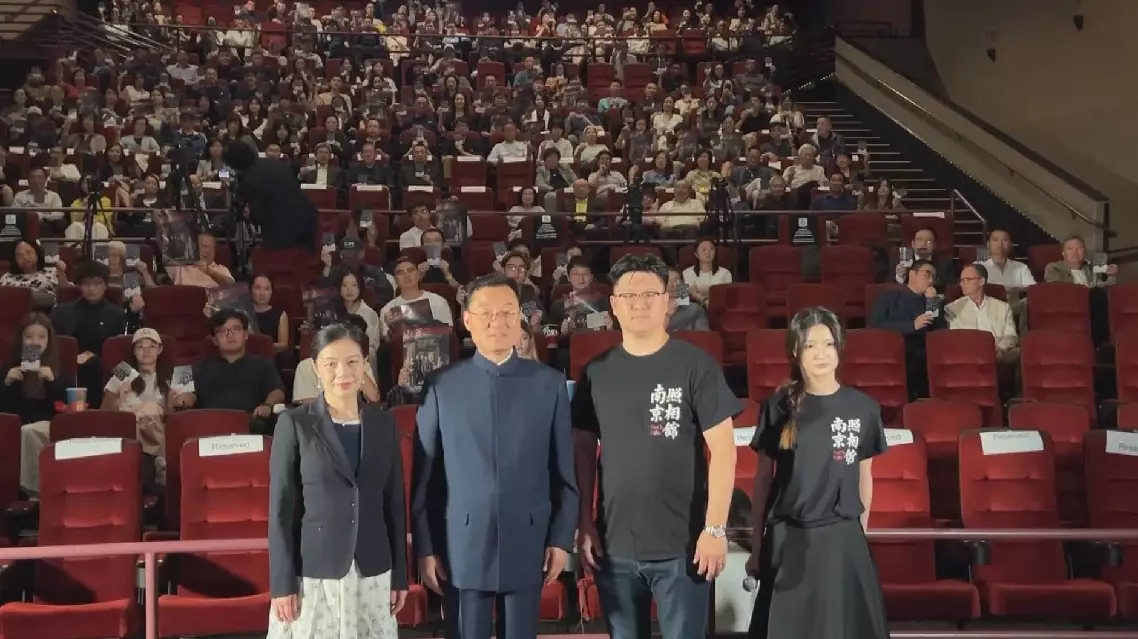
Chinese Ambassador to the United States Xie Feng called for strengthened cooperation in maintaining global peace in the new era at the North American premiere of the critically-acclaimed Chinese wartime film "Dead to Rights" in Washington, D.C. on Wednesday.
"Dead to Rights", based on harrowing events of the Nanjing Massacre during Japan's invasion of China, was held at a cinema in the U.S. capital, with more than 200 guests from various sectors attending the event.
This year marks the 80th anniversary of the victory in the Chinese People's War of Resistance against Japanese Aggression and the World Anti-Fascist War. On Sept. 3, China will hold a grand military parade to commemorate these milestones. Against this backdrop, "Dead to Rights" takes audiences back to one of the darkest and most overlooked chapter of World War II -- the Nanjing Massacre.
The film centers on a group of Chinese civilians who take refuge in a photography studio during the Japanese aggressors' brutal occupation of Nanjing in December 1937.
In a desperate attempt to stay alive, they are forced to assist a Japanese military photographer in developing film, only to discover that the negatives contain damning evidence of atrocities committed by Japanese forces across the city. They secretly keep the negatives and risk their lives to deliver them to the outside world, hoping that the truth would be revealed.
In his remarks at the premiere, Ambassador Xie highlighted the film's critical reception and box office success in China, praising its powerful historical authenticity and profound artistic portrayal of wartime humanity.
The ambassador said that the film transcends time to illuminate history's darkest chapters while revealing humanity's brightest resilience. It reminds people of war's brutality, peace's preciousness, and people's duty to learn from history while forging the future, he said.
"During the Chinese People's War of Resistance Against Japanese Aggression and the World Anti-Fascist War, the Chinese and American people stood together as allies, fighting side by side and leaving behind a historic legacy of jointly safeguarding human peace and justice. In this era of peace, China and the United States share only the responsibility to maintain peace, without any reason for confrontation. The two countries should work together to forge a correct way of dealing with each other in the new era that features mutual respect, peaceful coexistence, and win-win cooperation," said Xie.
The film "Dead to Rights" will be officially released in major cinemas across U.S. cities on Aug 15.
The Nanjing Massacre took place when Japanese troops captured the then-Chinese capital on Dec. 13, 1937. Over the course of six weeks, they killed approximately 300,000 Chinese civilians and unarmed soldiers in one of the most barbaric episodes of World War II.
Chinese ambassador attends North America premiere of Nanjing Massacre film
China will take further steps to expand high-standard opening-up and create a new landscape of win-win cooperation in 2026, which marks the start of the 15th Five-Year Plan period (2026-2030), Commerce Minister Wang Wentao said in a recent interview with China Media Group.
Wang said opening up and cooperation for mutual benefit are integral to Chinese modernization. This year, China will actively expand voluntary opening up.
The country will steadily open up such areas as value-added telecommunications, biotechnology and wholly foreign-owned hospitals, while accelerating comprehensive pilot and demonstration programs for expanded opening-up in the services sector, he noted.
"We will expand the scope and regions of unilateral opening-up and ensure the implementation of zero-tariff treatment on 100 percent of tariff lines for all African countries that have diplomatic relations with China. We will vigorously promote the effective implementation of policies for special customs operations of the Hainan Free Trade Port, further enhance the level of trade and investment liberalization and facilitation, optimize the regional layout and coverage of pilot free trade zones, and support these zones in carrying out more robust institutional opening-up trials in areas such as market access, environmental standards and government procurement, so as to better leverage their role as comprehensive pilot platforms for reform and opening-up," said Wang.
Wang said China will promote the orderly planning of cross-border industrial and supply chains.
Efforts will be made to deepen economic and trade cooperation under the Belt and Road Initiative, enhance integration and connectivity across production and supply chains, and encourage cooperation in areas including green development, the digital economy, green minerals, new infrastructure and new energy so as to help build global production and supply chain partnerships that are equal, inclusive and constructive, he noted.
"We will give play to the platform role of overseas economic and trade cooperation zones, expand overseas marketing networks and explore international markets through outward investment, achieve mutual promotion between investment and trade, and advance the integrated development of trade and investment. We will also improve the overseas comprehensive service system and the national-level overseas comprehensive service platform," said the minister.
In addition, China will participate constructively in global economic governance, according to the minister.
In 2026, Wang said, China will pursue flexible and pragmatic approaches to negotiate trade and investment agreements with more willing countries and regions, while strengthening economic and trade cooperation under multilateral frameworks such as BRICS, G20 and the Shanghai Cooperation Organization, to further promote mutual benefit and win-win outcomes.
China to expand high-standard opening-up to foster win-win cooperation: minister