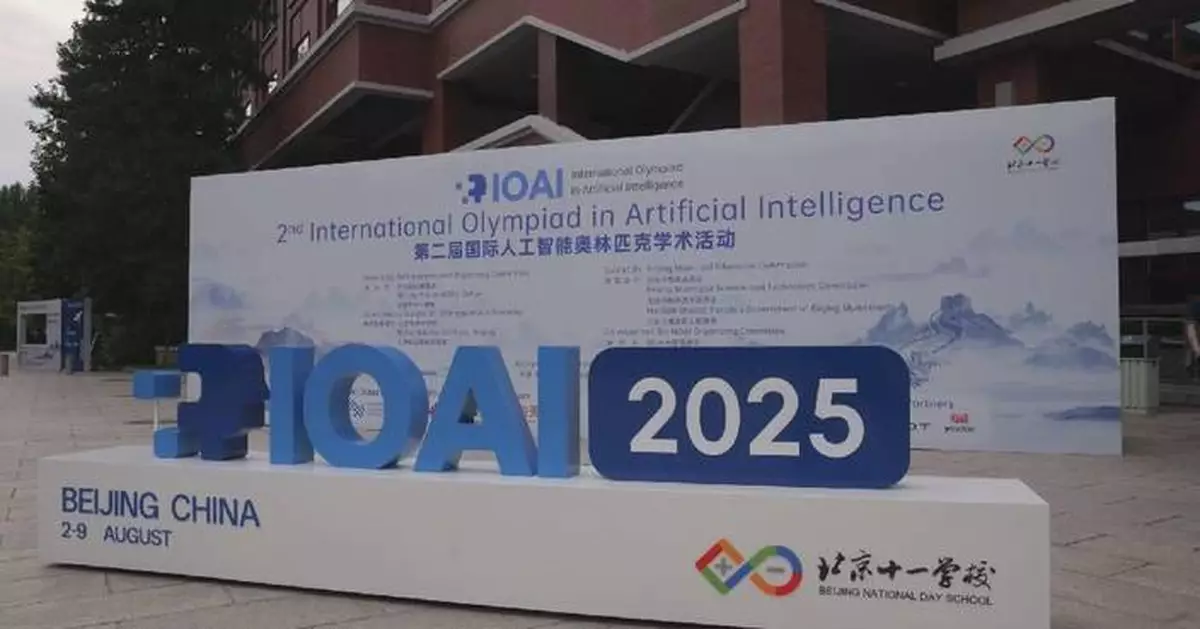
The second International Olympiad in Artificial Intelligence (IOAI) wrapped up in Beijing on Friday, showcasing the next generation of innovators as young minds from around the globe tackled real-world challenges through cutting-edge AI and robotics.
The event opened on Monday, bringing together 77 teams of middle school students from 61 countries and regions in an academic event focused on AI application and innovation.
The competition pioneered a hands-on AI deployment challenge, requiring students to program industrial robots for tasks, testing both algorithm design and teamwork.
For the team challenge finals, participants were required to program robots to avoid obstacles, select objects of various shapes, and place them on distant shelves. The task comprehensively evaluated participants' skills.
"From visual recognition to path planning, we coded manually. It's highly complex, involving not just algorithms but also hardware and systems," said Wang Mutian, a member of the Chinese team.
Competition robots, already active in smart retail and industrial sorting, highlighted the event’s mission of challenging students to address real-world problems and harness robotics to truly assist humans in their work.
"We hope to guide students through the full process of AI, from research and development to product testing and application, planting seeds of innovation in these outstanding young minds," said Zhang Zhizheng, vice president of Large Models at the Beijing Galbot Co.
AI is reshaping all aspects of life. Primary and Middle Schools in Beijing have achieved 65 percent AI application coverage. Starting this fall, all schools will mandate AI literacy courses (over 8 class hours annually).
Many schools now prioritize using AI tools to enhance learning interest and literacy of students.
"For writing, we introduced human-AI interactive evaluation. History classes launched a project called 'Terracotta Warriors Restoration' to spark creativity, improving efficiency, quality, encouraging more initiative from students," said Xie Danyang, teacher at the Beijing National Day School.
"Elementary schools focus on experiential learning, junior highs on AI-aided study and life empowerment, while senior highs emphasize comprehensive applications to inspire scientific spirit," said Wang Pan, spokesperson of the Beijing Municipal Education Commission.
Beijing wraps up AI Olympiad, showcasing next generation of innovators