Skip to Content Facebook Feature Image

Attorney says heart device did not shock Tennessee man in execution who said he was 'hurting so bad'

News

Attorney says heart device did not shock Tennessee man in execution who said he was 'hurting so bad'
News

News

Attorney says heart device did not shock Tennessee man in execution who said he was 'hurting so bad'

2025-08-09 07:20 Last Updated At:07:30

NASHVILLE, Tenn. (AP) — A Tennessee man who said he was “hurting so bad” during his lethal injection this week for the 1980s killings of his girlfriend and her two young daughters was not shocked by his implanted defibrillator, his attorney said Friday.

Kelley Henry, the federal public defender for Byron Black, said her team received an initial evaluation of the data from his implantable cardioverter defibrillator.

The ICD information eliminates one possible cause for Black's comment about pain during his execution Tuesday, and other actions such as when he picked his head up off the gurney and groaned, she said. But many questions remain unanswered, she said.

“Make no mistake, we all saw with our own eyes that the pentobarbital did not work like the State’s expert testified that it would," Henry said in her statement, referencing Tennessee's execution drug, pentobarbital. "Mr. Black suffered.”

Black was executed after a back-and-forth in court over whether officials would need to disable his ICD due to claims it might cause unnecessary, painful shocks to try to fix his heartbeat as the drugs were administered, potentially prolonging the execution.

An autopsy report is expected to be released in eight to 12 weeks, Henry said. She also said their team will be making public records requests to try to piece together what happened. She has said this includes access to Black's electrocardiograph readings from the execution.

Tennessee Attorney General Jonathan Skrmetti said Friday that news of the lack of a defibrillator shock was “just as the state’s medical expert predicted and entirely contrary to the confident predictions of Black’s expert.” Skrmetti cited Black’s numerous failed legal challenges and said, “Byron Black’s execution was entirely legal.”

“Every American has the right to their own opinion about the death penalty, but courts rely on actual facts and actual law, not on theatrics and passion,” Skrmetti said in a statement.

Black was convicted in the 1988 shooting deaths of his girlfriend Angela Clay, 29, and her two daughters, Latoya Clay, 9, and Lakeisha Clay, 6. Prosecutors said he was in a jealous rage when he shot the three at their home. At the time, Black was on work-release while serving time for shooting Clay’s estranged husband.

Black died at 10:43 a.m. on Tuesday, prison officials said. It was about 10 minutes after the execution started and Black talked about being in pain.

Ahead of that, when he was asked for any last words, he replied, “No sir.”

Black looked around the room as the execution began, lifting his head off the gurney multiple times, and could be heard sighing and breathing heavily. All seven media witnesses to the execution agreed he appeared to be in discomfort.

“Oh, it’s hurting so bad,” Black said, as he lay with his hands and chest restrained to the gurney, a sheet covering up past his lower half, and an IV line in his right arm visible to media witnesses.

“I’m so sorry. Just listen to my voice,” responded his spiritual adviser in the death chamber.

In mid-July, a trial court judge agreed with Black’s attorneys and ordered officials to have the defibrillator deactivated. But Tennessee’s Supreme Court overturned that decision last Thursday, saying the other judge lacked authority to order the change.

The state disputed that the lethal injection would cause Black’s defibrillator to shock him and said he wouldn’t feel them regardless.

Before the execution, the state said in a court filing that a "lethal dose of pentobarbital ensures that Black will not be conscious to experience any pain." The state said unconsciousness occurs within 20 to 30 seconds of administering the drug, followed by respiratory arrest and cardiovascular collapse.

Black, 69, was in a wheelchair, suffering from dementia, brain damage, kidney failure, congestive heart failure and other conditions, his attorneys have said. They said he had an intellectual disability that should have protected him from execution, but was denied a new hearing because he had already been rejected under older standards.

The nonprofit Death Penalty Information Center and Black's attorneys said it’s unaware of any other cases with similar claims to Black’s about ICDs or pacemakers. Black’s attorneys said they haven’t found a comparable case, either.

Henry also said officials struggled to insert an IV into his left side, and ultimately did after using some medical device, presumably to find a usable vein, Henry said. They seemed to have no trouble getting an IV into Black’s right side, she said.

That process is not viewed by media witnesses, whose perspective begins when Black is already strapped in and hooked up to IV lines on the gurney.
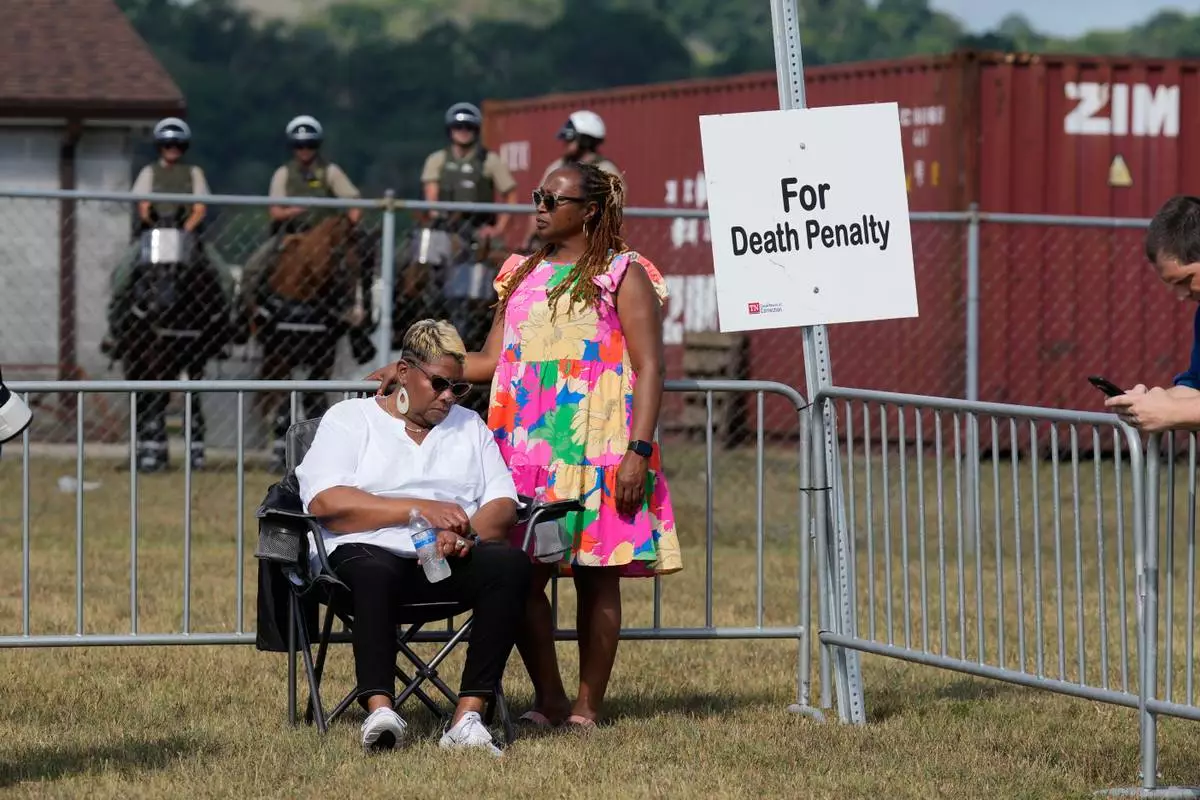
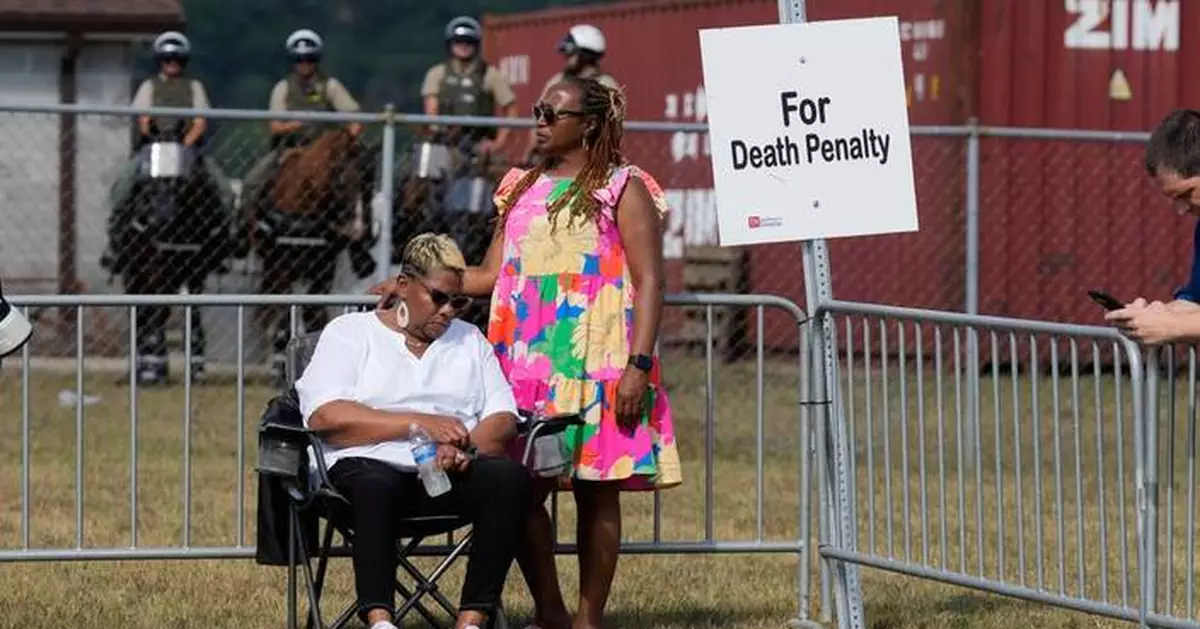
Relatives of the victims of convicted murderer Byron Black stay in the area reserved for pro-death penalty advocates outside Riverbend Maximum Security Institution before the execution of Black, Tuesday, Aug. 5, 2025, in Nashville, Tenn. (AP Photo/Mark Humphrey)
Relatives of the victims of convicted murderer Byron Black stay in the area reserved for pro-death penalty advocates outside Riverbend Maximum Security Institution before the execution of Black, Tuesday, Aug. 5, 2025, in Nashville, Tenn. (AP Photo/Mark Humphrey)

CARACAS, Venezuela (AP) — President Donald Trump is set to meet Thursday at the White House with Venezuelan opposition leader María Corina Machado, whose political party is widely considered to have won 2024 elections rejected by then-President Nicolás Maduro before the United States captured him in an audacious military raid this month.

Less than two weeks after U.S. forces seized Maduro and his wife at a heavily guarded compound in Caracas and brought them to New York to stand trial on drug trafficking charges, Trump will host the Nobel Peace Prize laureate Machado, having already dismissed her credibility to run Venezuela and raised doubts about his stated commitment to backing democratic rule in the country.

“She’s a very nice woman,” Trump told Reuters in an interview about Machado. “I’ve seen her on television. I think we’re just going to talk basics.”

The meeting comes as Trump and his top advisers have signaled their willingness to work with acting President Delcy Rodríguez, who was Maduro’s vice president and along with others in the deposed leader's inner circle remain in charge of day-to-day governmental operations.

Rodríguez herself has adopted a less strident position toward Trump and his “America First” policies toward the Western Hemisphere, saying she plans to continue releasing prisoners detained under Maduro — a move reportedly made at the behest of the Trump administration. Venezuela released several Americans this week.

Trump, a Republican, said Wednesday that he had a “great conversation” with Rodríguez, their first since Maduro was ousted.

“We had a call, a long call. We discussed a lot of things,” Trump told reporters. “And I think we’re getting along very well with Venezuela.”

In endorsing Rodríguez, Trump has sidelined Machado, who has long been a face of resistance in Venezuela. She had sought to cultivate relationships with Trump and key advisers like Secretary of State Marco Rubio among the American right wing in a political gamble to ally herself with the U.S. government. She also intends to have a meeting in the Senate on Thursday afternoon.

Despite her alliance with Republicans, Trump was quick to snub her following Maduro’s capture. Just hours afterward, Trump said of Machado that “it would be very tough for her to be the leader. She doesn’t have the support within or the respect within the country. She’s a very nice woman, but she doesn’t have the respect.”

Machado has steered a careful course to avoid offending Trump, notably after winning last year’s Nobel Peace Prize, which Trump coveted. She has since thanked Trump and offered to share the prize with him, a move that has been rejected by the Nobel Institute.

Machado’s whereabouts have been largely unknown since she went into hiding early last year after being briefly detained in Caracas. She briefly reappeared in Oslo, Norway, in December after her daughter received the Nobel Peace Prize on her behalf.

The industrial engineer and daughter of a steel magnate began challenging the ruling party in 2004, when the nongovernmental organization she co-founded, Súmate, promoted a referendum to recall then-President Hugo Chávez. The initiative failed, and Machado and other Súmate executives were charged with conspiracy.

A year later, she drew the anger of Chávez and his allies again for traveling to Washington to meet President George W. Bush. A photo showing her shaking hands with Bush in the Oval Office lives in the collective memory. Chávez considered Bush an adversary.

Almost two decades later, she marshaled millions of Venezuelans to reject Chávez’s successor, Maduro, for another term in the 2024 election. But ruling party-loyal electoral authorities declared him the winner despite ample credible evidence to the contrary. Ensuing anti-government protests ended in a brutal crackdown by state security forces.

Janetsky reported from Mexico City. AP Diplomatic Writer Matthew Lee in Washington contributed to this report.

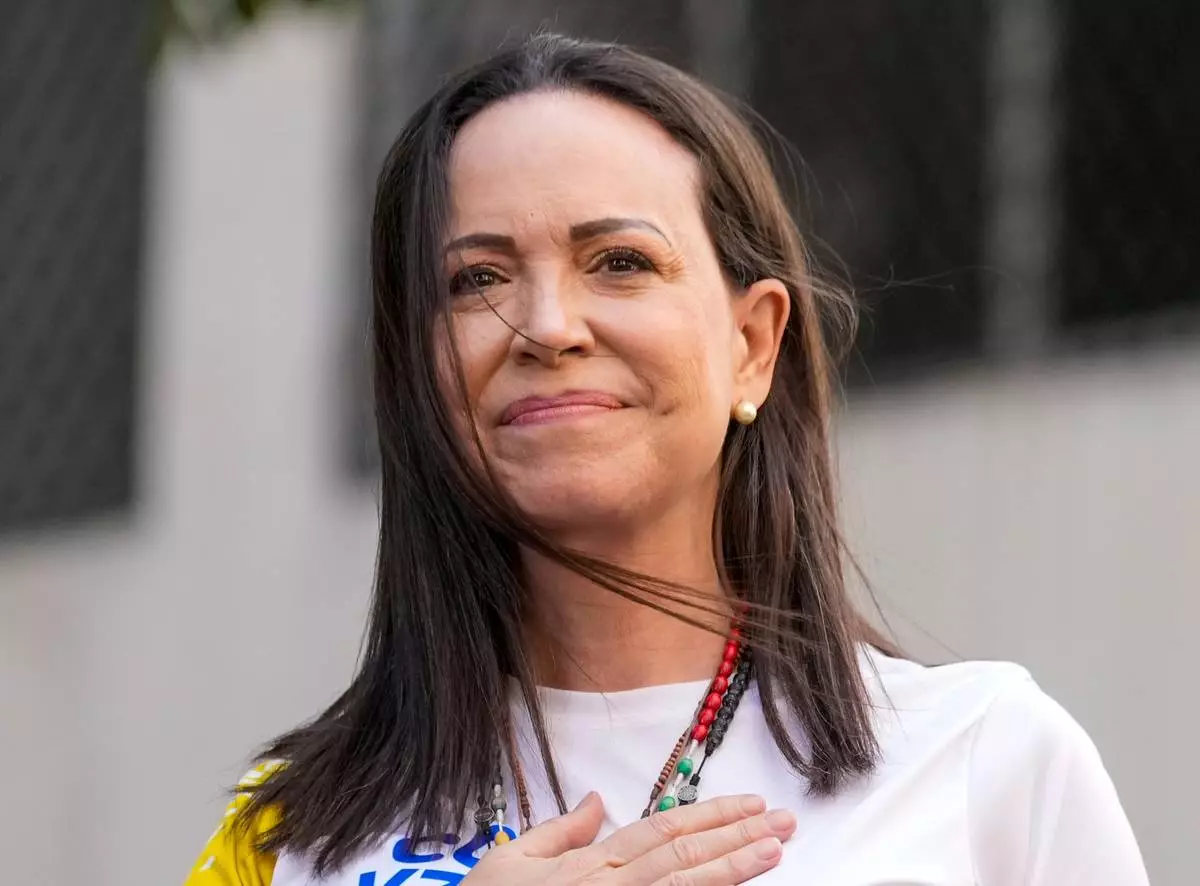
FILE - Opposition leader Maria Corina Machado gestures to supporters during a protest against President Nicolas Maduro the day before his inauguration for a third term, in Caracas, Venezuela, Thursday, Jan. 9, 2025. (AP Photo/Ariana Cubillos, file)

FILE - Opposition leader Maria Corina Machado gestures to supporters during a protest against President Nicolas Maduro the day before his inauguration for a third term, in Caracas, Venezuela, Thursday, Jan. 9, 2025. (AP Photo/Ariana Cubillos, file)

Recommended Articles