FEHD releases first batch of gravidtrap index for Aedes albopictus in August
The Food and Environmental Hygiene Department (FEHD) announced today (August 9) that it will enhance the dissemination of gravidtrap index data to allow more citizens to quickly grasp the mosquito infestation situation and strengthen mosquito control efforts, thereby reducing the risk of chikungunya fever (CF) transmission.
The FEHD has previously announced the gravidtrap index data in July and is currently conducting mosquito infestation surveys in various survey areas for August. Once the surveys are completed in individual survey areas and the latest gravidtrap and density indices are available, the FEHD will disseminate the relevant information through press releases, its website, and social media.
The first batch of gravidtrap index and density index for August, covering 13 survey areas, is as follows:
District |
Survey Area |
August 2025 |
First Phase Gravidtrap Index |
First Phase Density Index |
Eastern |
North Point |
7.1% |
1.0 |
Southern |
Deep Water Bay and Repulse Bay |
5.3% |
1.0 |
Wanchai |
Wan Chai North |
0.0% |
N/A |
Yau Tsim |
Tsim Sha Tsui |
3.1% |
1.0 |
Tsim Sha Tsui East |
7.4% |
1.0 |
Kowloon City |
Kowloon City North |
5.6% |
1.0 |
Wong Tai Sin |
Wong Tai Sin Central |
3.8% |
1.0 |
Sha Tin |
Tai Wai |
1.6% |
1.0 |
Sha Tin East |
4.8% |
1.0 |
Ma On Shan |
6.5% |
1.0 |
Tai Po |
Tai Po East |
3.9% |
1.0 |
Tuen Mun |
So Kwun Wat |
16.4% |
1.0 |
Kwai Tsing |
Tsing Yi South |
3.6% |
1.0 |
The index in So Kwun Wat, Tuen Mun District, reached 16.4 per cent. In response to the recent CF situation, the FEHD has activated a mechanism that strengthen mosquito control work in areas with the gravidtrap index between 10 per cent and 20 per cent, which was originally activated when the gravidtrap index reaches 20% or above. The FEHD will collaborate with relevant departments and stakeholders to identify locations with high mosquito infestation, and carry out intensive and targeted mosquito control measures. The FEHD will also organise exhibitions, distribute leaflets and posters, and notify the residential estates subscribed to the gravidtrap Rapid Alert System, advising property management agents and residents to stay vigilant and join hands in taking mosquito prevention and elimination measures.
Members of public should adopt the following measures, strengthening the prevention against the breeding of mosquitoes:
Tidy up their premises and check for any accumulation of water in containers inside their premises;
Remove all unnecessary water collection and eliminate the sources;
Completely change the water in flower vases at least once a week and remove the water on the plant saucers;
Properly cover all containers that hold water;
Properly dispose of refuse, such as soft drink cans, empty bottles and boxes, in covered litter containers; and
Level irregular ground surfaces and holes.
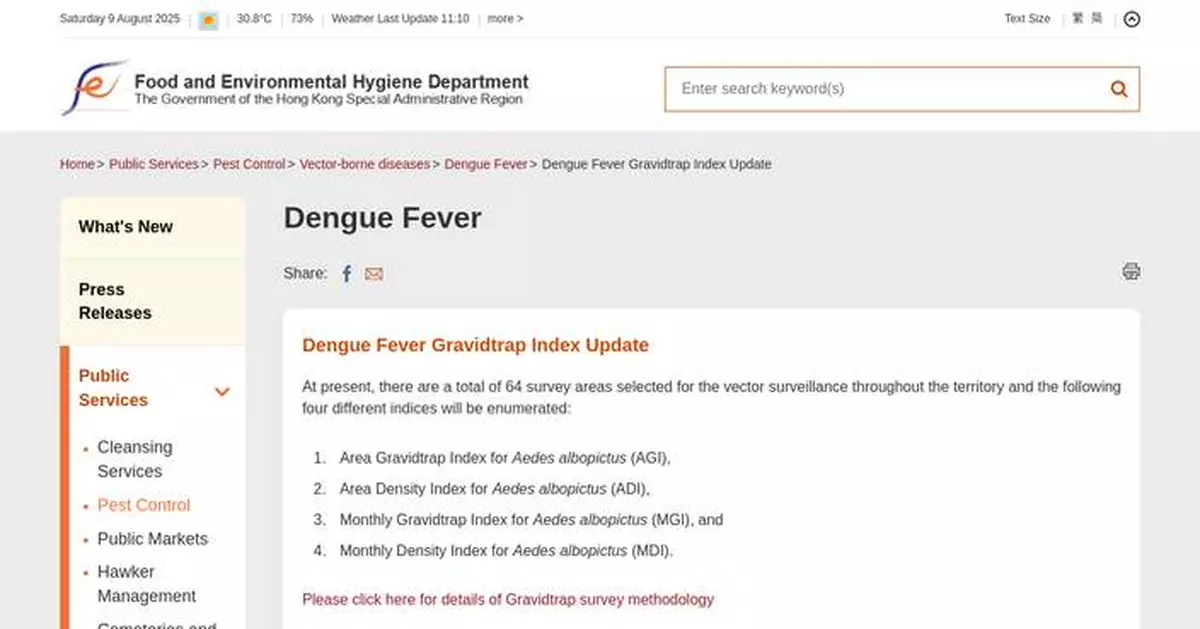
Following the recommendations from the World Health Organization and taking into account the local situation in Hong Kong, the FEHD sets up gravidtraps in districts where mosquito-borne diseases have been recorded in the past, as well as in densely populated places such as housing estates, hospitals and schools, to monitor the breeding and distribution of Aedes albopictus mosquitoes, which can transmit CF and dengue fever. At present, the FEHD has set up gravidtraps in 64 survey areas of the community. During the two weeks of surveillance, the FEHD will collect the gravidtraps once a week. After the first week of surveillance, the FEHD will immediately examine the glue boards inside the retrieved gravidtraps for the presence of adult Aedine mosquitoes, to compile the Gravidtrap Index (First Phase) and Density Index (First Phase). At the end of the second week of surveillance, the FEHD will instantly check the glue boards for the presence of adult Aedine mosquitoes. Data of the two weeks' surveillance will be combined to obtain the Area Gravidtrap Index and the Area Density Index. The gravidtrap and density indices for Aedes albopictus in different survey areas as well as information on mosquito prevention and control measures are available on the department's webpage (www.fehd.gov.hk/english/pestcontrol/dengue_fever/Dengue_Fever_Gravidtrap_Index_Update.html#).
Source: AI-found images
Seven persons arrested during anti-illegal worker operation
The Immigration Department (ImmD) mounted an anti-illegal worker operation codenamed "Contribute" today (January 15).During the operation, ImmD Task Force officers raided premises under renovation in a newly built public housing estate in Sheung Shui district.A total of six suspected illegal workers and one suspected employer were arrested. Thearrested suspected illegal workers comprise six men, aged 22 to 41. Furthermore, one man, aged 45, suspected of employing the illegal workers, was also arrested. An investigation into the suspected employers is ongoing, and the possibility of further arrests is not ruled out.
Apart from mounting the enforcement operation, ImmD officers and a promotional vehicle have been deployed to distribute "Don't Employ Illegal Workers" leaflets and convey the message in the estate.
An ImmD spokesman said, "Any person who contravenes a condition of stay in force in respect of him or her shall be guilty of an offence. Also, visitors are not allowed to take employment in Hong Kong, whether paid or unpaid, without the permission of the Director of Immigration. Offenders are liable to prosecution and upon conviction face a maximum fine of $50,000 and up to two years' imprisonment. Aiders and abettors are also liable to prosecution and penalties."
The spokesman stressed that it is a serious offence to employ people who are not lawfully employable. Under the Immigration Ordinance, the maximum penalty for an employer employing a person who is not lawfully employable, i.e. an illegal immigrant, a person who is the subject of a removal order or a deportation order, an overstayer or a person who was refused permission to land, has been significantly increased from a fine of $350,000 and three years' imprisonment to a fine of $500,000 and 10 years' imprisonment to reflect the gravity of such offences. The director, manager, secretary, partner, etc, of the company concerned may also bear criminal liability. The High Court has laid down sentencing guidelines that the employer of an illegal worker should be given an immediate custodial sentence.
According to the court sentencing, employers must take all practicable steps to determine whether a person is lawfully employable prior to employment. Apart from inspecting a prospective employee's identity card, the employer has the explicit duty to make enquiries regarding the person and ensure that the answers would not cast any reasonable doubt concerning the lawful employability of the person. The court will not accept failure to do so as a defence in proceedings. It is also an offence if an employer fails to inspect the job seeker's valid travel document if the job seeker does not have a Hong Kong permanent identity card. Offenders are liable upon conviction to a maximum fine of $150,000 and to imprisonment for one year. In that connection, the spokesman would like to remind all employers not to defy the law by employing illegal workers. The ImmD will continue to take resolute enforcement action to combat such offences.
Under the existing mechanism, the ImmD will, as a standard procedure, conduct an initial screening of vulnerable persons, including illegal workers, illegal immigrants, sex workers and foreign domestic helpers, who are arrested during any operation with a view to ascertaining whether they are trafficking in persons (TIP) and/or forced labour victims. When any TIP and/or forced labour indicator is revealed in the initial screening, the ImmD officers will conduct a full debriefing and identification by using a standardised checklist to ascertain the presence of TIP and/or forced labour elements. Identified TIP and/or forced labour victims will be provided with various forms of support and assistance, including urgent intervention, medical services, counselling, shelter or temporary accommodation and other supporting services. The ImmD calls on TIP and/or forced labour victims to report crimes to the relevant departments immediately.
For reporting illegal employment activities, please call the dedicated hotline 3861 5000, by fax at 2824 1166, email to anti_crime@immd.gov.hk, or submit "Online Reporting of Immigration Offences" form at www.immd.gov.hk.
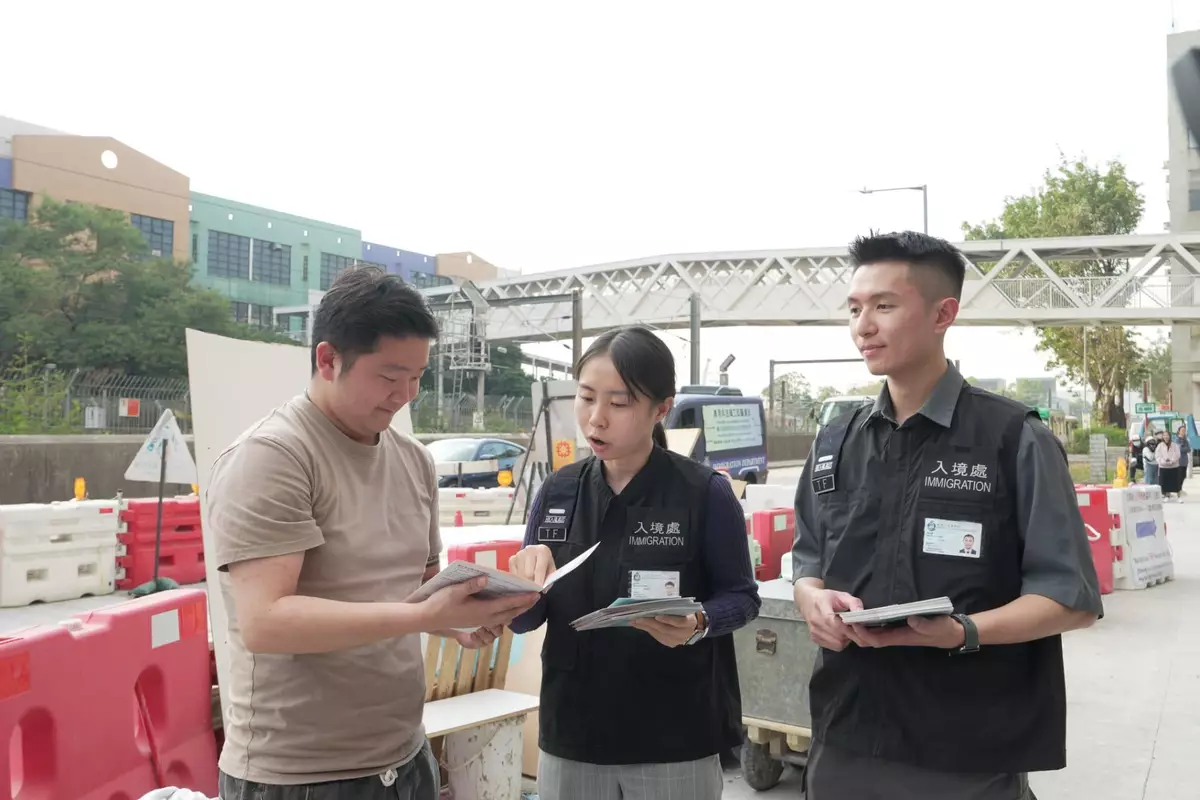
Seven persons arrested during anti-illegal worker operation Source: HKSAR Government Press Releases
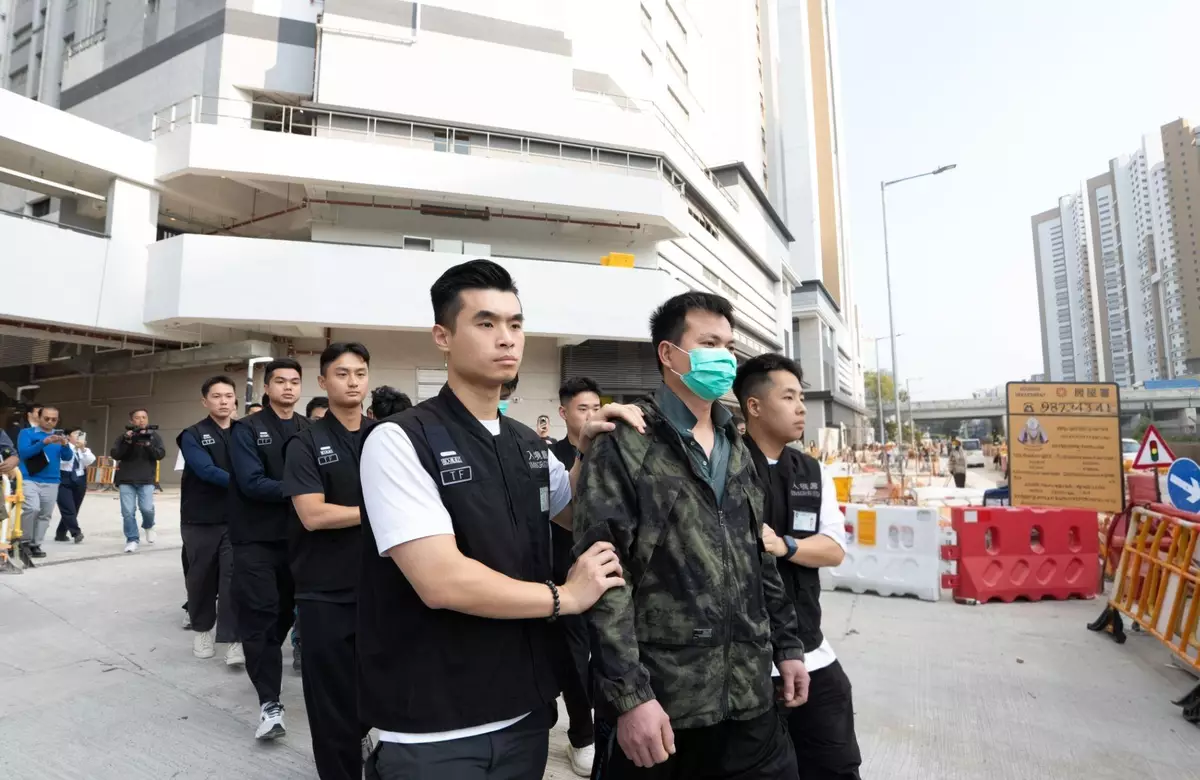
Seven persons arrested during anti-illegal worker operation Source: HKSAR Government Press Releases