Desertification control efforts in north China's Inner Mongolia Autonomous Region have pioneered an innovative approach that combines ecological conservation with economic benefits, bringing greenery to the arid landscape and potentially serving as a replicable model.
Fighting sand takes both grit and flexibility. In Kubuqi Desert, China's seventh-largest desert, the Chinese government has been trying something bold to combat desertification: planting solar panels to restore the arid land.
In many places, solar panels are about cutting carbon. But in Inner Mongolia, they inhibit winds, fix sand, and give the land a second chance to breathe.
The poles stabilize the shifting sand. And the panels above cast shade -- slowing evaporation and giving scarce moisture a better chance to linger.
This is part of a 400-kilometer-long, 5-kilometer-wide ecological barrier built to shield the Yellow River, China's second-longest, from the encroaching Kubuqi Desert. Additionally, its goal is to achieve an installed capacity of 100 million kilowatts and to help treat 200,000 hectares of sandy land.
Desert control comes with trade-offs. That's where the electricity helps. It's not only providing clean energy but also functioning as a vital economic catalyst that sustains the entire ecological restoration effort.
"In the first half of this year, Dalad Banner has generated 360 million kilowatt-hours of green electricity, which translates to a direct reduction of carbon dioxide emissions by 2.772 million tons," said Li Kai, an official with Dalad Banner Energy Bureau.
China's fight against desertification spans decades. On the road to the Mu Us Desert, traces of early efforts remain -- checkerboard windbreaks and green patches sprouted from earlier aerial seeding.
This method has earned China one of the United Nations' highest environmental honors in 2017.
Saihanba Afforestation Community in north China's Hebei Province received the Champions of the Earth award during the UN's Environment Assembly in Nairobi, Kenya, for transforming degraded land into a lush paradise.
The checkboard method has since been adopted by African countries battling severe desertification.
Given the precious nature of underground water resources, their utilization for large-scale ecological restoration presents significant sustainability challenges, thereby raising the critical question of how to effectively rehabilitate desert ecosystems without depleting these vital groundwater reserves.
Accordingly, the exploration continues in China. Instead of irrigation, researchers are placing a new biodegradable hydrogel into the soil. It's designed to retain moisture, allowing plants to survive on rainfall alone.
"Our innovation handles greening and sand control in one go -- way more efficient than old-school methods. It has greatly reduced labor costs," said Wang Xiang, assistant to the president of Xi'an Meinan Biotechnology Co., Ltd.
The hydrogel method is now being scaled up. Demand is rising, especially from desert-prone countries in the Middle East.
"Therefore, I believe our technology is well-suited for global desertification control partners to combat the worsening of desertification worldwide jointly. Currently, many partners and countries have already shown interest in our solution," said Wang.
This year marks 20 years since Chinese President Xi Jinping first proposed the idea that "lucid waters and lush mountains are invaluable assets."
Xi first proposed the "Two Mountains" theory on August. 15, 2005, when he visited Yucun village, Anji county, Huzhou city, east China's Zhejiang Province, while serving as Secretary of the CPC Zhejiang Provincial Committee.
As part of this vision, efforts to combat desertification have become an important part of ecological conservation in this country.
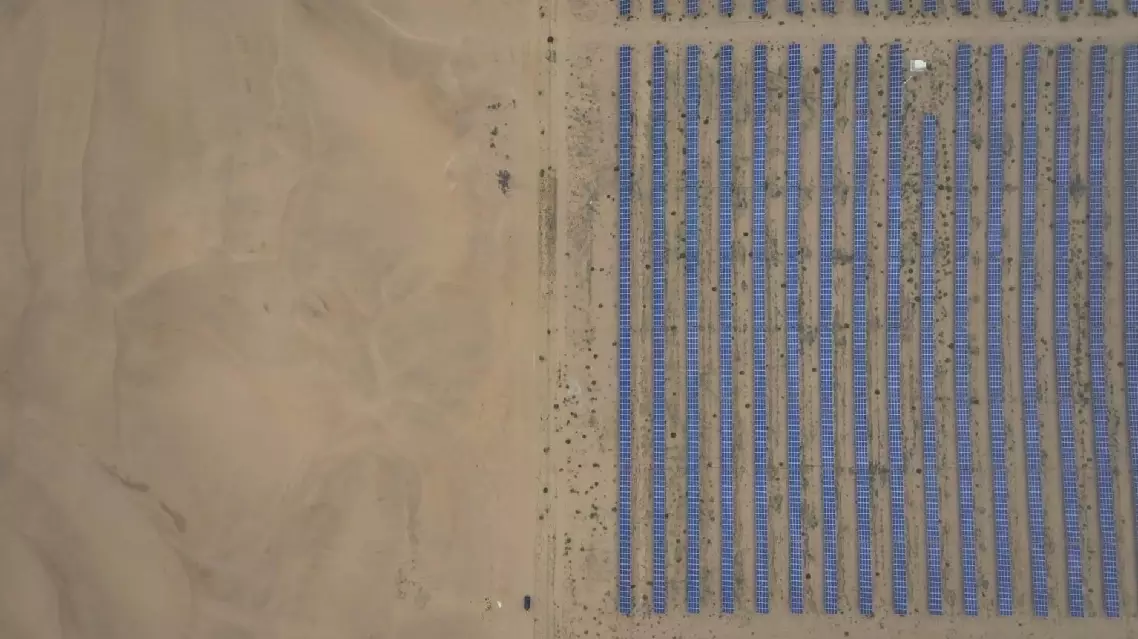
Vegetation returns to Inner Mongolia as China fights desertification with innovative measures