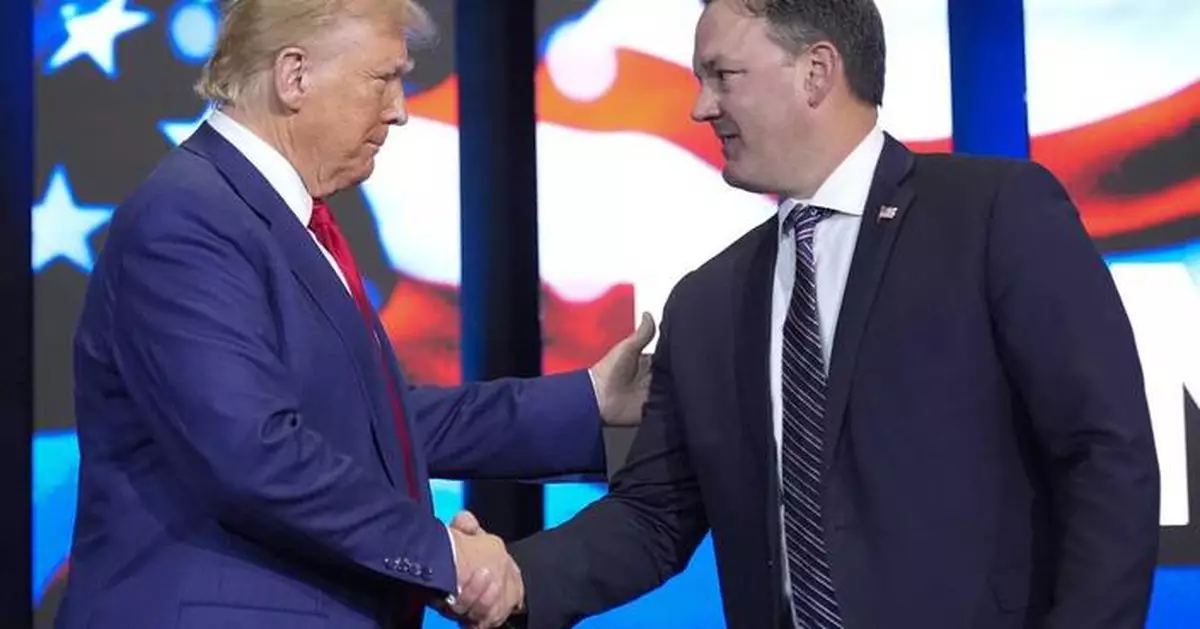
ATLANTA (AP) — President Donald Trump has endorsed Burt Jones' Republican bid for governor in Georgia, a boost to the incumbent lieutenant governor's effort to set himself up as the 2026 frontrunner for the GOP nomination.
Trump announced the nod Monday, noting that Jones was among the first Georgia Republicans to endorse Trump's first bid for the White House in 2016 and saying Jones “worked tirelessly to help us win” in all three of Trump's bids.
“He has been with us from the very beginning,” Trump wrote on social media. “I know his family well and have seen Burt tested at the most difficult levels and times.”
Republicans including Attorney General Chris Carr are vying with Jones to be their party's nominee to succeed Gov. Brian Kemp, who can’t run again because of term limits. Other Republican candidates who could enter the race include Secretary of State Brad Raffensperger.
“We’re fighting for election integrity, lower taxes, and to secure Georgia values — and with Trump’s support, we’re just getting started,” Jones wrote online Monday.
But Carr has argued he is better positioned to win a general election.
Republicans have won every governor’s election since 2002 in Georgia, even as the state has become more competitive. Top Democrats seeking to end GOP dominance include former Atlanta Mayor Keisha Lance Bottoms, state Sen. Jason Esteves, former labor commissioner Michael Thurmond and state Rep. Derrick Jackson.
Any Democratic nominee is likely to try to turn Trump's endorsement of Jones against him.
“For Burt Jones, fealty to extreme, partisan politics has always trumped doing what’s right for Georgia — and that’s why this endorsement shouldn’t surprise anyone,” Democratic Governors Association spokesperson Kevin Donohoe said in a statement.
Jones was one of 16 state Republicans who signed certificates stating that Trump had won Georgia in 2020 and declaring themselves the state’s “duly elected and qualified” electors even though Democrat Joe Biden had been declared the state’s winner. Jones also pushed for a special session in Georgia aimed at overturning Biden’s narrow win in the state. Prosecutors considered criminal charges against Jones but rejected the move, concluding Jones didn't act with criminal intent.
Jones touted that peril as proof he is an authentic supporter of Trump in a speech at the state Republican convention in June in Dalton.
“I’ve been the Trump guy since 2015, not ’16,” Jones said. “I’ve taken all the battle scars and everything else. I know who ran and hid during 2020 and everything else. The circle is small.”
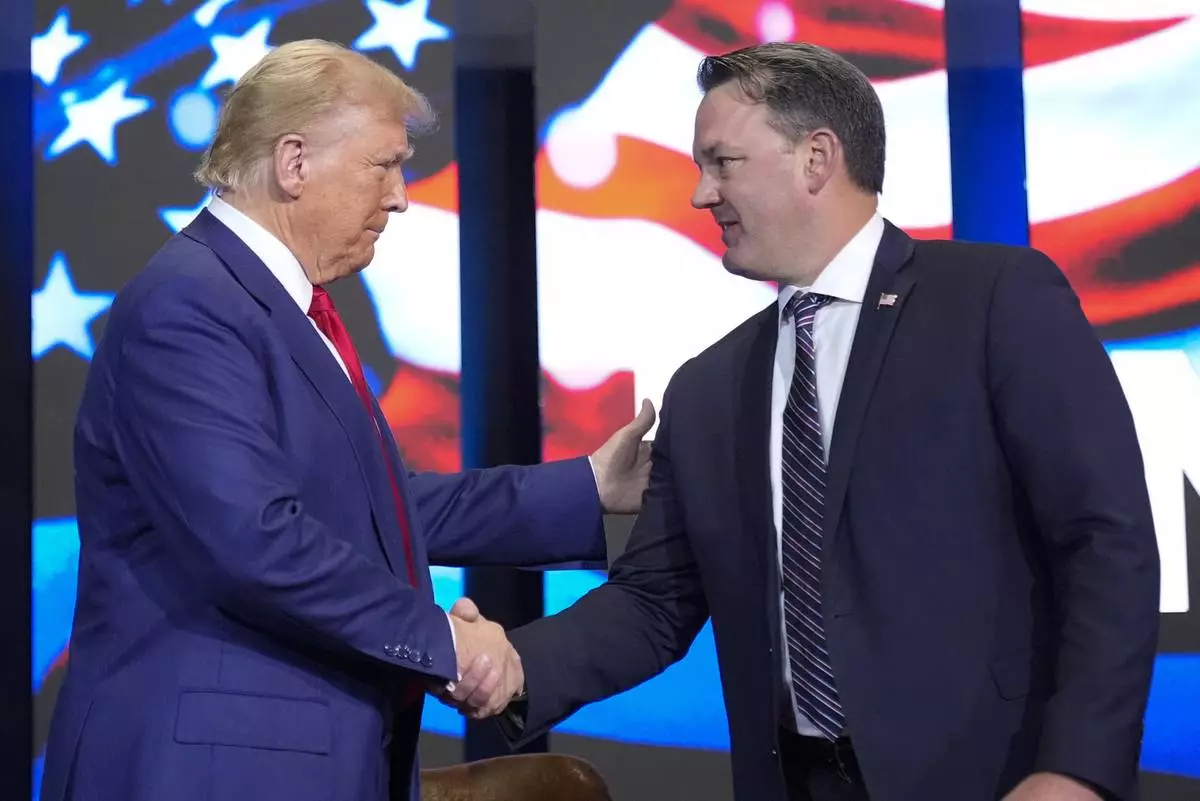
FILE -Republican presidential nominee former President Donald Trump arrives for a faith town hall with Georgia Lt. Gov. Burt Jones at Christ Chapel Zebulon, Oct. 23, 2024, in Zebulon, Ga. (AP Photo/Alex Brandon), File)
LONDON (AP) — With one puff of a cigarette, a woman in Canada became a global symbol of defiance against Iran's bloody crackdown on dissent — and the world saw the flame.
A video that has gone viral in recent days shows the woman — who described herself as an Iranian refugee — snapping open a lighter and setting the flame to a photo she holds. It ignites, illuminating the visage of Ayatollah Ali Khamenei, Iran's highest cleric. Then the woman dips a cigarette into the glow, takes a quick drag — and lets what remains of the image fall to the pavement.
Whether staged or a spontaneous act of defiance — and there’s plenty of debate — the video has become one of the defining images of the protests in Iran against the Islamic Republic’s ailing economy, as U.S. President Donald Trump considers military action in the country again.
The gesture has jumped from the virtual world to the real one, with opponents of the regime lighting cigarettes on photos of the ayatollah from Israel to Germany and Switzerland to the United States.
In the 34 seconds of footage, many across platforms like X, Instagram and Reddit saw one person defy a series of the theocracy’s laws and norms in a riveting act of autonomy. She wears no hijab, three years after the “Women, Life, Freedom” protests against the regime’s required headscarves.
She burns an image of Iran’s supreme leader, a crime in the Islamic republic punishable by death. Her curly hair cascades — yet another transgression in the Iranian government’s eyes. She lights a cigarette from the flame — a gesture considered immodest in Iran.
And in those few seconds, circulated and amplified a million times over, she steps into history.
In 2026, social media is a central battleground for narrative control over conflicts. Protesters in Iran say the unrest is a demonstration against the regime’s strictures and competence. Iran has long cast it as a plot by outsiders like United States and Israel to destabilize the Islamic Republic.
And both sides are racing to tell the story of it that will endure.
Iranian state media announces wave after wave of arrests by authorities, targeting those it calls “terrorists” and also apparently looking for Starlink satellite internet dishes, the only way to get videos and images out to the internet. There was evidence on Thursday that the regime’s bloody crackdown had somewhat smothered the dissent after activists said it had killed at least 2,615 people. That figure dwarfs the death toll from any other round of protest or unrest in Iran in decades and recalls the mayhem of the country’s 1979 Islamic Revolution.
Social media has bloomed with photos of people lighting cigarettes from photos of Iran’s leader. “Smoke ’em if you got ’em. #Iran,” posted Republican U.S. Sen. Tim Sheehy of Montana.
In the age of AI, misinformation and disinformation, there’s abundant reason to question emotionally and politically charged images. So when “the cigarette girl” appeared online this month, plenty of users did just that.
It wasn’t immediately clear, for example, whether she was lighting up inside Iran or somewhere with free-speech protections as a sign of solidarity. Some spotted a background that seemed to be in Canada. She confirmed that in interviews. But did her collar line up correctly? Was the flame realistic? Would a real woman let her hair get so close to the fire?
Many wondered: Is the “cigarette girl” an example of “psyops?” That, too, is unclear. That’s a feature of warfare and statecraft as old as human conflict, in which an image or sound is deliberately disseminated by someone with a stake in the outcome. From the allies’ fake radio broadcasts during World War II to the Cold War’s nuclear missile parades, history is rich with examples.
The U.S. Army doesn’t even hide it. The 4th Psychological Operations Group out of Ft. Bragg in North Carolina last year released a recruitment video called, “Ghost in the Machine 2 that’s peppered with references to “PSYWAR.”And the Gaza war featured a ferocious battle of optics: Hamas forced Israeli hostages to publicly smile and pose before being released, and Israel broadcast their jubilant reunions with family and friends.
Whatever the answer, the symbolism of the Iranian woman's act was powerful enough to rocket around the world on social media — and inspire people at real-life protests to copy it.
The woman did not respond to multiple efforts by The Associated Press to confirm her identity. But she has spoken to other outlets, and AP confirmed the authenticity of those interviews.
On X, she calls herself a “radical feminist” and uses the handle Morticia Addams —- after the exuberantly creepy matriarch of “The Addams Family” — sheerly out of her interest in “spooky things,” the woman said in an interview with the nonprofit outlet The Objective.
She doesn’t allow her real name to be published for safety reasons after what she describes as a harrowing journey from being a dissident in Iran — where she says she was arrested and abused — to safety in Turkey. There, she told The Objective, she obtained a student visa for Canada. Now, in her mid-20s, she said she has refugee status in and lives in Toronto.
It was there, on Jan. 7, that she filmed what’s become known as “the cigarette girl” video a day before the Iranian regime imposed a near-total internet blackout.
“I just wanted to tell my friends that my heart, my soul was with them,” she said in an interview on CNN-News18, a network affiliate in India.
In the interviews, the woman said she was arrested for the first time at 17 during the “bloody November” protests of 2019, demonstrations that erupted after Trump pulled the U.S. out of the nuclear deal that Iran had struck with world powers that imposed crushing sanctions.
“I was strongly opposed to the Islamic regime,” she told The Objective. Security forces “arrested me with tasers and batons. I spent a night in a detention center without my family knowing where I was or what had happened to me.” Her family eventually secured her release by offering a pay slip for bail. “I was under surveillance from that moment on.”
In 2022 during the protests after the death of Mahsa Amini in custody, she said she participated in a YouTube program opposing the mandatory hijab and began receiving calls from blocked numbers threatening her. In 2024, after Iranian President Ebrahim Raisi died in a helicopter crash, she shared her story about it — and was arrested in her home in Isfahan.
The woman said she was questioned and “subjected to severe humiliation and physical abuse.” Then without explanation, she was released on a high bail. She fled to Turkey and began her journey to Canada and, eventually, global notoriety.
“All my family members are still in Iran, and I haven’t heard from them in a few days,” she said in the interview, published Tuesday. “I’m truly worried that the Islamic regime might attack them.”
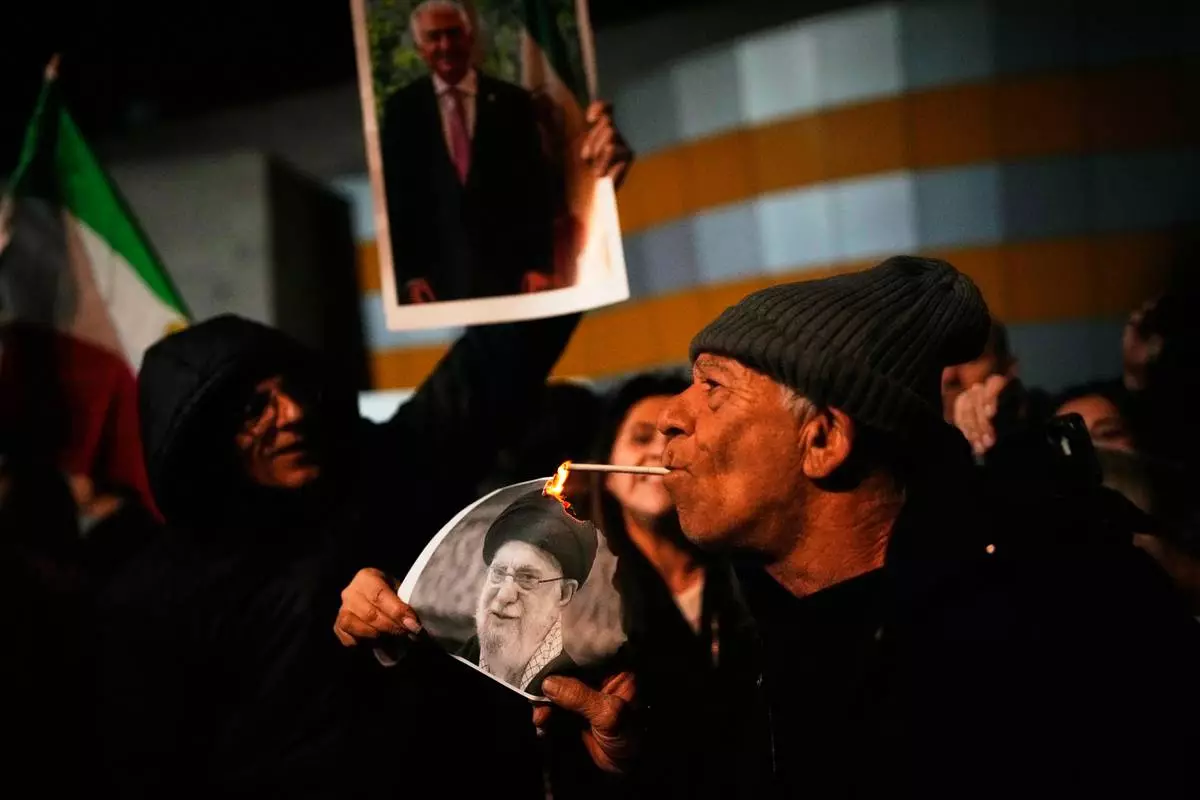
A demonstrator lights a cigarette with a burning poster depicting Supreme Leader Ayatollah Ali Khamenei during a rally in support of Iran's anti-government protests, in Holon, Israel Wednesday, Jan. 14, 2026. (AP Photo/Ohad Zwigenberg)
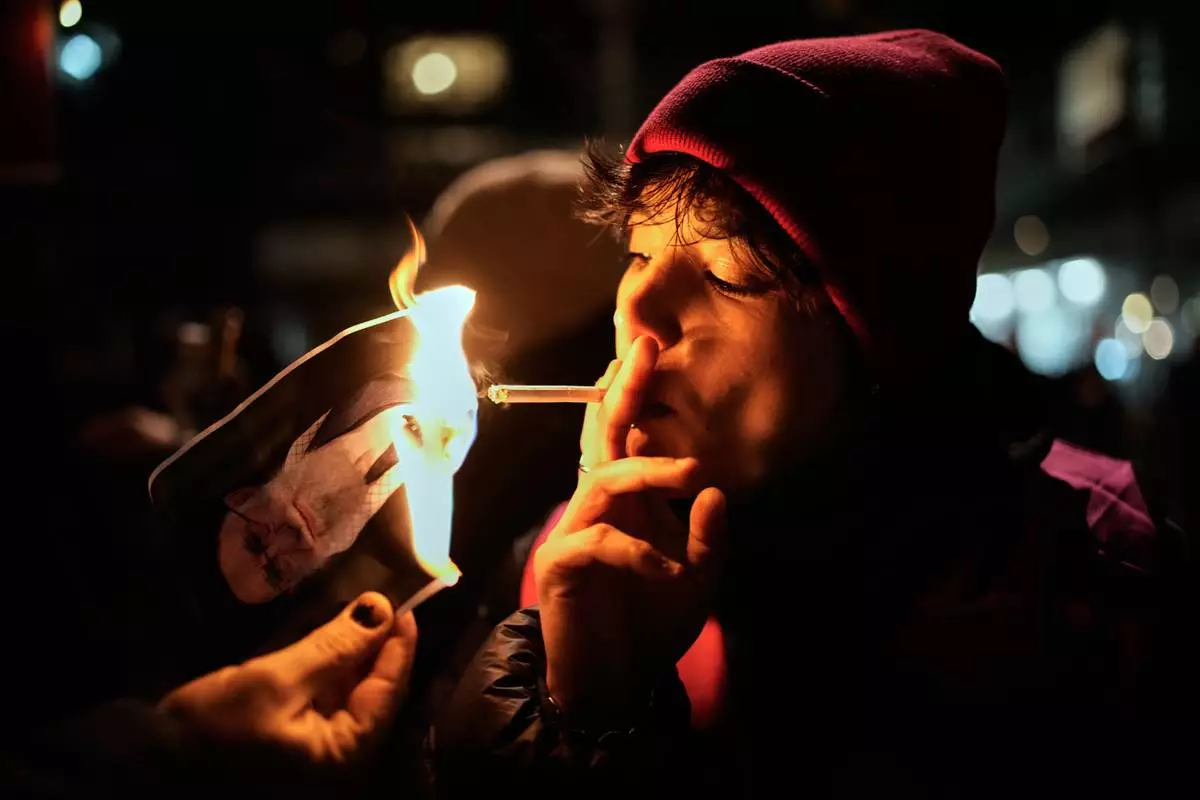
CORRECTS MONTH - A protester lights a cigarette off a burning poster of Iran's Supreme Leader Ayatollah Ali Khamenei during a demonstration in Berlin, Germany, in support of the nationwide mass protests in Iran against the government, Wednesday, Jan. 14, 2026. (AP Photo/Ebrahim Noroozi)
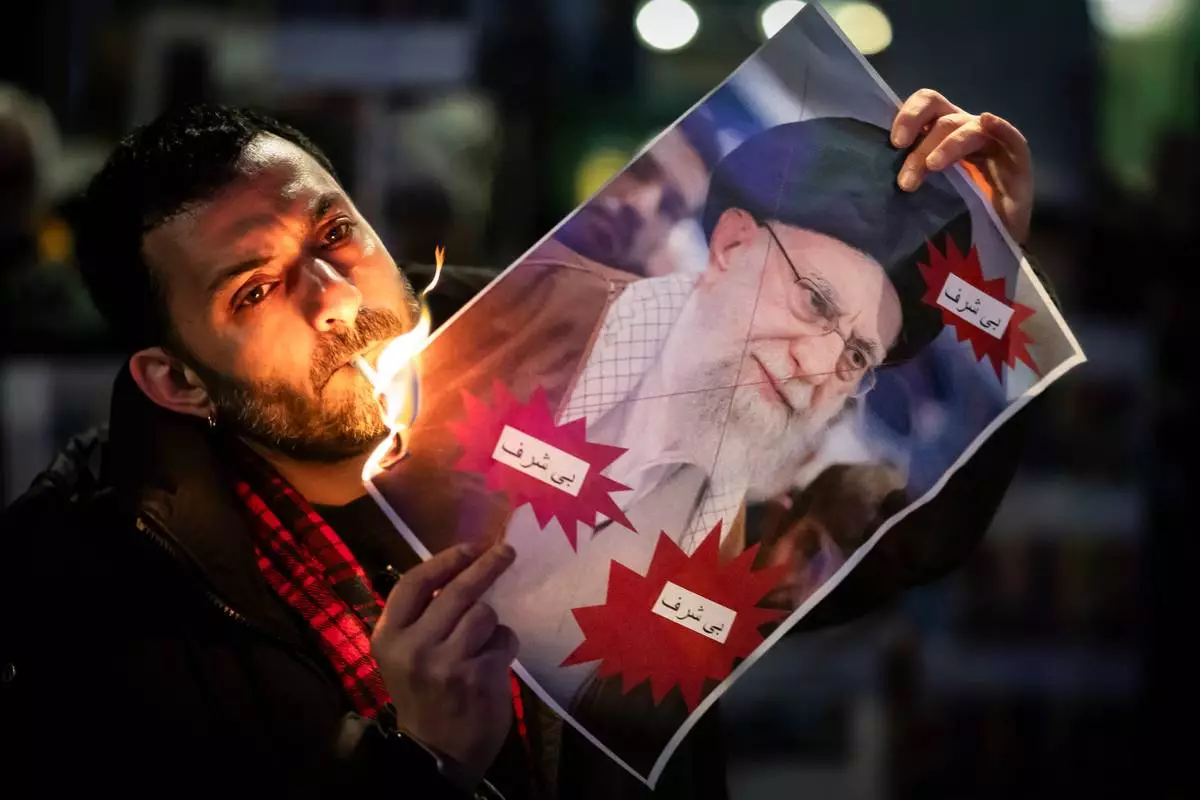
A protester burns an image of the Ayatollah Ali Khamenei with a cigarette during rally in support of the nationwide mass demonstrations in Iran against the government, Tuesday, Jan. 13, 2026 in Zuerich, Switzerland.(Michael Buholzer /Keystone via AP)