The set of the powerful war drama "Dead To Rights," a harrowing cinematic portrayal of the Nanjing Massacre during Japan's invasion of China, has opened to the public, allowing audiences to step back in time and deeply feel the devastation wrought by Japanese aggressors and the immense sacrifices of those who resisted.
Based on a true story, "Dead to Rights" follows two Chinese who risked their lives to preserve photographic evidence of Japanese military atrocities during the Nanjing Massacre, in which over 300,000 people were killed.
In the film, a group of civilians are forced to develop photos for Japanese military photographers in exchange for survival. When they uncover images proving the massacre, they make the perilous decision to smuggle the evidence out.
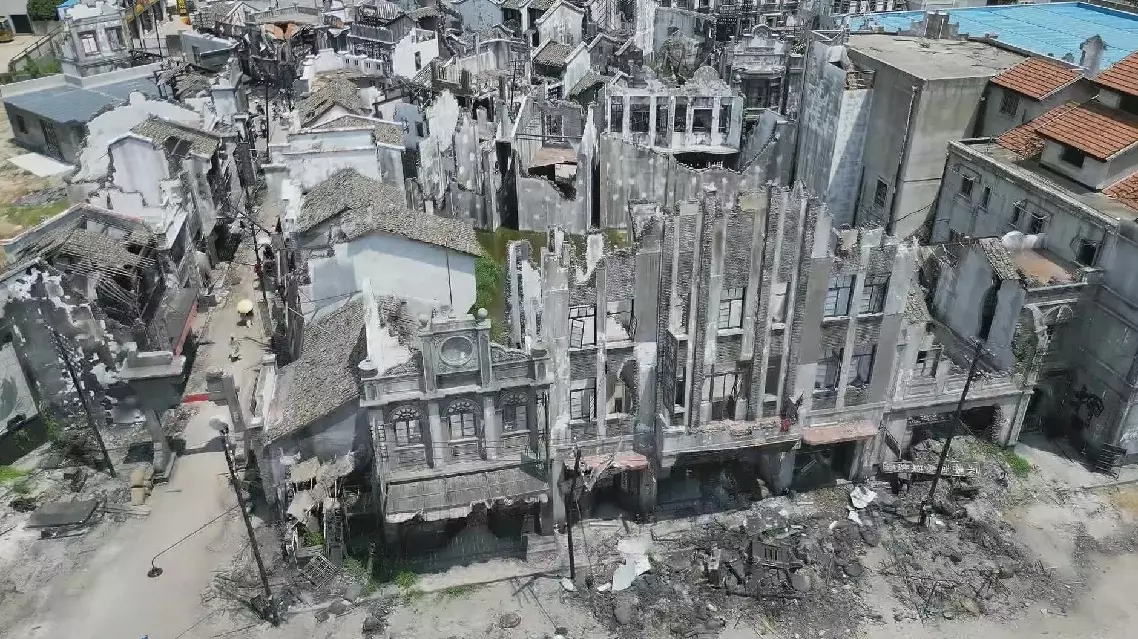
To recreate the historical setting, a team of nearly 500 people spent three months transforming a 25,000-square-meter site into a vivid, immersive replica of wartime Nanjing - turning archival photographs into cinematic reality.
Around 70 percent of the film was shot in the Shanghai Film Park, where visitors can not only walk through the recreated streets of wartime Nanjing, but also watch the film in a theater right on the set, immersing themselves in history like never before.
At the heart of the story is a photo studio. Though destroyed in the movie, the studio has been carefully rebuilt, with every prop and interior detail preserved as it appeared on screen.
"In the film, the owner of the photo studio hides inside a cabinet. I tried it myself, and the space is so cramped. You can feel how terrifying it must have been to peek out through the cracks. It makes me appreciate how hard-won our happiness today really is," said Zheng, a visitor from central China's Henan Province.
A striking 12-meter-high, 112-meter-long section of ruined city wall was built brick by brick, replicating the original Nanjing city wall at full scale.
"I just heard from the staff member there that this is a [duplicate of] a very historical place from the 1930s. So, I feel that [the reason] why they are making such good movies [is] because the setup is already just like that. So, it is interesting to see," said Suleman Shah, a visitor from Pakistan.
"It's definitely more shocking [than reading records]. You walk through the ruins from the bombings, and it's hard to breathe," said Tang, a visitor from Shanghai.
"I saw just this movie in Nanjing. I now come back here and watch all the buildings that the cast of this movie built here in Shanghai. For me, it's very important to see and also remember the war," said Jordan, a visitor from Italy.
The experience is enhanced by a fully functioning cinema seamlessly integrated into the set, allowing visitors to immediately watch the film after touring the recreated scenes.
"Because of the schedule, we visited the set first and are now going to watch the film. I brought my two sons, so they can remember history," said Jin, another visitor from Henan.
According to Lu Xuling, general manager of the Shanghai Film Park, they've also created a large immersive patriotic education project called 'Beneath Nanjing Walls'. Visitors put on costumes, step into the film, and experience the role of a character from the movie or from history, gaining a deeper understanding of the story, and a more profound connection to this part of history.
Movie set of "Dead To Rights" takes audiences back to wartime Nanjing