Erhai Lake in southwest China's Yunnan Province has undergone a dramatic transformation over the past decade, emerging as a symbol of ecological revival and rural prosperity; yet, it was once choked by pollution and foul smells, forcing many lifelong villagers to leave the shores where they were born.
The alpine freshwater lake, sitting at 1,972 meters above sea level and covering 252 square km, is one of the largest plateau lakes in the province.
Known as the "mother lake" by local residents of Dali Bai Autonomous Prefecture, the ear-shaped lake suffered severe degradation from the 1980s due to unchecked development.
According to the villagers of Gusheng, excessive fertilizer use and the direct discharge of untreated domestic sewage were the main culprits.
The stench made living by the shore unbearable and fishing also became a thing of the past, they recalled.
A turning point came in January 2015, when President Xi Jinping, also general secretary of the Communist Party of China (CPC) Central Committee, visited the lake during an inspection tour to the province.
When visiting a village near Erhai Lake, Xi instructed villagers that the environment should not suffer for the sake of economic growth.
He called on residents and the local government to protect this piece of natural beauty, underscoring that it is a "long-term task [and] work is far from over".
"I took a group photo with the Party secretary and governor of Yunnan by Erhai Lake, I told them that I hoped the water would be even clearer when I return for another photo in a few years -- and if not, I would come looking for them," Xi said when speaking to locals during the inspection tour.
Later that year, Dali launched an intensive campaign to restore the lake's ecosystem.
Twenty wastewater treatment plants and over 5,700 kilometers of sewage pipelines were built, creating a basin-wide network for household wastewater collection and treatment.
A 129-km ecological corridor now rings the lake, serving as a green buffer.
Local officials said that public awareness about environment has enhanced significantly.
"The biggest change is that people now see protecting Erhai as their own affairs, something that cannot be compromised," said He Qiaokun, Party secretary of Gusheng Village.
In 2019, China Agricultural University launched a program, known as "science and technology backyards", aiming to study and solve practical problems in the development of agriculture and rural areas, train high-level agricultural talents, and serve rural and agricultural modernization.
In February 2022, the initiative expanded to Gusheng Village, establishing the country's first sci-tech backyard dedicated to curbing agricultural runoff in a lake basin.
"Agriculture has a lot to do with ecology. From Cangshan Mountain to Erhai Lake it's only five kilometers in a straight line. After heavy rains, pollutants can be washed into the lake in a short period. Our challenge is to protect the environment without reducing yields or cutting farmers' incomes. It's a tough nut to crack. Our goal is to cut pollutant inflow by 10 percent," said Jin Kemo, who leads the project from the university.
In May 2023, Xi replied to a letter from students participating in the program.
In his letter, Xi encouraged the students to make greater contributions to rural revitalization. Xi said he was gratified to know that the students went deep into the fields and villages to get to know about people's wellbeing and gain knowledge through serving rural revitalization.
"[The general secretary's letter] was indeed a thumb-up to what we have been doing. It has deepened our sense of mission. We now have 16 such backyards and will keep expanding the program across the basin," Jin said.
Today, all 27 main rivers flowing into Erhai meet top water-quality standards, and the lake's transparency exceeds two meters.
The once-vanished aquatic plant, known locally as sea lettuce flower, has returned.
Moreover, the ecological recovery has also delivered economic benefits.
In 2024, Dali recorded an unprecedented 110 million tourist arrivals from home and abroad.
"When Erhai thrives, so does Dali. Many villagers have run guesthouses and hostels, and great changes have taken place in our living environment. This is the kind of life and surroundings we dreamed of. We feel very happy," said He Qiaokun.
For He Licheng, a resident of Gusheng Village, the responsibility on his shoulders is increasingly heavier.
"We used to only take from Erhai. Now we protect it. The good life we enjoy today is the lake's gift to us. 'Lucid waters and lush mountains are invaluable assets.' We truly understand it now. And we'll keep telling the story of Erhai's protection, better and better," said He.
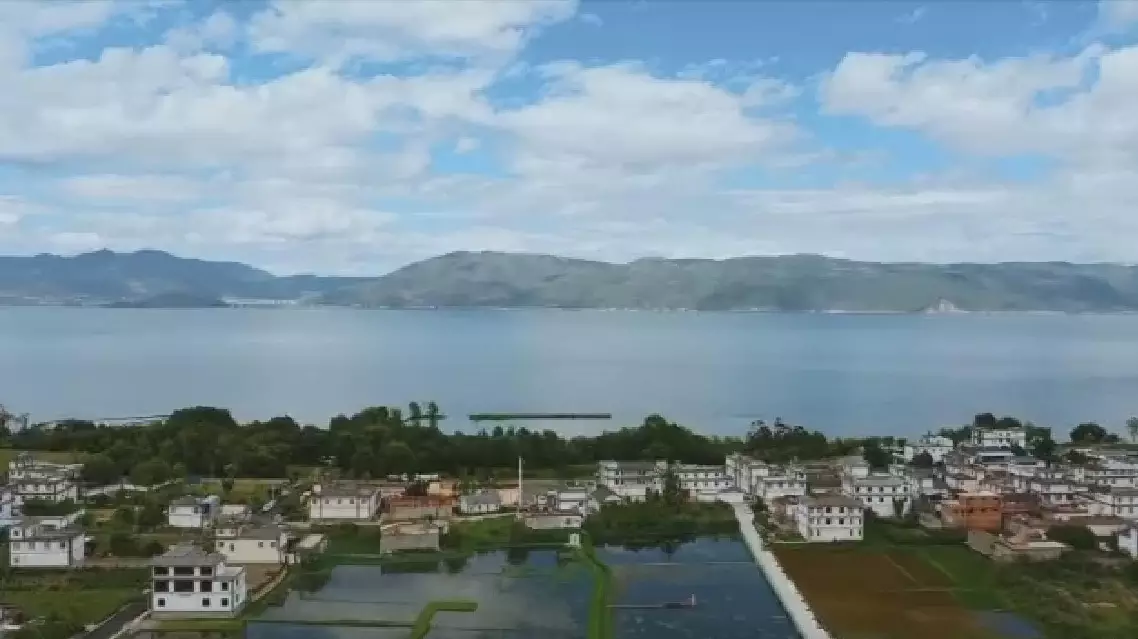
Erhai Lake revives from pollution to prosperity over past decade