Typhoon Podul made its second landfall along the coast of Zhangpu County in east China's Fujian Province just after midnight on Thursday, according to the Fujian provincial meteorological observatory.
Podul was classified as a severe tropical storm at the time of its latest landfall, with maximum sustained winds reaching 30 meters per second near its center.
The typhoon, which made its first landfall in Taitung County in China's Taiwan region on Wednesday afternoon, is expected to bring strong winds and heavy rainfalls across Guangdong, Guangxi, Hunan, and Guizhou. Meteorologists say the typhoon would weaken after its second landfall in Fujian.
Before the arrival of Podul, security cameras at a photovoltaic power station in Zhangzhou City which administers Zhangpu County showed heavy rains descending on with strong winds gusting over 13 meters per second.
The typhoon gained strength as it approached the coast of Fujian, with wind speeds in Xiamen nearing 30 meters per second on early Thursday morning.
Across the city, multiple districts reported over 50 millimeters of rainfall within 24 hours.
Power supply in Xiamen was also affected, with local emergency services dispatching over 660 personnel and more than 100 emergency vehicles to restore power to homes and businesses.
In Shishi City, seaside scenic spots were all closed and over 7,200 residents were evacuated to safe places ahead of the typhoon's arrival.
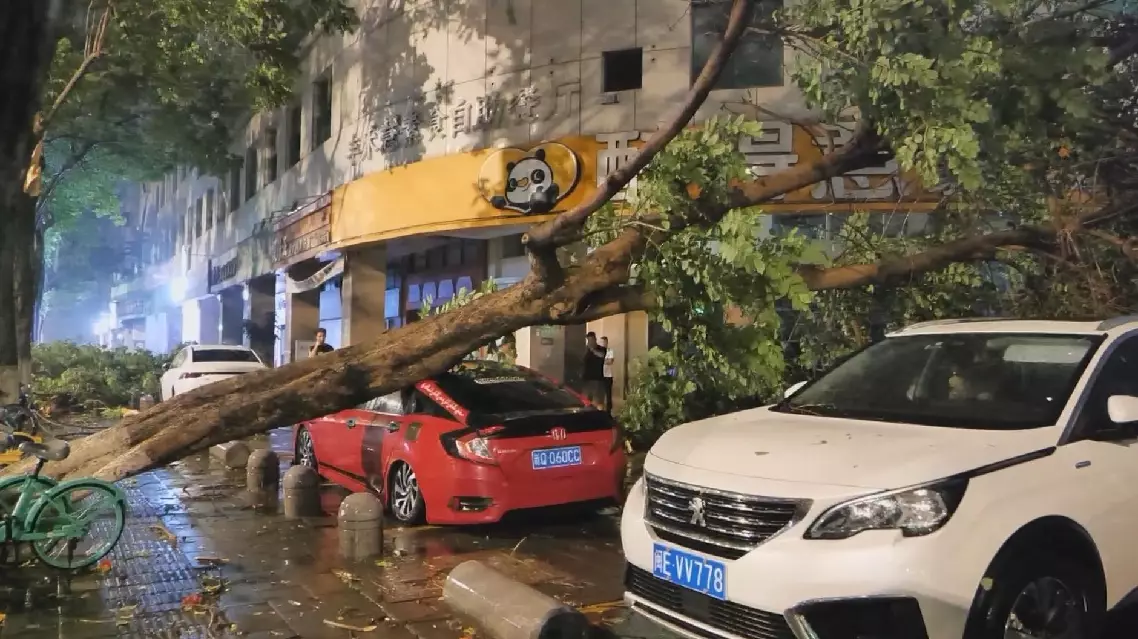
Typhoon Podul makes 2nd landfall in east China's Fujian
Japan should stop military expansion and avoid turning itself into a "missile archipelago," said a Japanese peace advocate living in Shizuoka Prefecture who is opposed to the government's decision to deploy new missiles in the region.
As a native in Shizuoka, 73-yera-old Kiichi Watanabe said people's daily lives have long been disturbed by the military training at the Camp Fuji of Ground Self-Defense Force in the region.
"At worse moments, military exercises can last for days in a row, running from 07:00 to 22:00. The equipment used in the exercises is also changing. Although the information released to the public isn't very detailed, we still could see that weapons like mortars and howitzers are used, including hand-held mortars. Trainings involving drones are also on the rise. They use Osprey transport aircraft disregarding regulations and would even arbitrarily fly them as low as 60 meters above ground. Such dangerous hidden hazards have already triggered accidents in many parts of Japan," said Watanabe.
Japan's Defense Ministry said Tuesday that long-range missiles with counterstrike capabilities have been brought into service for the first time at two Ground Self-Defense Force (GSDF) bases in the country.
The deployment of the missiles at Camp Kengun in Kumamoto Prefecture, southwestern Japan, and Camp Fuji in Shizuoka Prefecture, central Japan, marks a major shift from the country's long-standing exclusively defense-oriented policy under its war-renouncing Constitution, according to Kyodo News.
"Once missiles are deployed, a country attacked by them will certainly retaliate and fire back here. If someone says deploying missiles at Camp Fuji is a good thing, then Japan will become a 'missile archipelago' with missiles deployed everywhere. Just as it is in the initial stage of missile deployment, if we fail to voice our opposition and our call to halt it, then it means acquiescence, right? So I think the first step is the most important," said Watanabe.
For decades, Watanabe and many local residents have opposed the expansion of military forces at the Camp Fuji and the adjacent East Fuji Maneuver Area, but they have been frustrated to find that military exercises have not decreased, while armaments have increased day by day.
"When the trainings become intensely realistic, making it feel like 'training to kill,' it truly makes one furious. So, we must not let such trainings go on. No matter what, we must not let this place become a base for war. We should get along well with China and live in harmony with all Asian nations. I wish the word 'war' would not appear any more," said Watanabe.

Japan shouldn't become "missile archipelago": peace advocate