WASHINGTON (AP) — The left sees President Donald Trump's attempted takeover of Washington law enforcement as part of a multifront march to autocracy — “vindictive authoritarian rule,” as one activist put it — and as an extraordinary thing to do in rather ordinary times on the streets of the capital. To the right, it's a bold move to fracture the crust of Democratic urban bureaucracy and make D.C. a better place to live.
Where that debate settles — if it ever does — may determine whether Washington, a symbol for America in all its granite glory, history, achievement, inequality and dysfunction, becomes a model under the imprint of Trump for how cities are policed, cleaned up and run, or ruined.
Click to Gallery
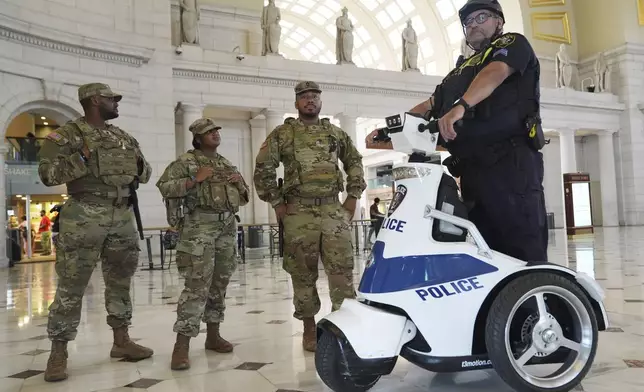
National Guard personnel talk to a member of the Amtrak Police, right, as travelers arrive at Union Station near the Capitol, in Washington, Friday, Aug. 15, 2025, in Washington. (AP Photo/Jacquelyn Martin)
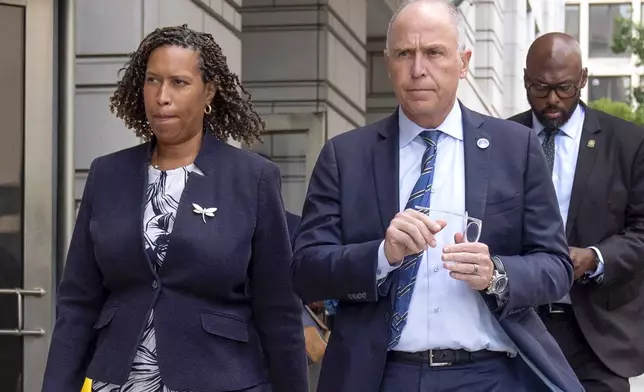
District of Columbia Mayor Muriel Bowser, left, and District of Columbia Attorney General Brian Schwalb walk out of federal court in Washington, Friday, Aug. 15, 2025. (AP Photo/Mark Schiefelbein)
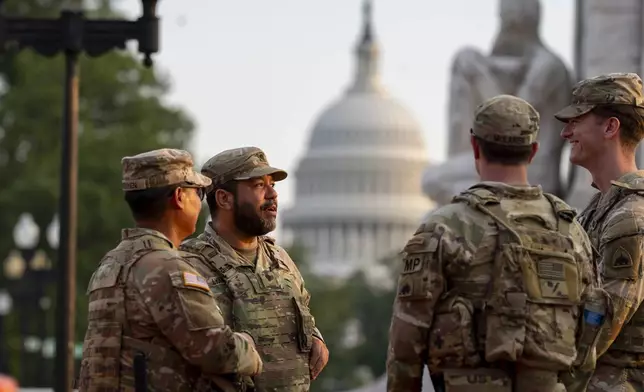
District of Columbia National Guard soldiers stand at Union Station with the U.S. Capitol behind them in Washington, Friday, Aug. 15, 2025, in Washington. (AP Photo/Alex Brandon)
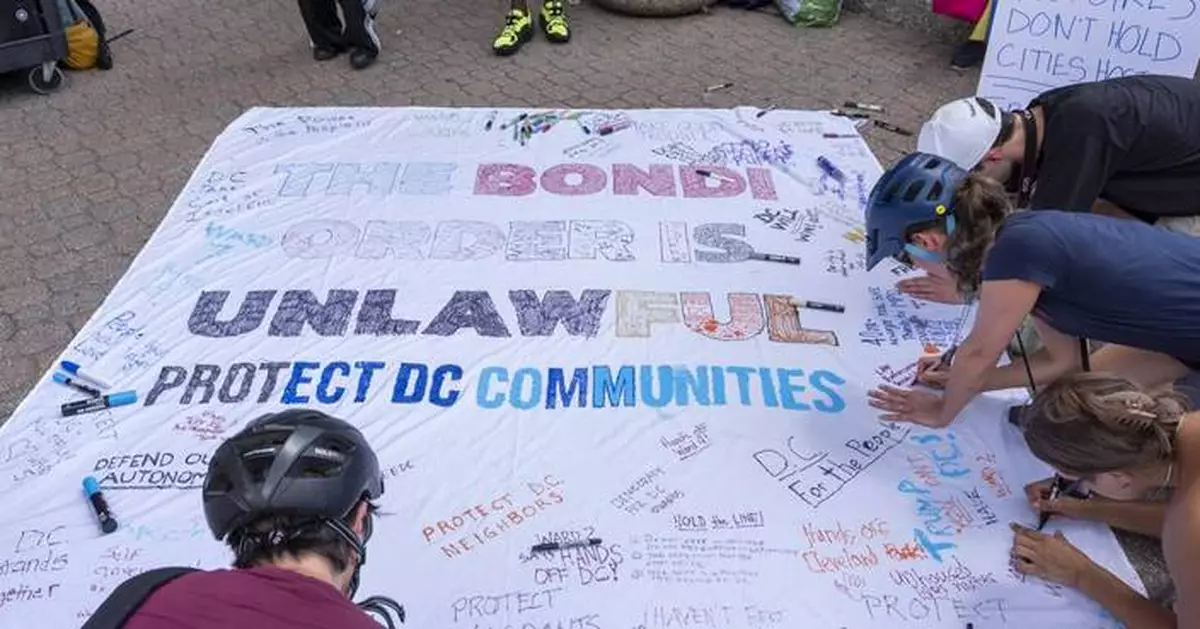
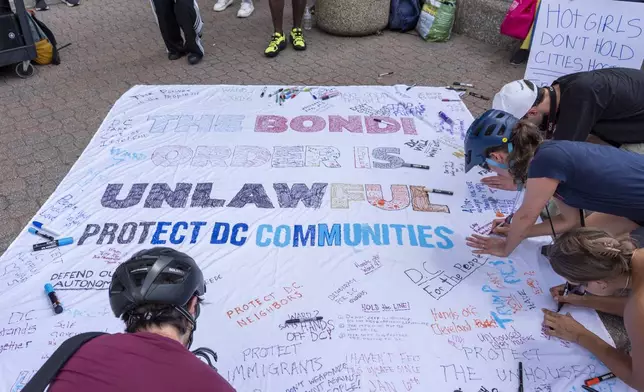
Activists with Free DC work on a banner as they gather outside Washington Metropolitan Police Department headquarters in Washington, Friday, Aug. 15, 2025. (AP Photo/Alex Brandon)
Under the name of his Making D.C. Safe and Beautiful Task Force, Trump put some 800 National Guard troops on Washington streets this past week, declaring at the outset, “Our capital city has been overtaken by violent gangs and bloodthirsty criminals.”
Grunge was also on his mind. “If our capital is dirty, our whole country is dirty, and they don’t respect us.”
He then upped the stakes by declaring federal control of the district’s police department and naming an emergency chief. That set off alarms and prompted local officials to sue to stop the effort. “I have never seen a single government action that would cause a greater threat to law and order than this dangerous directive,” Police Chief Pamela Smith said.
On Friday, the Trump administration partially retreated from its effort to seize control of the Metropolitan Police Department when a judge, skeptical that the president had the authority to do what he tried to do, urged both sides to reach a compromise, which they did — at least for now.
Trump's Justice Department agreed to leave Smith in control, while still intending to instruct her department on law enforcement practices. In a new memo, Attorney General Pam Bondi directed the force to cooperate with federal immigration enforcement regardless of any city law.
In this heavily Democratic city, local officials and many citizens did not like the National Guard deployment. At the same time, they acknowledged the Republican president had the right to order it because of the federal government’s unique powers in the district.
But Trump's attempt to seize formal control of the police department, for the first time since D.C. gained a partial measure of autonomy in the Home Rule Act of 1973, was their red line.
For sure, there have been times when the U.S. military has been deployed to American streets, but almost always in the face of a riot or a calamitous event like the Sept. 11, 2001, terrorist attacks. Trump's use of force was born of an emergency that he saw and city officials — and many others — did not.
A stranger to nuance, Trump has used the language of emergency to justify much of what he's done: his deportations of foreigners, his tariffs, his short-term deployment of National Guard troops to Los Angeles, and now his aggressive intervention into Washington policing.
Washington does have crime and endemic homelessness, like every city in the country. But there was nothing like an urban fire that the masses thought needed to be quelled. Violent crime is down, as it is in many U.S. cities.
Washington is also a city about which most Americans feel ownership — or at least that they have a stake. More than 25 million of them visited in 2024, a record year, plus over 2 million people from abroad. It's where middle schoolers on field trips get to see what they learn about in class — and perhaps to dance to pop tunes with the man with the music player so often in front of the White House.
Washington is part federal theme park, with its historic buildings and museums, and part downtown, where restaurants and lobbyists outnumber any corporate presence. Neighborhoods range from the places where Jeff Bezos set a record for a home purchase price to destitute streets in economically depressed areas that are also magnets for drugs and crime.
In 1968, the capital was a city on fire with riots. Twenty years later, a murder spree and crack epidemic fed the sense of a place out of control. But over the last 30 years, the city’s population and its collective wealth have swelled.
Against that backdrop, Philadelphia’s top prosecutor, District Attorney Larry Krasner, a Democrat, assailed Trump's moves in Washington.
“You’re talking about an emergency, really?” Krasner said, as if speaking with the president. “Or is it that you’re talking about an emergency because you want to pretend everything is an emergency so that you can roll tanks?"
In Washington, a coalition of activists called Not Above the Law denounced what they saw as just the latest step by Trump to seize levers of power he has no business grasping.
“The onslaught of lawlessness and autocratic activities has escalated,” said Lisa Gilbert, co-chair of the group and co-president of Public Citizen. “The last two weeks should have crystallized for all Americans that Donald Trump will not stop until democracy is replaced by vindictive authoritarian rule.”
Fifty miles northeast, in the nearest major city, Baltimore's Democratic mayor criticized what he saw as Trump's effort to distract the public from economic pain and “America’s falling standing in the world.”
“Every mayor and police chief in America works with our local federal agents to do great work — to go after gun traffickers, to go after violent organizations,” Brandon Scott said. “How is taking them off of that job, sending them out to just patrol the street, making our country safer?”
But the leader of the D.C. Police Union, Gregg Pemberton, endorsed Trump's intervention — while saying it should not become permanent.
“We stand with the president in recognizing that Washington, D.C., cannot continue on this trajectory,” Pemberton said. From his vantage point, “Crime is out of control, and our officers are stretched beyond their limits.”
The Home Rule Act lets a president invoke certain emergency powers over the police department for 30 days, after which Congress must decide whether to extend the period. Trump's attempt to use that provision stirred interest among some Republicans in Congress in giving him an even freer hand.
Among them, Rep. Andy Ogles of Tennessee drafted a resolution that would eliminate the time limit on federal control. This, he told Fox News Digital, would “give the president all the time and authority he needs to crush lawlessness, restore order, and reclaim our capital once and for all.”
Which raises a question that Trump has robustly hinted at and others are wondering, too: If there is success in the district — at least, success in the president's eyes — what might that mean for other American cities he thinks need to be fixed? Where does — where could — the federal government go next?
Associated Press writer Marc Levy in Harrisburg, Pennsylvania, contributed to this report.
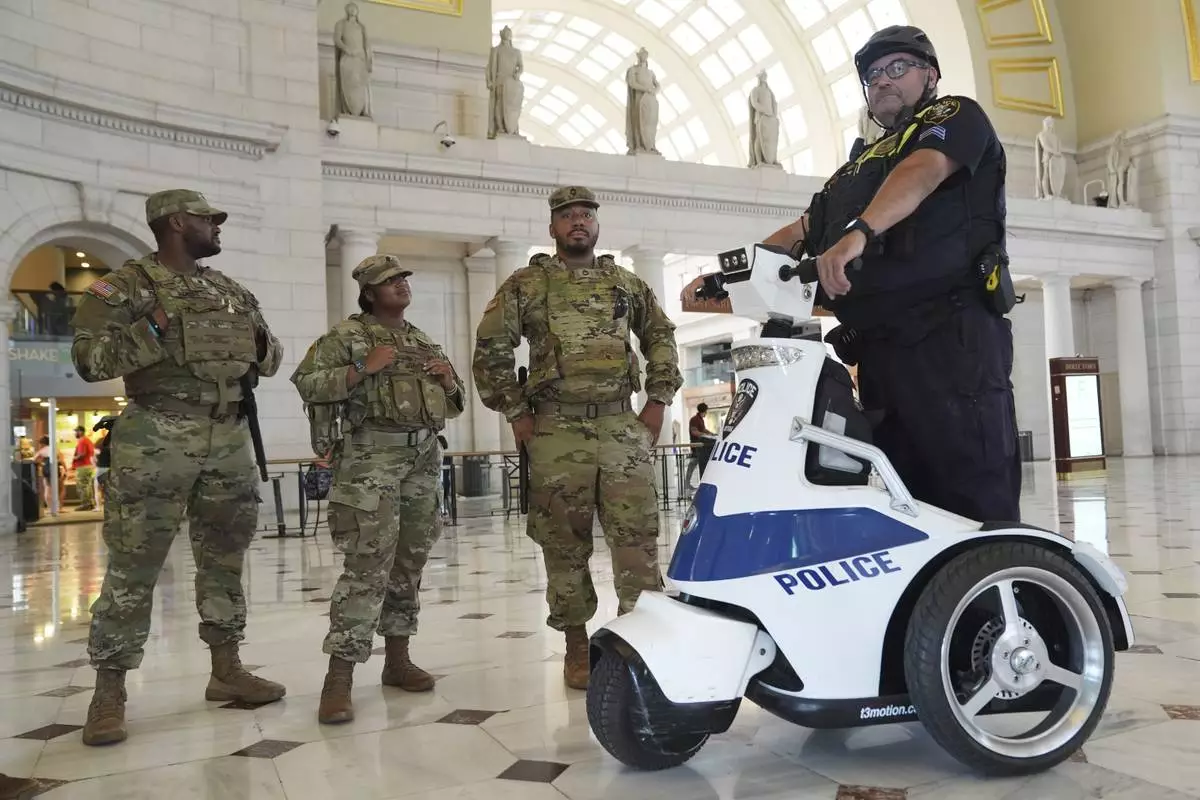
National Guard personnel talk to a member of the Amtrak Police, right, as travelers arrive at Union Station near the Capitol, in Washington, Friday, Aug. 15, 2025, in Washington. (AP Photo/Jacquelyn Martin)
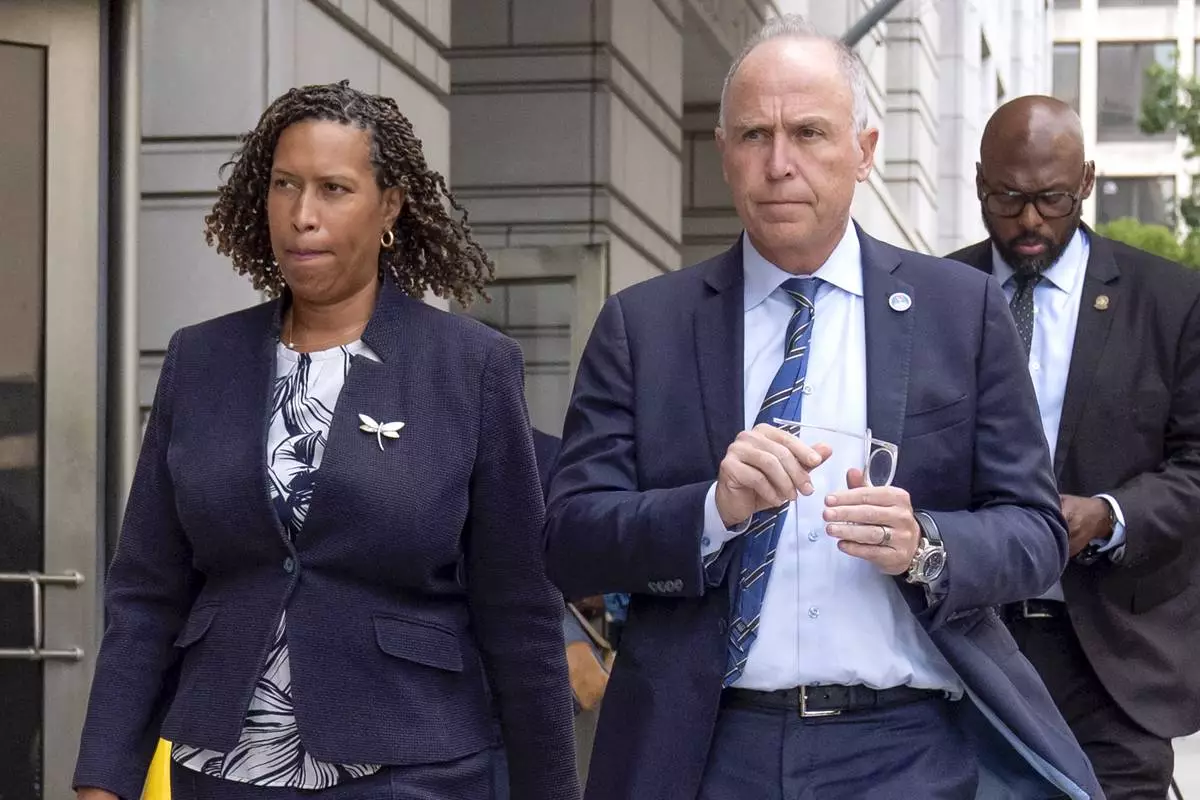
District of Columbia Mayor Muriel Bowser, left, and District of Columbia Attorney General Brian Schwalb walk out of federal court in Washington, Friday, Aug. 15, 2025. (AP Photo/Mark Schiefelbein)
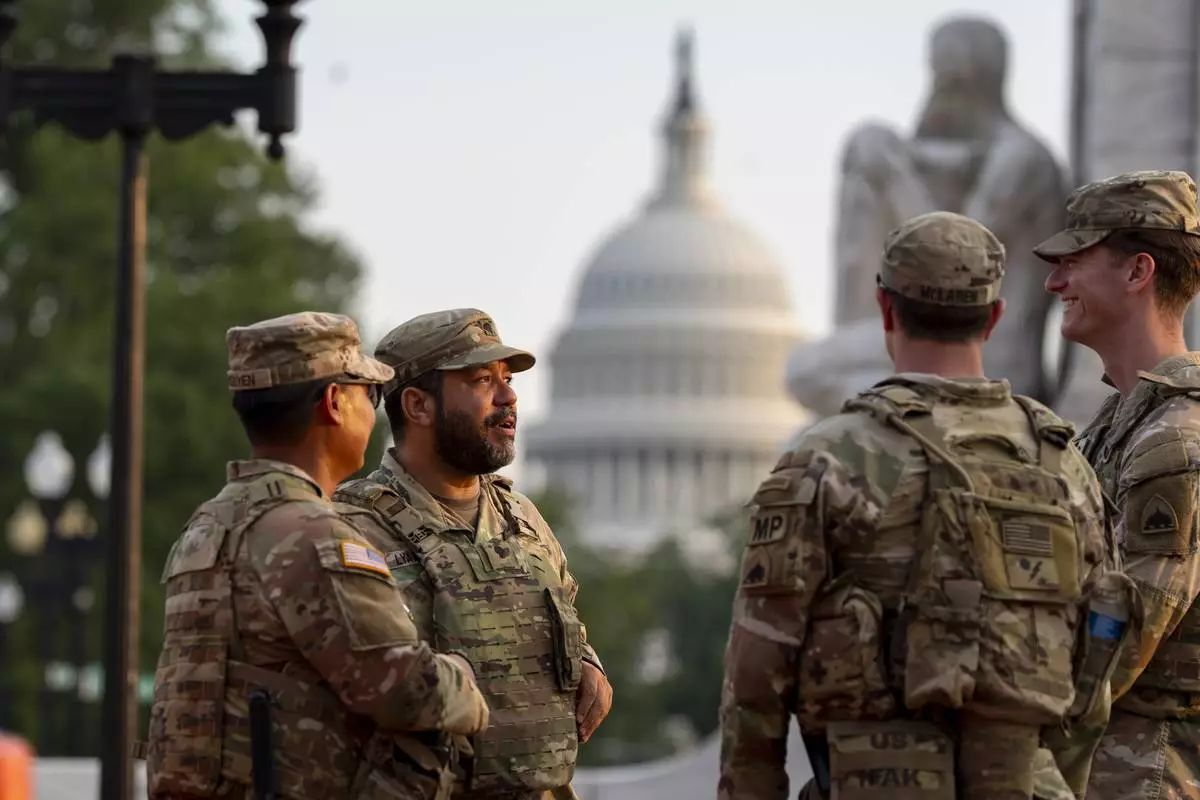
District of Columbia National Guard soldiers stand at Union Station with the U.S. Capitol behind them in Washington, Friday, Aug. 15, 2025, in Washington. (AP Photo/Alex Brandon)
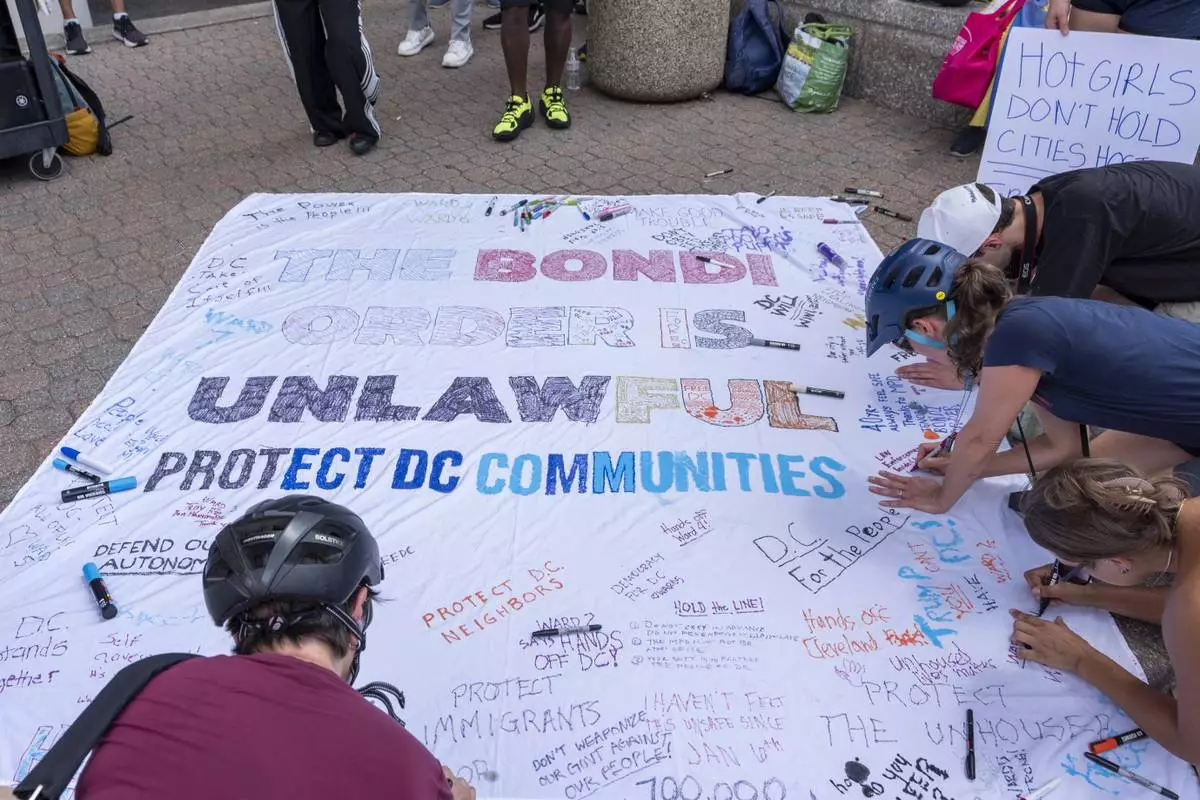
Activists with Free DC work on a banner as they gather outside Washington Metropolitan Police Department headquarters in Washington, Friday, Aug. 15, 2025. (AP Photo/Alex Brandon)
U.S. President Donald Trump said Wednesday that he’s been told “on good authority” that plans for executions in Iran have stopped, even as Tehran has signaled fast trials and executions ahead in its crackdown on protesters.
The U.S. president’s claims, which were made with few details, come as he’s told protesting Iranians in recent days that “help is on the way” and that his administration would “act accordingly” to respond to the Iranian government.
But Trump has not offered any details about how the U.S. might respond and it wasn’t clear if his comments Wednesday indicated he would hold off on action. Earlier Wednesday, Gholamhossein Mohseni-Ejei, Iran’s judiciary chief, said the government must act quickly to punish more than 18,000 people who have been detained through rapid trials and executions.
The security force crackdown on the demonstrations has killed at least 2,586, the U.S.-based Human Rights Activists News Agency reported. The death toll exceeds that of any other round of protest or unrest in Iran in decades and recalls the chaos surrounding the country’s 1979 Islamic Revolution.
Here is the latest:
Iran issued an order early Thursday to close its airspace, without explanation.
The order came amid heightened tensions over its bloody crackdown on protesters during nationwide protests and the possibility of American strikes in response.
The flight-tracking website FlightRadar24.com noted the order closed Iran’s airspace for a little more than two hours.
Iranian Foreign Minister Abbas Araghchi said in an interview with Fox News Channel’s “Special Report” that Iran is “ready for negotiation” and has been for the past 20 years. He urged the U.S. to find a solution through negotiation, and said “diplomacy is much better than war.”
Araghchi blamed terrorist groups for the violence as part of an “Israeli plot” to “drag (Trump) into the conflict.”
Britain has shut its embassy in Iran and withdrawn its diplomats as tensions spiral over security forces’ lethal crackdown on protests and speculation about U.S. action in response.
The U.K. Foreign Office said Wednesday that “we have temporarily closed the British Embassy in Tehran, this will now operate remotely.”
It said British staff have been withdrawn “due to the security situation.”
The government had already advised British citizens against traveling to Iran.
In a letter obtained by The Associated Press on Wednesday, Iranian Foreign Minister Abbas Araghchi called for the top U.N. official to condemn and reject “all acts of terrorism during the unrests regardless of the incentives.”
Araghchi reiterated Iranian officials’ claims, without providing evidence, that the U.S. and Israel have been directly involved in the escalation of recent nationwide protests in Iran that have killed more than 2,500 Iranians.
“Peaceful protests started from Dec. 28, 2025 on economic grounds were sabotaged by terrorist elements who turned them into armed riots,” he wrote to U.N. Secretary-General António Guterres.
A mass funeral was held in Tehran for some 100 security force members killed in the demonstrations. Tens of thousands of mourners attended, holding Iranian flags and photos of Ayatollah Ali Khamenei.
The caskets, draped in Iranian flags, stood stacked at least three high. Red and white roses and framed photographs of the dead covered them.
“We are very frightened because of these sounds (of gunfire) and protests,” said a mother of two shopping for fruits and vegetables, who spoke on condition of anonymity for fear of reprisals.
“We have heard many are killed and many are injured. Now peace has been restored, but schools are closed, and I’m scared to send my children to school again.”
Ahmadreza Tavakoli, 36, told The Associated Press he witnessed one demonstration in Tehran and was shocked by the use of firearms by authorities.
“People were out to express themselves and protest, but quickly it turned into a war zone,” Tavakoli said. “The people do not have guns. Only the security forces have guns.”
At a protest march of 900 Iranian exiles and German supporters in Berlin on Wednesday night, Maryam Nejatipur, 32, told The Associated Press how unbearably worried she was about her family back home.
“They’re in a complete blackout. We don’t have any news,” said the former teacher who was forced to leave her home country about two years ago.
She said she didn’t know how to get through the days since Iran shut down the internet and phones and she could not longer find out if her family was still alive.
She sobbed and said really she was not only worried about her immediate family but all Iranians. “There are 90 million people inside Iran and they are killing all of them,” she said.
U.S. envoy Steve Witkoff has met with exiled former crown prince of Iran Reza Pahlavi, a White House official confirmed on Wednesday, speaking on condition of anonymity about the private meeting. The official provided no further details.
Italy’s Foreign Minister Antonio Tajani has been meeting on Wednesday evening with officials from the Italian Ministry of Defense, the Italian Ambassador to Tehran and ambassadors from the main capitals involved in the current crisis in Iran.
The ministry reiterated its recommendation that Italian citizens should leave Iran if they are able to do so, a statement said.
Mohammad Pakpour, commander of Iran’s paramilitary Revolutionary Guard, threatened Wednesday that the country would give a “decisive response” to the death of Iranian “martyrs and security protectors,” according to Iran’s semiofficial Tasnim news agency.
Pakpour reiterated Iranian officials’ claims that U.S. and Israel have instigated these protests and that they are the “main killers” of the hundreds of casualties. He added that those countries will “receive the response in the appropriate time.”
Pakistan’s Prime Minister Shehbaz Sharif said in a call Wednesday with Qatar’s Emir Sheikh Tamim bin Hamad al-Thani that Pakistan would continue to play a positive role in maintaining regional peace and stability, a statement from Sharif’s office said.
The two leaders discussed recent developments in the Middle East and expressed satisfaction with the current trajectory of bilateral relations between Pakistan and Qatar, according to the statement.
Sharif praised Qatar’s role in promoting peace, dialogue and mediation in the region and acknowledged its efforts to defuse tensions through diplomatic means.
Both leaders agreed to remain in close contact in the coming days, the statement said.
Scores gathered on Wednesday in a show of support for the ongoing anti-government protests in Iran.
Some held posters of Iran’s exiled crown prince Reza Pahlavi and others of U.S. President Donald Trump. One placard read: “President Trump! Iranian people deserve freedom … Hear their voice.”
“We are here to be the voice of the Iranian people against the Islamic regime in Iran,” Esi Fallah told The Associated Press. “We are here to ask President Trump for help ... The regime in Iran fires at its people.”
Fallah added that he has not been able to contact his family in Iran due to the internet blackout. “We don’t know anything about them since Friday,” he said.
Another protester, Mahzad, who only gave his first name, said: “For five days, I have no news from my family or my friends. I don't know if they are still alive."
“U.S. citizens should leave Iran now. Consider departing Iran by land to Türkiye or Armenia, if safe to do so,” the virtual U.S. embassy in Tehran said in a statement Wednesday.
This is the third alert in five days.
The embassy also said U.S.-Iranian dual nationals must exit Iran using their Iranian passports.
Some personnel at Qatar’s Al Udeid Air Base have been advised to evacuate by Wednesday evening, a U.S. official said. The decision came as a senior official in Iran brought up an earlier Iranian attack there.
The official, who spoke to The Associated Press on Wednesday on the condition of anonymity to discuss sensitive plans, described the move at the base as a precautionary measure. The official wouldn’t go into any further details about the move, including whether the evacuation was optional or mandatory, if it affected troops or civilian personnel, or the number of those advised to leave, citing the need for operational security.
It comes as anti-government protests in nearby Iran continue and U.S. President Donald Trump has said that he is willing to conduct military operations in the country if the government continues to retaliate against the protesters.
SpaceX’s Starlink satellite internet service dropped its fees to allow protesters in Iran to send updates of what is happening inside the Islamic Republic following a communication blackout by authorities.
Elon Musk’s SpaceX has not officially announced the decision and did not respond to a request for comment, but activists told The Associated Press that Starlink has been available for free to anyone in Iran with the receivers since Tuesday.
“Starlink has been crucial,” said Mehdi Yahyanejad, an Iranian whose nonprofit Net Freedom Pioneers has helped smuggle units into Iran, pointing to footage that emerged Sunday showing rows of bodies at a forensic medical center near Tehran.
Starlink is banned in Iran.
Tens of thousands of mourners thronged the streets near Tehran University for a mass funeral of security forces and civilians on Wednesday.
After Iranian state television reported that 300 coffins would be on display at Tehran University, Associated Press reporters there saw around 100. It wasn’t clear why there was a discrepancy.
Many held Iranian flags and identical photos of Ayatollah Ali Khamenei and their relatives. The caskets, covered in Iranian flags, were stacked at least three high in the backs of trucks and covered with red and white roses and framed photographs of people who were killed. The crowd chanted and beat their chests in response to an emcee speaking from a stage.
One man in the crowd held up a photo of U.S. President Donald Trump during the Pennsylvania assassination attempt, emblazoned with: “The arrow doesn’t always miss!”
The presenter, his voice booming across the crowd, blamed the U.S. for the unrest. “All of our problems are because of America, today’s economic problems are because of American sanctions. Death to America!” he yelled, prompting the same chant from the tens of thousands of people, dressed mostly in black.
India's Embassy in Tehran urged Wednesday all Indian nationals to leave Iran, citing what it called an “evolving situation” in the Islamic Republic.
The statement, posted on X, also advised Indian citizens to remain highly vigilant and avoid areas where protests are taking place.
German police said Wednesday the two climbed over a fence into embassy grounds and tore down an Iranian flag. Both wanted to hoist two pre-Islamic Republic flags but failed, German news agency dpa reported.
They left the grounds when guards used pepper spray and were detained on the sidewalk outside.
The incident happened late Tuesday.
Major Middle East governments were discouraging the Trump administration from waging a war with Iran, fearing “unprecedented consequences” in the volatile region, an Arab Gulf diplomat said Wednesday.
The Cairo-based diplomat, who was given anonymity because he wasn't authorized to speak to the media, said major governments in the region, including Turkey, Egypt, Saudi Arabia and Pakistan, have been “in constant contact” with the U.S. administration over a potential American strike on Iran that could explode into a “full-blown war.”
Such a war will “certainly” have dire repercussions “not only on the Middle East but also on the global economy," he said.
Iranian state television said Wednesday’s mass funeral in Tehran would include 300 bodies of security force members and civilians. The funeral is expected to take place at Tehran University under heavy security.
The U.S.-based Human Rights Activists News Agency said 2,417 of the dead were protesters and 147 were government-affiliated. Twelve children were killed, along with 10 civilians it said were not taking part in protests. More than 18,400 people have been detained, the group said.
Gauging the demonstrations and the death toll from abroad has grown more difficult. The Associated Press has been unable to independently assess the toll, given the communications being disrupted in the country.
Melanie Lidman contributed from Jerusalem.
Trump’s decision to impose a 25% tariff on countries that trade with Iran could impact India, an expert said, as New Delhi already faces existing 50% U.S. trade levies due to its purchases of Russian oil.
Abhijit Mukhopadhyay, a senior economist at the Chintan Research Foundation in New Delhi, said the bigger risk is not India-Iran trade, but India’s access to the U.S. market, as its exports to Iran are modest.
India mainly exports rice, tea, sugar, pharmaceuticals and electrical machinery to Iran, while importing dry fruits and chemical products. Textiles and garments, gems and jewelry and engineering goods are likely to be the most vulnerable sectors, he said.
Trump’s latest move also could affect India’s investments in Iran, including the strategically important Chabahar port, which gives India a trade route to Afghanistan, Central Asia and Europe while bypassing Pakistan, Mukhopadhyay said.
Iran’s judiciary chief signals fast trials and executions for those detained in nationwide protests.
Gholamhossein Mohseni-Ejei made the comment in a video shared by Iranian state television on Wednesday.
He emphasized the need for swift action, saying delays would lessen the impact.
His remarks challenge Trump, who warned Iran about executions in an interview aired Tuesday.
Trump stated the U.S. would take strong action if Iran proceeded with executions. The situation highlights escalating tensions between the two countries over the handling of the protests.
Dozens of Pakistani students studying in Iran have returned home through a remote southwestern border crossing, a Pakistani immigration official said Wednesday.
Federal Investigation Agency spokesperson in Quetta city, Samina Raisani, said about 60 students crossed into Pakistan on Tuesday through Gabd border in Balochistan province with valid travel documents.
More students were expected to return through the same crossing later Wednesday, she said.
Mudassir Tipu, Pakistan’s ambassador to Iran, said Tuesday that Iranian universities had rescheduled exams and permitted international students to leave the country.
The satellite internet provider Starlink now offers free service to people in Iran who have access to the company's receivers, activists said Wednesday.
Mehdi Yahyanejad, a Los Angeles-based activist who helped get the units into Iran, told The Associated Press that the free service had started. Other activists also confirmed in messages online that the service was free.
Starlink has been the only way for Iranians to communicate with the outside world since authorities shut down the internet Thursday night as nationwide protests swelled and they began a bloody crackdown against demonstrators.
Starlink did not immediately acknowledge the decision.

This frame grab from videos taken between Jan. 9 and Jan. 11, 2026, and circulating on social media purportedly shows images from a morgue with dozens of bodies and mourners after crackdown on the outskirts of Iran's capital, in Kahrizak, Tehran Province. (UGC via AP)