The Battle of Cheqiao in 1944, waged by the New Fourth Army in Cheqiao Town, east China's Zhejiang Province, is commemorated as the pivotal turning point in the Central China battlefield by shifting from guerrilla warfare in the backstage to strategic counteroffensives during China's War of Resistance Against Japanese Aggression.
In 1944, Italy surrendered, German forces were in retreat, and Japan was losing ground in the Pacific. In China's backstage battlefield, hope for a counteroffensive was ignited as troop morale surged and combat capabilities markedly improved. However, disjointed fronts, blockaded routes, and the lack of a secure hinterland continued to severely restrict operations.
With the slogan "This year, destroy Hitler; next year, defeat the Japanese" resonating across China, the Central Jiangsu battlefield resolved to launch a strategic counterattack.
After meticulous deliberation to identify the enemy's weak points and explore the possibility of breaking the blockade to establish deeper bases, the New Fourth Army focused its attention on Cheqiao Town, southeast of Huai'an City.
"Cheqiao seemed tightly controlled by the enemy, but it was actually a weak spot. It was right between two Japanese divisions -- though deep in enemy territory, coordination between their defense sectors was poor and there were many gaps. If we took Cheqiao, it would tear a hole in their entire defense line, linking up the Central Jiangsu base areas," said Yu Zhaowen, chairman of the Huai'an Writers Association and author of "Cheqiao, Cheqiao," a book about the battle of Cheqiao.
Cheqiao was garrisoned by over 80 Japanese troops and more than 600 puppet soldiers, with 53 bunkers and defensive installations -- a key enemy stronghold.
Su Yu, then commander of the New Fourth Army's First Division, decided to personally lead a surprise strike deep into enemy territory. He understood that victory required a synchronized assault on the stronghold and interception of enemy reinforcements.
"We never moved without maps. I carried them on my back and followed Su Yu closely. He knew the terrain well -- often scouting personally. The battle plan for Cheqiao was calculated step by step by him," said Qin Shujin, former mapping officer of the New Fourth Army's First Division, in an interview filmed in 2018.
"We were puzzled when Su Yu led us on a seemingly roundabout route during reconnaissance. Only after the battle did we realize he was personally choosing the route for attack and the battlefield. He even had roads built that looked like they were for farming but were actually for troop movement," said Lu Jingrong, former confidential clerk at the headquarters of the division, who was interviewed in the same year. As the battle erupted, Cheqiao's outskirts were engulfed in a storm of artillery fire. The Japanese enemies resisted with desperate ferocity. The soldiers of the New Fourth Army pressed forward through smoke and shrapnel as the conflict descended into brutal hand-to-hand combat -- a whirlwind of thrusting steel, rifle butts striking against skulls, and the primal cries of men battling for every inch of blood-soaked ground.
"The enemy's bayonets were already at our bellies. Our soldiers threw grenades and ammunition crates at the Japanese. Some used rifle butts, others used fists -- they fought tooth and nail. Once the Japanese broke, they ran," Shu Xun, former political instructor of a regiment of the division, recounted in an interview filmed in 1996.
After three hours of fierce fighting, Cheqiao was completely taken. Reinforcements were ambushed and crushed. All Japanese and puppet troops were wiped out. Twenty-four Japanese soldiers were captured alive -- the highest number of Japanese prisoners taken in a single battle in China's War of Resistance before 1944.
"The victory at Cheqiao opened up a new phase in the war. This triumph wouldn't have been possible without the support of the local people. Without the people, there would have been no victory. That's why the saying 'The nation is the people, and the people are the nation' is no empty slogan -- it echoes exactly what President Xi Jinping emphasized during his speech at the New Fourth Army Memorial in Yancheng, Jiangsu," Yu said.
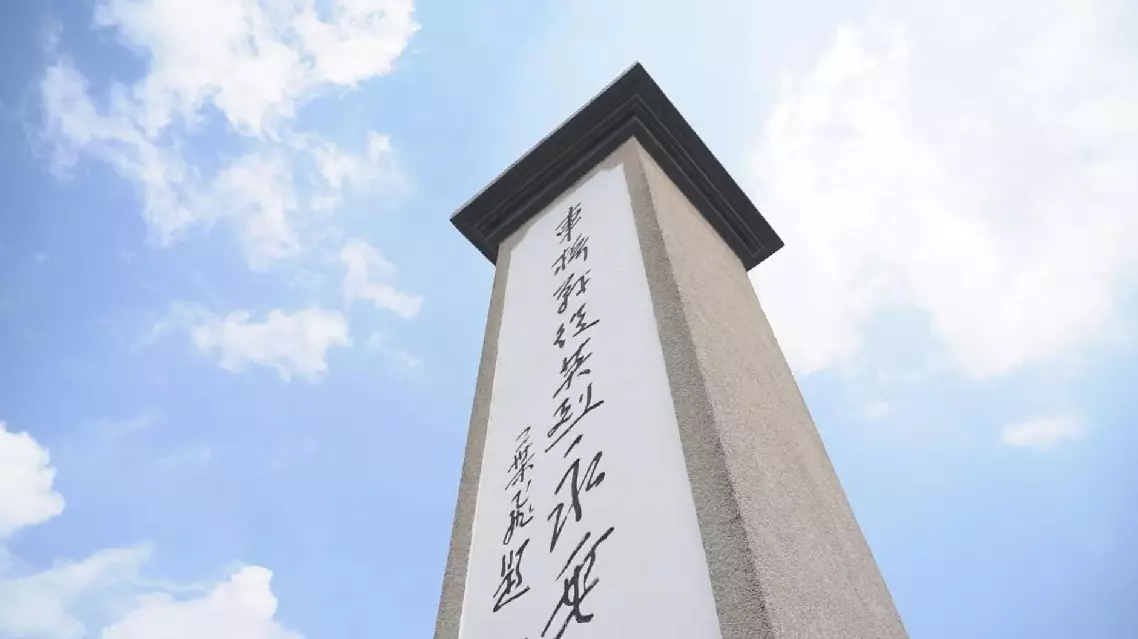
Battle of Cheqiao honored as turning point in China's WWII triumph over Japan