INDIANAPOLIS (AP) — Daniel Jones chose the Indianapolis Colts because he wanted a chance to prove he could still be a starting NFL quarterback.
The gamble paid off Tuesday when coach Shane Steichen announced that Jones would start the Sept. 7 season opener against Miami, beating out Anthony Richardson, who just two years ago was dubbed the franchise’s quarterback of the future.
The reason: consistency and accuracy.
“The operation at the line, discernment, checks, the protection, the ball placement, I think all of that played a factor in it," Steichen said. “I think Daniel did a great job doing that.”
Steichen hinted a decision was coming soon following Saturday's 23-19 loss to Green Bay in the Colts' only home preseason game.
On Monday, he met with team co-owner Carlie Irsay-Gordon and general manager Chris Ballard before informing the two quarterbacks and the rest of the team Tuesday before he went public.
Ballard and Steichen also know this is a critical season for their futures with the franchise, which has missed the playoffs four straight seasons, and they're not about to put Jones on a short leash.
“He's our starter for the season,” Steichen said.
For Jones, the decision caps a harrowing nine-month journey in which he lost the starting job with the New York Giants, then sought and was granted his release. The Minnesota Vikings signed him five days later, but Jones never took a snap for a team that lost to the Los Angeles Rams in the wild-card round.
Instead of re-signing him, the Vikings allowed Jones to test free agency. He wound up signing a one-year, $14 million contract with Indy because of the opportunity to compete with Richardson, the No. 4 overall pick in the 2023 draft, for the starting job.
“That was obviously a big piece of why I came here — to play and be on the field, to be with this group,” Jones said. “It's a strong group of players and a strong group of coaches and I think there's a lot to be excited about.”
Jones has thrown for 14,582 yards with 70 TDs and 47 interceptions since being the Giants' selection at No. 6 overall in 2019. He finished last season with 2,070 yards, eight TDs and seven interceptions in 10 games with the Giants.
For Richardson, it's another setback in a short career that has been defined by injuries, missed games and blown opportunities.
The Colts took Richardson to end the revolving door at quarterback. Indy had a different opening-day starter every year from 2017-23. Richardson ended that streak last year.
But Richardson made only four starts as a rookie before needing season-ending shoulder surgery. Last year, injuries cost him four more starts and he was benched for two games after pulling himself out of a game because he said he needed a breather.
While Richardson has provided glimpses of the strong arm and impressive runs that impressed Indy's scouts when he was playing for the Florida Gators, he's only 8-7 as an NFL starter — and has been unable to finish some of those games because of injuries.
In 2024, Richardson completed 47.7% of his throws, the lowest percentage of any regular starter in the league, and had 12 interceptions and eight touchdown passes. That's why the Colts wanted the competition.
Richardson worked on his footwork in hopes of improving his accuracy during the offseason, and while many of his teammates thought this was the best he'd looked in his three training camps, it wasn't good enough.
“I guess you could say (I was) somewhat surprised, but at the end of the day we all knew somebody was going to have to be on this end of the stick and, you know, it was me,” Richardson said. “I feel like I did improve. My improvement was there, but there are still ways I can improve, still ways I can become a better player, become a starter in the league.”
It's hardly the first time a high draft pick has fallen on hard times early in his career. Richardson becomes the fifth top-10 pick who has not started the opener of their third season. Carson Wentz in 2018 and Michael Vick in 2003 were out because of injuries while Trey Lance in 2023, Josh Rosen in 2020 and Matt Leinart in 2008 did not win the starting job.
And despite making the decision, Steichen insisted Indy continues to believe Richardson still has a bright future in the league — and with the Colts.
“I think Daniel was ahead of him (Richardson) there,” Steichen said when asked specifically about Jones’ consistency on the field. “I think there’s still room for A.R. to grow. He’s only 23 years old. He’s still learning, still growing and for the first time in his career, this is an opportunity for him to sit at the start of a season and learn in a different role.”
AP NFL: https://apnews.com/hub/NFL
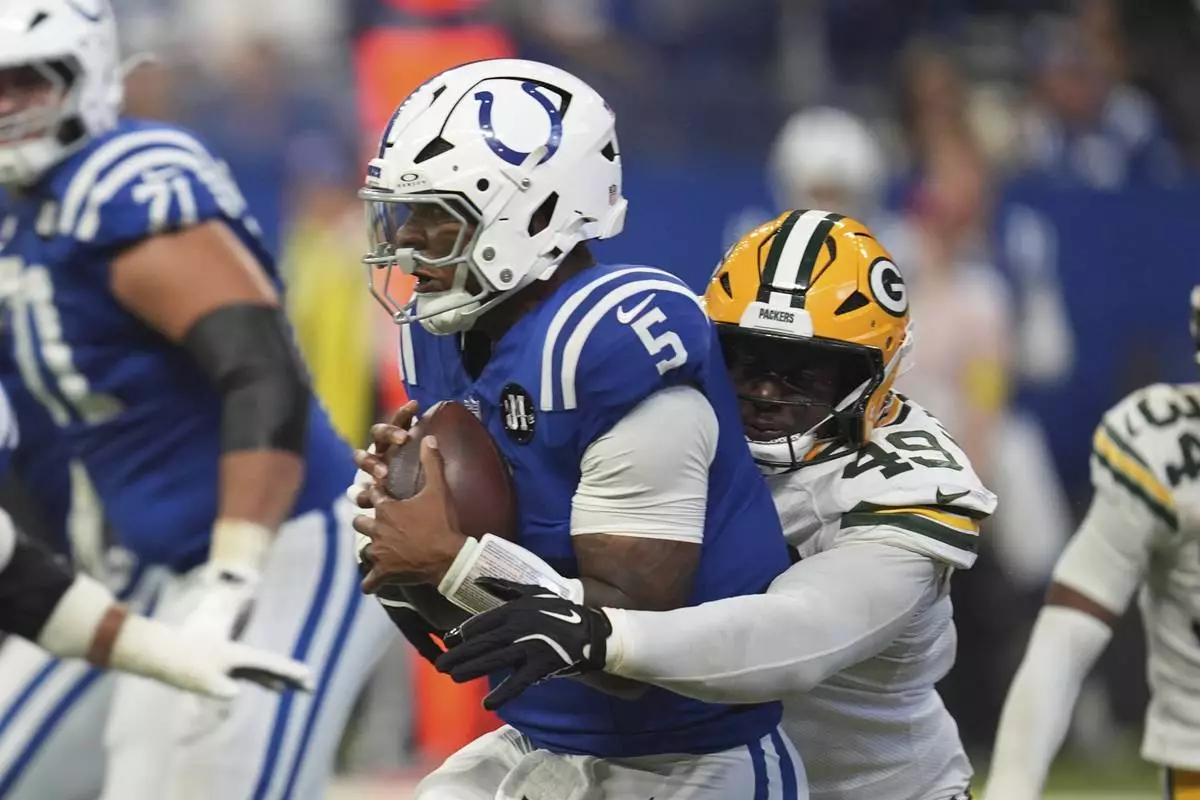
Indianapolis Colts quarterback Anthony Richardson Sr. (5) is sacked by Green Bay Packers defensive end Deslin Alexandre (49) during the first half of a preseason NFL football game, Saturday, Aug. 16, 2025, in Indianapolis. (AP Photo/Michael Conroy)

Indianapolis Colts quarterback Daniel Jones (17) hands off to Jonathan Taylor (28) during the first half of a preseason NFL football game against the Green Bay Packers, Saturday, Aug. 16, 2025, in Indianapolis. (AP Photo/AJ Mast)
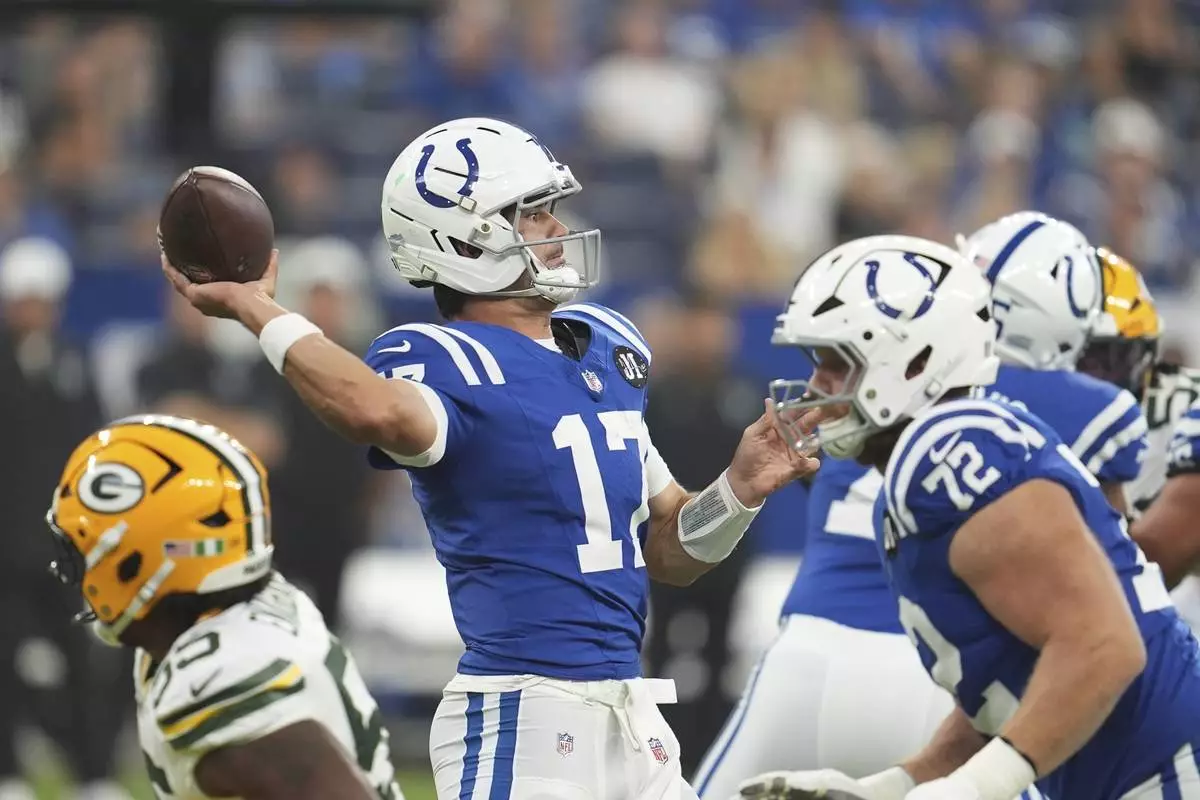
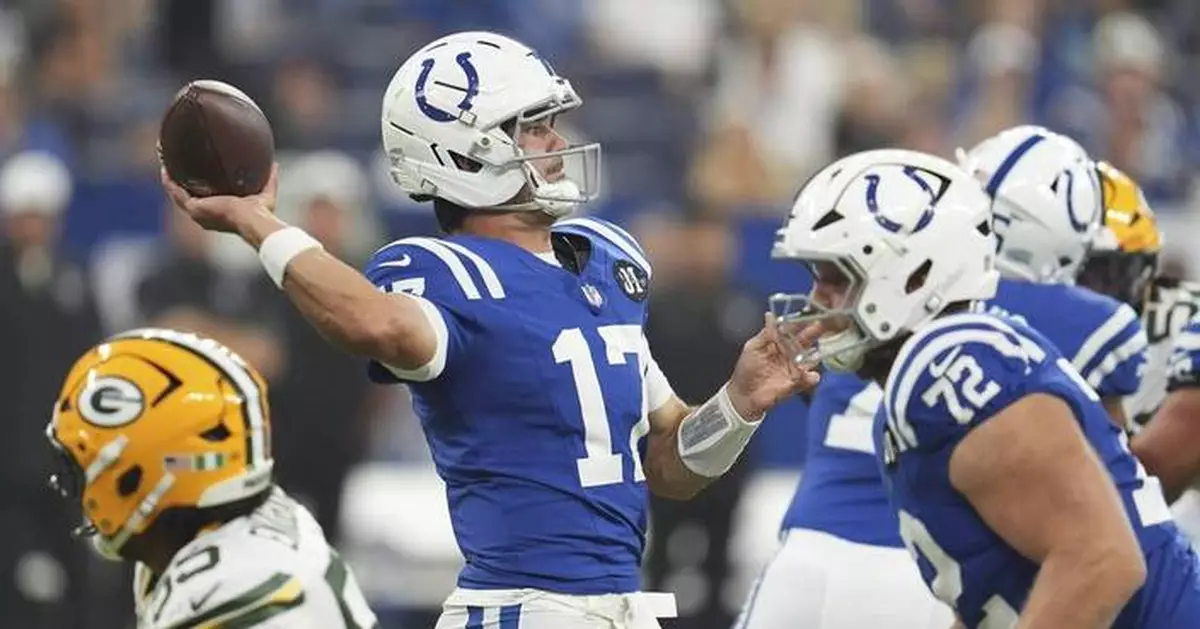
Indianapolis Colts quarterback Daniel Jones (17) throws during the first half of a preseason NFL football game against the Green Bay Packers, Saturday, Aug. 16, 2025, in Indianapolis. (AP Photo/Michael Conroy)
BOGOTA, Colombia (AP) — At the start of this decade, Latin America was hurtling to the left. Progressives, seizing on public outrage over entrenched inequities exacerbated by the pandemic, swept to power in many of the region’s biggest economies, including Brazil, Chile, Colombia and Peru.
A political backlash is brewing, though. Although homicide rates have broadly declined across Latin America compared to a decade ago, spikes in some countries and a regionwide rise in other crimes, particularly extortion, have created the conditions for conservative populists to score votes by promising strong-arm tactics against crime and immigration.
Stump speeches casting migrants as criminals and pitching heavy-handed security strategies popularized by El Salvador’s president, Nayib Bukele, have won conservative candidates U.S. President Donald Trump's backing and fired up their disaffected electorates despite concerns that such tactics could encourage human rights abuses or threaten democracy.
“You have an emergent right wing that is very much in collaboration across the region and with the U.S. through the MAGA movement, which has also used crime as a rallying cry for political mobilization,” said Enrique Roig, vice president of the nonprofit Human Rights First and a former State Department official. “It's easier to sell locking people up than it is to deal with the reasons why mainly young men join gangs in countries like El Salvador.”
Although populist politics across the political spectrum have done well, only the right has offered short-term security solutions that will make voters “feel safer in six months” even if they have to “sacrifice democracy and human rights,” said Adam Isacson, director for defense oversight at the Washington Office on Latin America organization.
Proposals offered by the left, such as community violence prevention programs, better police training, and judicial and prison reforms, take more time to bear fruit, he said.
“It’s absolutely what you’re supposed to be doing, but people’s patience runs out,” Isacson said of long-term proposals. “So, there come the Bukeles of the world saying, ‘You want to feel better? We got this.’”
In Colombia, where swaths of the countryside have fallen into renewed conflict, pro-Trump businessman Abelardo de la Espriella has topped polls ahead of Sunday's runoff election as he takes his cues from Bukele.
In Peru, where extortion has increased fivefold in the past five years, Keiko Fujimori rocketed to a June 7 presidential runoff on a law-and-order platform, vowing to deploy the military in prisons and along borders as she leans on the authoritarian legacy of her disgraced late father, former President Alberto Fujimori.
Costa Ricans, rattled by record levels of drug-related killings, elected conservative populist Laura Fernández in February for her tough-on-crime platform. Honduran businessman Nasry Asfura swept December's election after Trump endorsed him as a partner in the fight against “narco-communists.”
Latin America and the Caribbean last year saw their combined average homicide rate drop by more than 5% compared to 2024, with the median rate reaching about 17.6 per 100,000 people, according to InSight Crime, a think tank focused on organized crime in the Americas.
But there are a few key exceptions. Drug-fueled killings have increased in Peru and Colombia, the world's top cocaine producers, as well as in neighboring Ecuador, whose major ports traffickers see as a gateway to European markets.
Last year, authorities tallied 2,400 homicides in Peru and 14,780 in Colombia, which were the most in each country since at least 2020. Killings rose a remarkable 31% in Ecuador year-on-year, to 9,216.
Gangs are blamed for much of the violence that began soaring in Ecuador during the COVID-19 pandemic, as cartels from Mexico, Colombia and the Balkans expanded their operations and hired locals, who set off a deadly fight over drug-trafficking routes. Their territorial disputes include prisons, where hundreds of inmates have been killed since 2021.
Ecuadorian authorities also recorded more than 16,100 cases of extortion last year, which was down from 23,000 in 2024, though experts say it's an underreported crime.
Four years ago, Chilean voters rejected ultra-conservative lawmaker José Antonio Kast in favor of ex-President Gabriel Boric, a young, tattooed former student protest leader seeking to address Chile’s endemic social inequities. Last year, though, fears over rising crime — and its frequent association in media with the country's growing population of Venezuelan immigrants — played into Kast’s hands, returning him to power.
As Venezuelan crime syndicates like the Tren de Aragua gang seized on their country’s mass migration wave to infiltrate human trafficking networks following the pandemic, Chile, long one of Latin America's safest countries, witnessed an unprecedented explosion of carjackings, kidnappings and shoot-outs.
Chile’s homicide rate rose by 30%, to a peak of 6.7 per 100,000 people from 2021 to 2022, according to the Interior Ministry. It has since dropped but has stayed above pre-2021 levels. Other types of violent crime are still rising, including kidnappings, which have increased by nearly 180% over the past four years.
Drawing inspiration from Bukele, whose mega-prisons in El Salvador he toured while campaigning, Kast handily beat his Communist opponent in December with pledges to build a massive border wall, toughen prison conditions for gang members and deport hundreds of thousands of migrants without legal status. For his promises of safety, voters shrugged off Kast's opposition to abortion and same-sex marriage rights and his defense of Augusto Pinochet's bloody dictatorship.
In Peru, despite the contentious legacy of the convicted Alberto Fujimori, his daughter's candidacy has taken advantage of a surge in violent crime four years after she lost the election to schoolteacher Pedro Castillo.
Campaigning under the slogan “Peru with Order,” Keiko Fujimori won the largest vote share in April's first round of voting. Results of the June 7 runoff still show her in a technical tie with the political heir of the imprisoned Castillo, nationalist Roberto Sánchez.
Experts say the public's appetite for tough tactics — historically associated with the region's right-wing 20th-century dictatorships — has grown alongside its shrinking confidence in state institutions and its deepening ambivalence about democracy.
“The thinking is often, ‘democracy hasn’t been able to keep me and my family safe, so maybe democracy is part of the problem,’” said Eduardo Moncada, director of the Institute of Latin American Studies at Columbia University.
That poses a major challenge to the Latin American left, which in many countries has presided over sluggish economies, grappled with corruption scandals and failed to fulfill promises of social reform in recent years.
Even progressives such as Jeannette Jara in Chile and Sánchez in Peru have shifted with the political tide. Uruguay's president, Yamandú Orsi, called Bukele's model an example worthy of further study. The center-left Guatemalan government declared a state of emergency to crack down on gang violence this year and welcomed the Trump administration's help targeting drug traffickers.
Recently elected politicians' hard-line ambitions, though, have collided with the practicalities of governing complex and cash-strapped democracies like Ecuador and Chile. They are nothing like tiny El Salvador, where Bukele’s party holds a legislative supermajority.
Ecuadorian President Daniel Noboa's promises in his 2023 campaign included locking up gang leaders on barges and building mega-prisons. He abandoned the floating prisons proposal after taking office, and it took his government until November to open the first mega-prison.
“Building mega-prisons hasn’t been that easy or that straightforward because the country is in a very bad state financially and because President Daniel Noboa still sees himself as a democrat,” said Beatriz García Nice, policy analyst for the Washington-based Stimson Center think tank.
Nearly three months into Kast's tenure, pollsters say a skeptical public can't tell the difference between his security crackdown and that of his left-wing predecessor. His government has organized only two deportation flights after promising to immediately round up and expel Chile’s more than 300,000 immigrants without legal status. A different, more sheepish tone has crept into his speeches. Last month, he came under fire for calling the mass deportation promise “a metaphor.”
Even as he pitched new security measures in a June 1 address, including banning those convicted of attacking police from receiving social benefits, he tried to whittle down his supporters' outsize expectations.
“Governing, as many of you know, means taking responsibility for reality, especially when it’s difficult,” he said. “I’m proceeding step by step because this isn’t something that happens overnight.”
DeBre reported from Buenos Aires, Argentina.
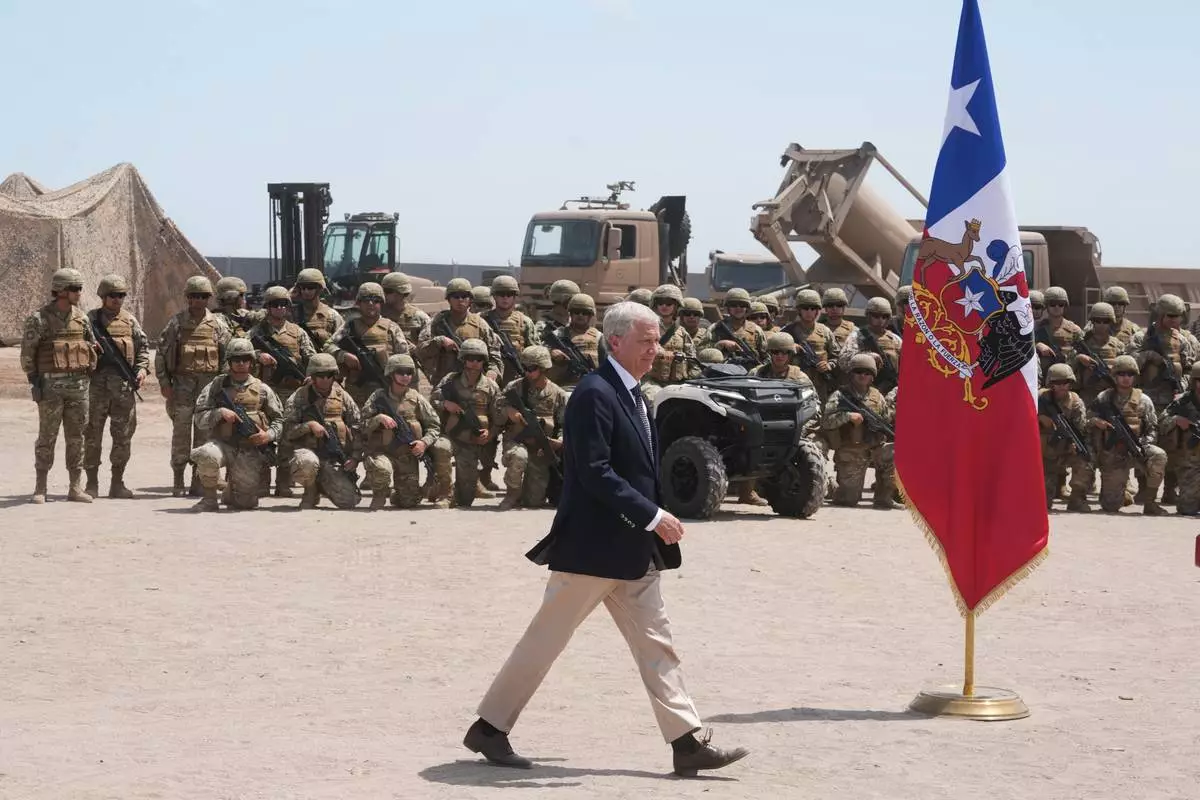
FILE - Chilean President Jose Antonio Kast arrives for a press conference at the military base "Solo de Zaldivar," near the Chacalluta border crossing, in Arica, Chile, March 16, 2026, after signing a decree to deter irregular migration along the northern border with Peru and Bolivia. (AP Photo/Esteban Felix, File)
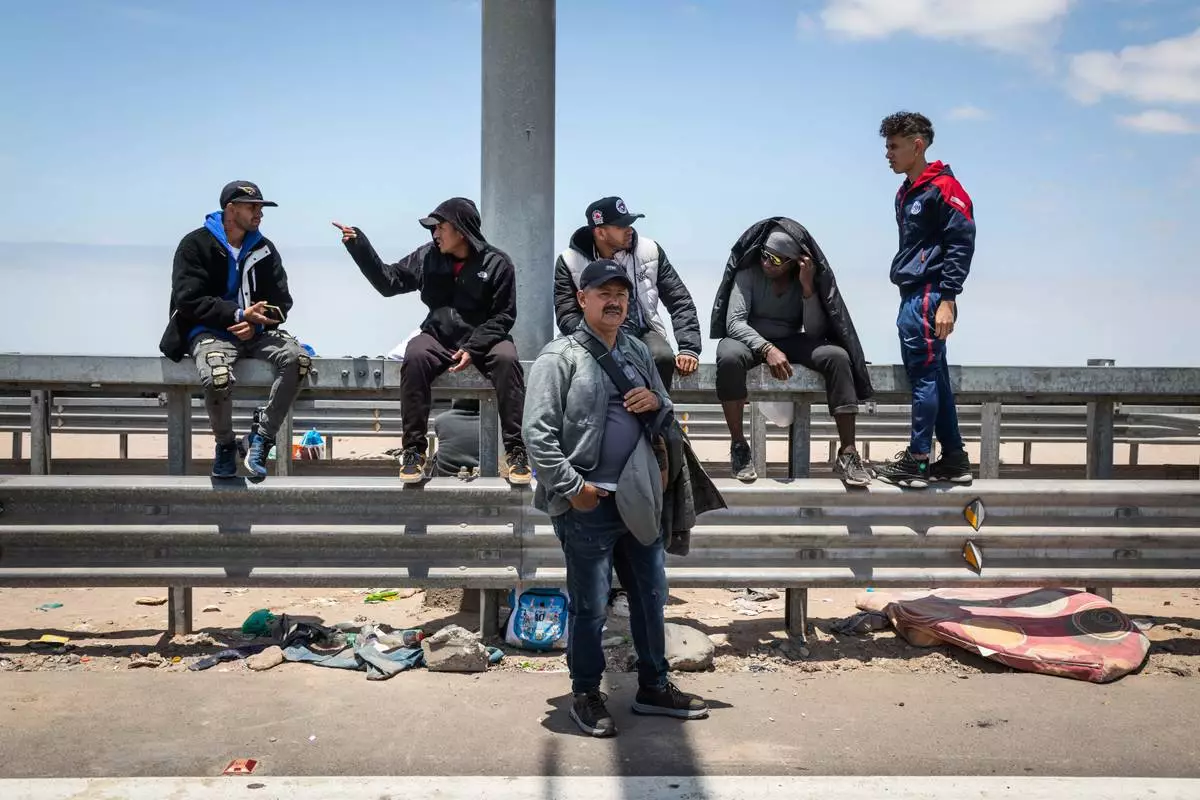
FILE - Migrants, mostly from Venezuela, wait to cross into Peru at the Chacalluta border crossing point in Arica, Chile, Nov. 28, 2025. (AP Photo/Ibar Silva, File)
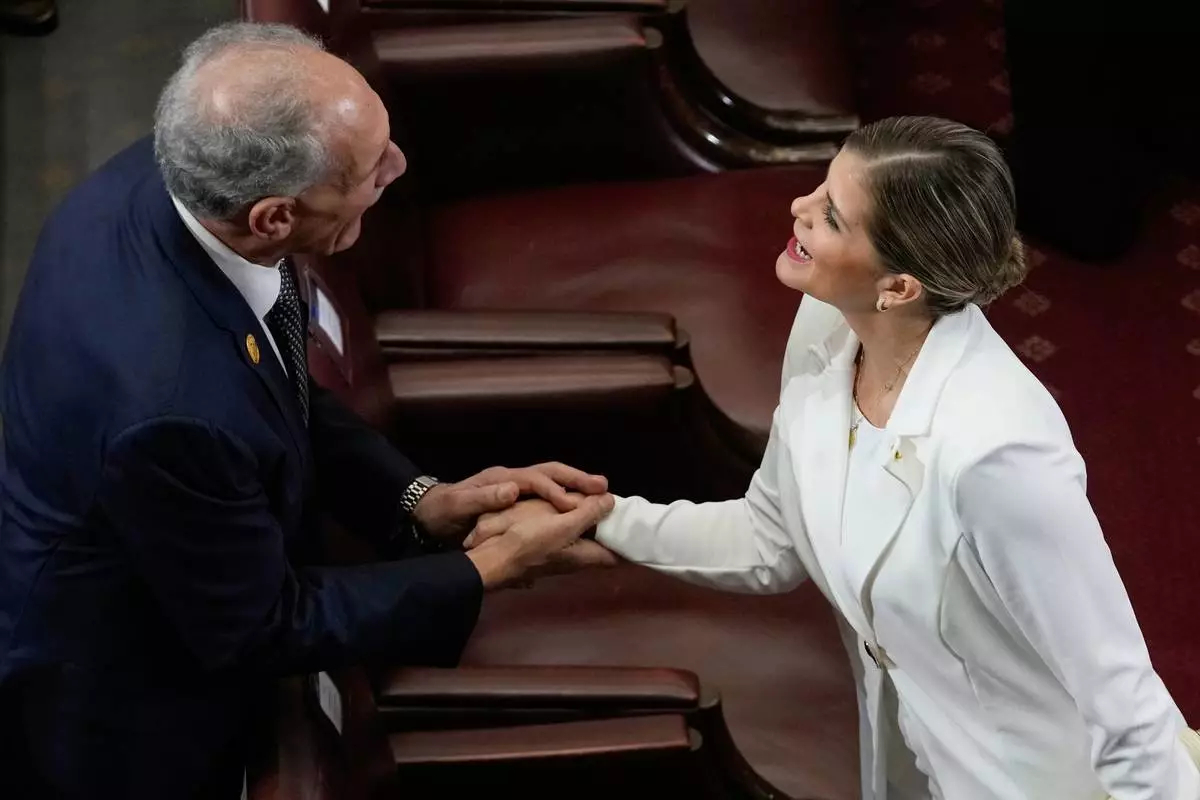
FILE - Honduran President Nasry Asfura, left, and Costa Rica President-elect Laura Fernandez shake hands during the inauguration ceremony of Chile's President Jose Antonio Kast, in Valparaiso, Chile, March 11, 2026. (AP Photo/Esteban Felix, File)
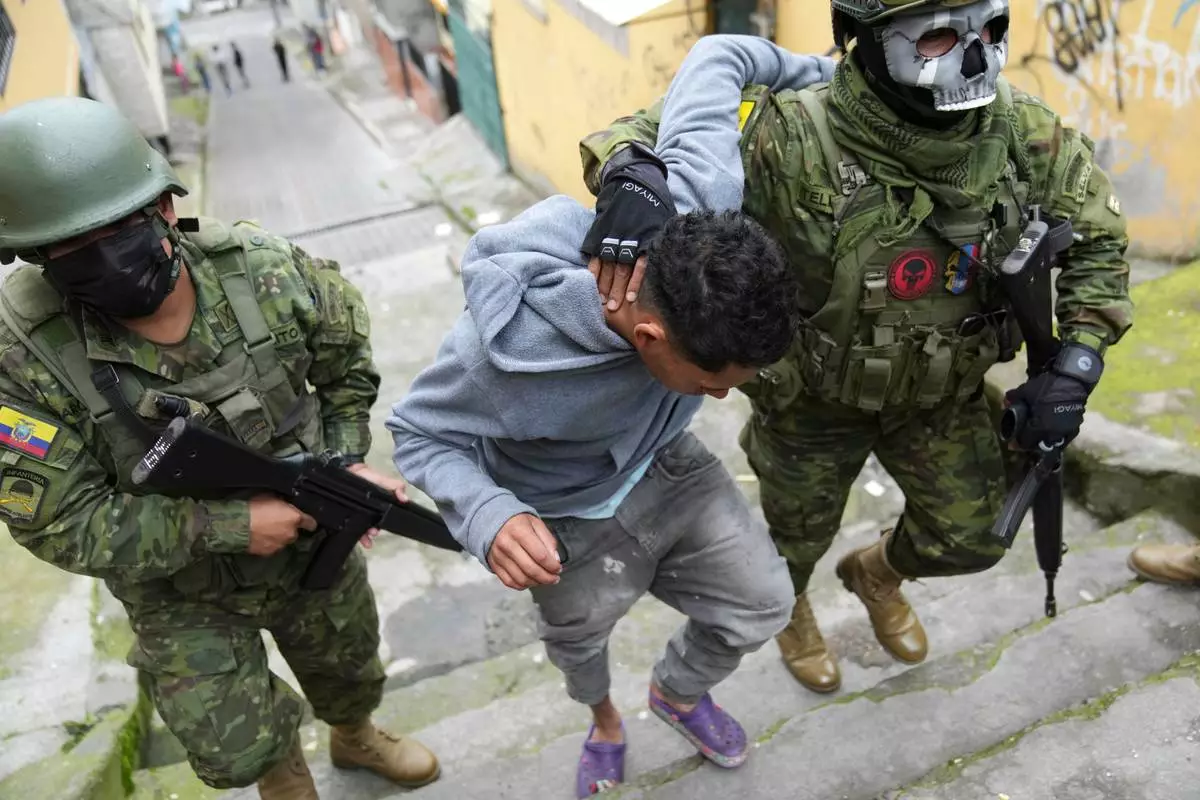
FILE - Soldiers briefly detain a youth to walk him to an area to check if he has gang-related tattoos as they patrol the south side of Quito, Ecuador, Jan. 12, 2024, in the wake of the apparent escape of a powerful gang leader from prison. (AP Photo/Dolores Ochoa, File)
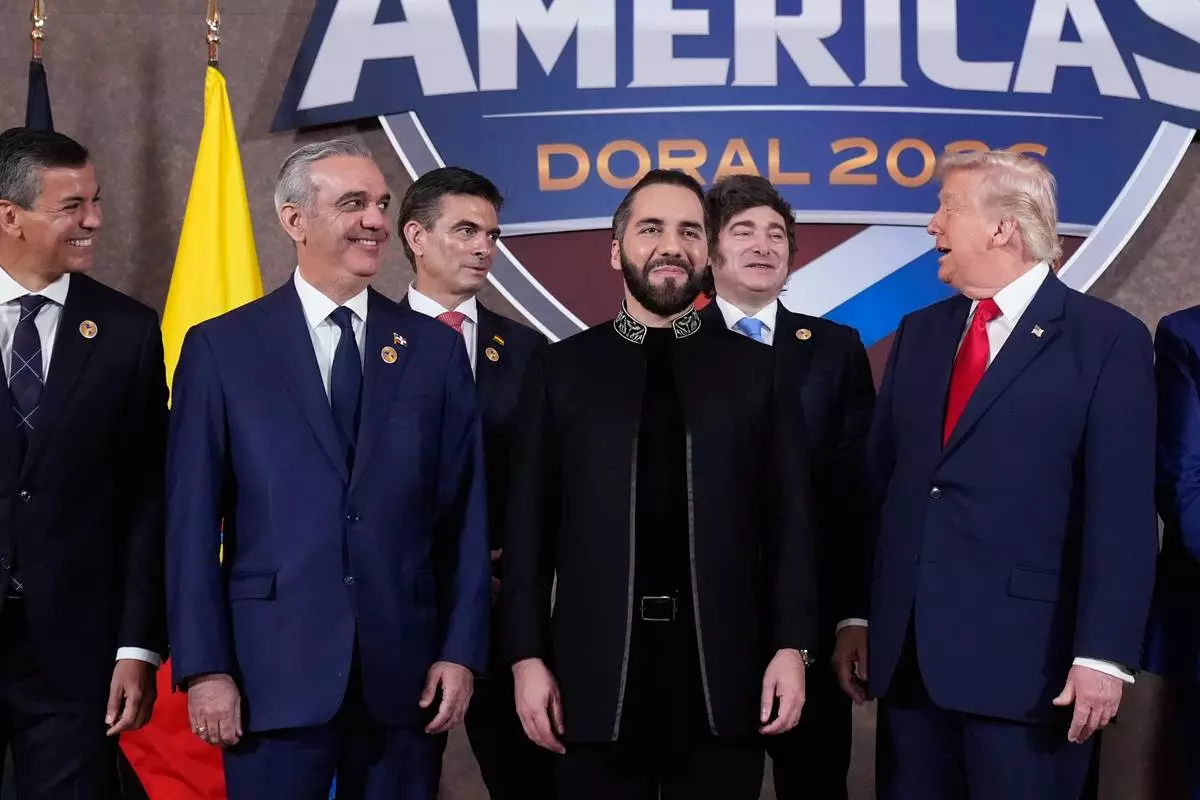
FILE - President Donald Trump poses for a group photo with, from left, Paraguay President Santiago Peña, Dominican Republic President Luis Abinader, Bolivia President Rodrigo Paz Pereira, El Salvador President Nayib Bukele, and Argentina President Javier Milei, at the Shield of the Americas Summit at Trump National Doral Miami in Doral, Fla., March 7, 2026. (AP Photo/Mark Schiefelbein, File)