PORTLAND, Ore. (AP) — The Oregon city at the heart of a major U.S. Supreme Court homelessness ruling has agreed to ensure camping spaces for at least 150 people as part of a settlement reached with a disability rights group that sued the city over its camping rules.
Disability Rights Oregon, which sued Grants Pass in January, said Friday that it had reached a settlement agreement. The advocacy group accused the city of discriminating against people with disabilities and violating a state law requiring cities’ camping regulations to be “objectively reasonable.”
“This settlement represents a significant step forward in ensuring people with disabilities experiencing homelessness have places to rest, basic necessities like drinking water, and real opportunity to stabilize their lives,” Jake Cornett, executive director and CEO of Disability Rights Oregon, said in a statement.
Grants Pass Mayor Clint Scherf said in an email Tuesday that the city appreciates having reached an agreement and will "continue to work toward effective measures to benefit all members of our community.”
A copy of the settlement agreement showed the city signed off on it earlier this month.
Josephine County Circuit Court Judge Sarah McGlaughlin issued a preliminary injunction in March blocking the city from enforcing its camping rules unless it increased capacity at city-approved sites for camping and ensured they are physically accessible to people with disabilities.
City ordinances prohibit sleeping or leaving personal property in a park overnight in most cases. Those found in violation can be fined up to $50.
The city said Friday on Facebook that law enforcement “will begin noticing the parks, and occupants will have 72 hours to remove their belongings.”
The city’s website shows three “designated resting locations” in the downtown area, near City Hall and the police station, where people can stay for four days before having to relocate. The time limit can be enforced unless disability accommodations are necessary, the city said on Facebook.
At resting sites, individuals are limited to spaces that are 8 feet by 8 feet (2.4 meters by 2.4 meters), with buffers of 3 feet (0.9 meters) between spaces, as outlined in city code.
Under the settlement, Grants Pass must ensure that at least 150 camping spaces are available in compliance with the Americans with Disabilities Act for the next 12 months. Drinking water and hand washing stations must be available on-site.
The city must also provide $60,000 in grant funding to a nonprofit for homeless services.
Grants Pass, a small city of about 40,000 along the Rogue River in the mountains of southern Oregon, has struggled for years to address the homelessness crisis and become emblematic of the national debate over how to deal with it. Its parks in particular became a flashpoint, with many of them becoming the site of encampments blighted by drug use and litter.
Last June, in a case brought by the city, the U.S. Supreme Court ruled that communities can ban sleeping outside and fine people for doing so, even when there are not enough shelter beds.
After the high court ruling, Grants Pass banned camping on all city property except locations designated by the City Council, which established sites for the town’s hundreds of homeless people in a bid to move them from the parks.
Upon taking office in January, the new mayor and new council members moved to close the larger of the two sites, which housed roughly 120 tents, according to Disability Rights Oregon's complaint, which said the sites were frequently crowded with poor conditions and inaccessible to people with disabilities because of loose gravel. After the lawsuit was filed, the city reopened a second, smaller site.
McGlaughin’s order in March said the city had to increase capacity to what it had been before the larger site was closed.
Elsewhere, the California city of San Jose is similarly planning to open sanctioned camping sites in addition to the “safe parking” it offers for people who live in vehicles such as RVs. The city of San Rafael, also in the San Francisco Bay Area, also has a sanctioned camping program.
Homelessness increased 18% last year nationwide, driven mostly by a lack of affordable housing as well as devastating natural disasters and an increase in migrants in some areas.
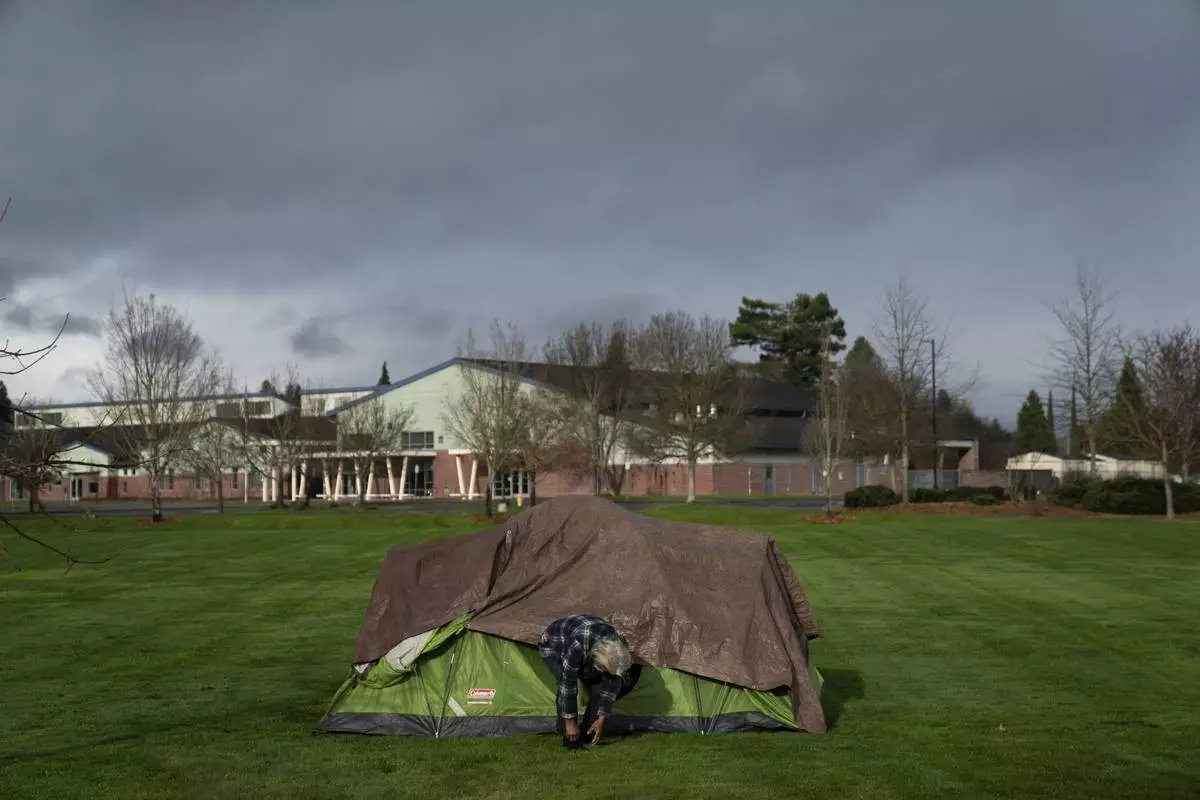
FILE - With Fruitdale Elementary School in the background, a homeless man adjusts his shoe at Fruitdale Park, March 23, 2024, in Grants Pass, Ore. (AP Photo/Jenny Kane, File)
RHO, Italy (AP) — No ice is colder and harder than speedskating ice. The precision it takes has meant that Olympic speedskaters have never competed for gold on a temporary indoor rink – until the 2026 Milan Cortina Winter Games.
In the pursuit of maximum glide and minimum friction, Olympic officials brought on ice master Mark Messer, a veteran of six previous Olympic speedskating tracks and the ice technician in charge of the Olympic Oval in Calgary, Canada — one of the fastest tracks in the world with over 300 records.
Messer has been putting that experience to work one thin layer of ice at a time since the end of October at the new Speed Skating Stadium, built inside adjacent trade fair halls in the city of Rho just north of Milan.
“It’s one of the biggest challenges I’ve had in icemaking,’’ Messer said during an interview less than two weeks into the process.
If Goldilocks were a speedskater, hockey ice would be medium hard, for fast puck movement and sharp turns. Figure skating ice would be softer, allowing push off for jumps and so the ice doesn’t shatter on landing. Curling ice is the softest and warmest of all, for controlled sliding.
For speedskating ice to be just right, it must be hard, cold and clean. And very, very smooth.
“The blades are so sharp, that if there is some dirt, the blade will lose the edge,’’ Messer said, and the skater will lose speed.
Speedskater Enrico Fabris, who won two Olympic golds in Turin in 2006, has traded in his skates to be deputy sports manager at the speedskating venue in Rho. For him, perfect ice means the conditions are the same for all skaters — and then if it's fast ice, so much the better.
"It's more of a pleasure to skate on this ice,'' he said.
Messer’s first Olympics were in Calgary in 1988 — the first time speedskating was held indoors. “That gave us some advantages because we didn’t have to worry about the weather, wind blowing or rain,’’ he said. Now he is upping the challenge by becoming the first ice master to build a temporary rink for the Olympics.
Before Messer arrived in Italy, workers spent weeks setting up insulation to level the floor and then a network of pipes and rubber tubes that carry glycol — an antifreeze — that is brought down to minus 7 or minus 8 degrees Celsius (17.6 to 19.4 degrees Fahrenheit) to make the ice.
Water is run through a purification system — but it can’t be too pure, or the ice that forms will be too brittle. Just the right amount of impurities “holds the ice together,’’ Messer said.
The first layers of water are applied slowly, with a spray nozzle; after the ice reaches a few centimeters it is painted white — a full day’s work — and the stripes are added to make lanes.
“The first one takes about 45 minutes. And then as soon as it freezes, we go back and do it again, and again and again. So we do it hundreds of times,’’ Messer said.
As the ice gets thicker, and is more stable, workers apply subsequent layers of water with hoses. Messer attaches his hose to hockey sticks for easier spreading.
What must absolutely be avoided is dirt, dust or frost — all of which can cause friction for the skaters, slowing them down. The goal is that when the skaters push “they can go as far as possible with the least amount of effort,’’ Messer said.
The Zamboni ice resurfacing machine plays a key role in keeping the track clean, cutting off a layer and spraying water to make a new surface.
One challenge is gauging how quickly the water from the resurfacing machine freezes in the temporary rink.
Another is getting the ice to the right thickness so that the Zamboni, weighing in at six tons, doesn’t shift the insulation, rubber tubing or ice itself.
“When you drive that out, if there’s anything moving it will move. We don’t want that,’’ Messer said.
The rink got its first big test on Nov. 29-30 during a Junior World Cup event. In a permanent rink, test events are usually held a year before the Olympics, leaving more time for adjustments. “We have a very small window to learn,’’ Messer acknowledged.
Dutch speedskater Kayo Vos, who won the men’s neo-senior 1,000 meters, said the ice was a little soft — but Messer didn’t seem too concerned.
“We went very modest to start, now we can start to change the temperatures and try to make it faster and still maintain it as a safe ice,’’ he said.
Fine-tuning the air temperature and humidity and ice temperature must be done methodically — taking into account that there will be 6,000 spectators in the venue for each event. The next real test will be on Jan. 31, when the Olympians take to the ice for their first training session.
“Eighty percent of the work is done but the hardest part is the last 20 percent, where we have to try to find the values and the way of running the equipment so all the skaters get the same conditions and all the skaters get the best conditions,’’ Messer said.
AP Winter Olympics: https://apnews.com/hub/milan-cortina-2026-winter-olympics

Serpentines are set on the ice of the stadium where speed skating discipline of the Milan Cortina 2026 Winter Olympics will take place, in Rho, outskirt of Milan, Tuesday, Nov. 11, 2025. (AP Photo/Luca Bruno)

Ice Master Mark Messer poses in the stadium where speed skating discipline of the Milan Cortina 2026 Winter Olympics will take place, in Rho, outskirt of Milan, Tuesday, Nov. 11, 2025. (AP Photo/Luca Bruno)
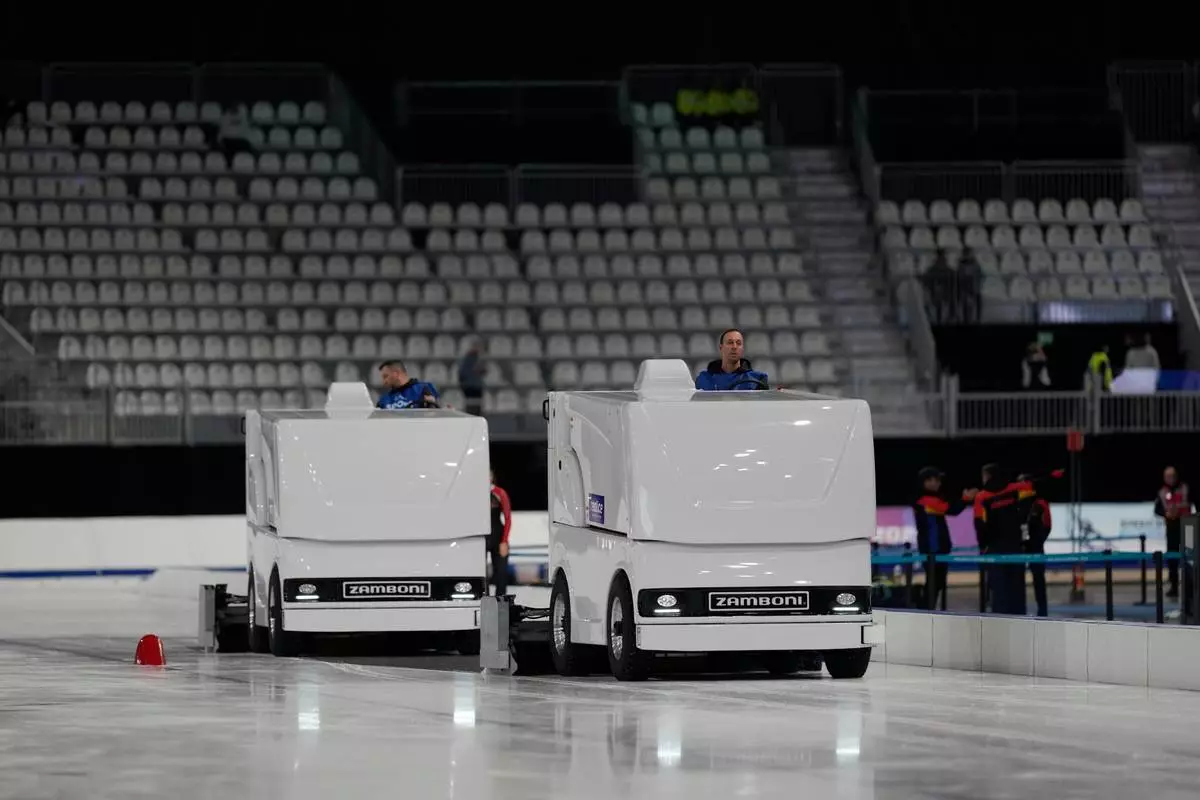
Workers clean the ice surface during a peed skating Junior World Cup and Olympic test event, in Rho, near Milan, Italy, Saturday, Nov. 29, 2025. (AP Photo/Luca Bruno)

Ice Master Mark Messer poses in the stadium where speed skating discipline of the Milan Cortina 2026 Winter Olympics will take place, in Rho, outskirt of Milan, Tuesday, Nov. 11, 2025. (AP Photo/Luca Bruno)

Ice Master Mark Messer poses in the stadium where speed skating discipline of the Milan Cortina 2026 Winter Olympics will take place, in Rho, outskirt of Milan, Tuesday, Nov. 11, 2025. (AP Photo/Luca Bruno)