NEW YORK (AP) — States are warning beachgoers about a summertime surge in infections from a frightening, flesh-eating bacteria found in coastal waters.
Vibrio vulnificus are becoming an annual threat along the Gulf Coast and — increasingly — up the Eastern Seaboard.
People should listen to the warnings, said Bernie Stewart, a 65-year-old retired bounty hunter in Florida who counts himself lucky to have survived an infection.
In August 2019, Stewart's right leg was infected while he was kayak fishing in Pensacola Bay. What at first appeared to be a sun blister led to three months in the hospital, where doctors performed 10 surgeries to remove decaying skin and prevent the bacteria from killing him.
“This ain't nothing to play with,” Stewart said.
Vibrio bacteria thrive in seawater and in the mix of fresh and saltwater found in estuaries and lagoons. Most infections are reported from May to October, and most happen in states along the Gulf Coast.
The Gulf’s water is "the perfect convergence of the right amount of salt and the right amount of heat to let this organism proliferate,” said Dr. Fred Lopez, an infectious diseases specialist at the LSU Health Sciences Center in New Orleans.
The nastiest type is Vibrio vulnificus. It accounts for around 200 of the more than 1,000 Vibrio illnesses each year, according to CDC data.
As many as 1 in 5 of those infections are fatal — a much higher rate than other types of Vibrio bacteria.
Some people become infected by eating eat raw or undercooked shellfish — particularly oysters. But a large percentage fall ill when the person is in ocean or brackish water and the bacteria enter the body through small breaks in the skin.
The antibiotics used to treat food poisoning cases don't work as well when the germ enters through breaks in the skin, Lopez said.
“They may require multiple surgeries to remove dead or infected tissue, and sometimes require amputation,” he said.
Doctors say severe cases are seen more often in elderly patients, people with weakened immune systems, and those with liver disease, diabetes and certain chronic illnesses.
Louisiana has seen an alarming jump in cases this summer, but other states are not. More cases are expected, as this is peak season for Vibrio vulnificus infections.
“It is really easy to sound unnecessary alarms because cases have increased, or feel too complacent because cases are low,” when data is incomplete, said Salvador Almagro-Moreno, a St. Jude Children’s Research Hospital who has studied the germ.
Infections have been reported as far north as New England — Massachusetts recently issued an alert after someone reportedly was infected on Cape Cod.
Scientists say climate change is helping the germs proliferate and spread northward. A 2023 study found that the northernmost case has been shifting by about 30 miles each year, and that cases overall have been rising.
As of late last week, 20 cases of Vibrio vulnificus had been reported among Louisiana residents this year. All were hospitalized and four died, the state’s health department said. That’s more than twice the average number of cases for this point in the season, and four times the death toll, state officials said.
Cases are not unusually higher in other Gulf States, however.
Florida, which tends to have more infections than other states, has reported 17 Vibrio vulnificus cases and five deaths this year, compared with 82 cases and 19 deaths at the same point last year.
State officials say they typically see more cases in years when Florida is hit by tropical storms, and hurricane season is only just beginning, Lopez noted.
Vibrio vulnificus can enter the body through unhealed cuts and scrapes, recent piercings and tattoos, and recent surgical incisions. If you have such a wound, try to stay out of saltwater or brackish water, and cover it with a waterproof bandage if there’s a chance of exposure.
If you do come in contact with coastal waters or raw seafood, immediately wash cuts and scrapes thoroughly with soap and clean running water, the CDC advises.
And see a doctor if you start to develop symptoms such as fever, chills, and hot red areas on the skin that start to turn dark and blister.
You can also become infected by eating seafood. Health officials say not to eat raw or undercooked oysters or other seafood, and do not let raw seafood, its drippings, or its juices contaminate other foods.
Oysters are a particular risk, and there is no way to tell if an oyster is contaminated just by looking at it.
Wash hands with soap and water after handing raw shellfish, and wear protective gloves if you have a weakened immune system and are at a higher risk of infection.
Health officials also offer cooking instructions for clams, mussels and other shellfish. They recommend throwing away any with open shells before cooking.
In Pensacola, Stewart said he’s advocated — unsuccessfully — for local officials to post signs about the dangers of going into the bay.
“Not everyone’s immune system is going to be strong,” he said.
The Associated Press Health and Science Department receives support from the Howard Hughes Medical Institute’s Department of Science Education and the Robert Wood Johnson Foundation. The AP is solely responsible for all content.

This electron microscope image provided by the Centers for Disease Control and Prevention shows Vibrio vulnificus bacteria in 2005. (Janice Haney Carr/CDC via AP)
MANCHESTER, England (AP) — Liverpool and Manchester City were stunned by late goals to drop points in the Premier League on Sunday.
Harrison Reed's spectacular strike in the seventh minute of stoppage time earned Fulham a 2-2 draw with Liverpool at Craven Cottage. And Enzo Fernandez poked home an equalizer in the 94th at the Etihad to seal a 1-1 draw for managerless Chelsea that dented City's title hopes.
Second-placed City led through Tijjani Reijnders at halftime, but is now six points behind leader Arsenal, which beat Bournemouth 3-2 on Saturday.
Defending champion Liverpool is fourth in the standings and 14 points adrift of Arsenal after substitute Reed let fly from around 25 meters (yards) to beat Liverpool goalkeeper Alisson.
Liverpool fans were still celebrating after Cody Gakpo had scored what looked like a late winner in the 94th. But they were left stunned by Reed's near instant response once play resumed.
Fulham led 1-0 at halftime through Harry Wilson, who burst through and fired low into the far corner. Florian Wirtz leveled in the 57th.
The result saw defending champion Liverpool drop yet more points in what has been a difficult second campaign for coach Arne Slot.
Matheus Cunha rescued a point for Manchester United in a 1-1 draw at Leeds.
The Brazil forward equalized for United after U.S. international Brenden Aaronson put Leeds in front in the second half at Elland Road.
Aaronson opened the scoring in the 62nd, but Cunha leveled three minutes later. Cunha was close to firing a winner late in the match with a curling shot from outside the box that struck the outside of the post.
United has lost just two of its last 14 games in the league, but six draws during that run have seen Ruben Amorim's team struggle to keep pace with the top three in the standings.
“This year I think we are in control of the games more often than last year,” Amorim told TNT Sports. “So it was a good game, but of course (I am) a little bit frustrated not to win.”
But it was other remarks by Amorim about his job and future that dominated the headlines.
“I came here to be the manager of Manchester United, not to be the coach of Manchester United,” Amorim said. “And that is clear. I know that my name is not (Thomas) Tuchel, it’s not (Antonio) Conte, it’s not (Jose) Mourinho but I’m the manager of Manchester United. And it’s going to be like this for 18 months or when the board decides to change."
Leeds is unbeaten in seven games and went ahead when Aaronson raced past United defender Ayden Heaven to shoot low into the far corner.
Cunha scored his third goal in his last five games when latching onto a pass from substitute Joshua Zirkzee and sliding a shot past Leeds goalkeeper Lucas Perri.
United has had to cope without injured inspirational captain Bruno Fernandes over the festive period as well as key forwards Bryan Mbeumo and Amad Diallo, who are playing at the Africa Cup of Nations. Mason Mount and Kobbie Mainoo are also out with injuries.
But Amorim suggested Fernandes and Mount could be close to returning.
Igor Thiago hit a hat trick in Brentford's 4-2 win at Everton.
The Brazilian forward has scored 14 goals in the league this season, behind only Manchester City's Erling Haaland.
Newcastle beat Crystal Palace 2-0 and Tottenham was denied victory at home to Sunderland when Brian Brobbey scored an 80th-minute equalizer for a 1-1 draw.
James Robson is at https://x.com/jamesalanrobson
AP soccer: https://apnews.com/hub/soccer

Chelsea's head coach Calum McFarlane, center, celebrates after Enzo Fernandez scoring during the English Premier League soccer match between Manchester City and Chelsea in Manchester, England, Sunday, Jan. 4, 2026. (AP Photo/Dave Thompson)
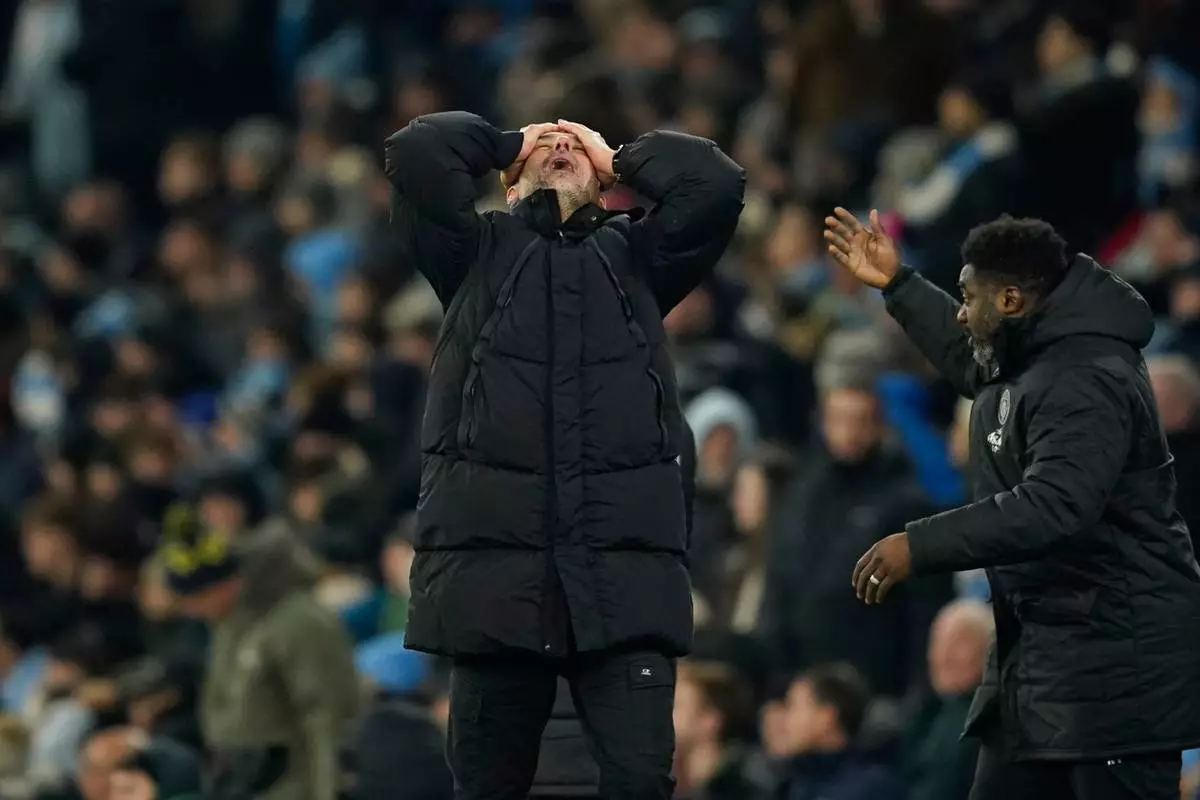
Manchester City's head coach Pep Guardiola, center, reacts after Chelsea's Enzo Fernandez scoring during the English Premier League soccer match between Manchester City and Chelsea in Manchester, England, Sunday, Jan. 4, 2026. (AP Photo/Dave Thompson)

Brentford's Igor Thiago, left, celebrates with team-mate Jordan Henderson after the English Premier League soccer match between FC Everton and FC Brentford in Liverpool, England, Sunday, Jan. 4, 2026. (Peter Byrne/PA via AP)

Liverpool's Cody Gakpo celebrates after scoring his side's second goal during the English Premier League soccer match between Fulham and Liverpool in London, Sunday, Jan. 4, 2026. (AP Photo/Alastair Grant)

Fulham's Harrison Reed, left, celebrates after scoring his side's second goal during the English Premier League soccer match between Fulham and Liverpool in London, Sunday, Jan. 4, 2026. (AP Photo/Alastair Grant)

Manchester United's Patrick Dorgu, left, and Leeds United's Gabriel Gudmundsson battle for the ball during the English Premier League soccer match between Leeds United and Manchester United in Leeds, England, Sunday, Jan. 4, 2026. (Danny Lawson/PA via AP)

Manchester United's Benjamin Sesko, left, and Leeds United's Anton Stach battle for the ball during the English Premier League soccer match between Leeds United and Manchester United in Leeds, England, Sunday, Jan. 4, 2026. (Danny Lawson/PA via AP)

Leeds United's Brenden Aaronson, right, celebrates with his teammates after scoring his sides first goal during the English Premier League soccer match between Leeds United and Manchester United in Leeds, England, Sunday, Jan. 4, 2026. (Danny Lawson/PA via AP)
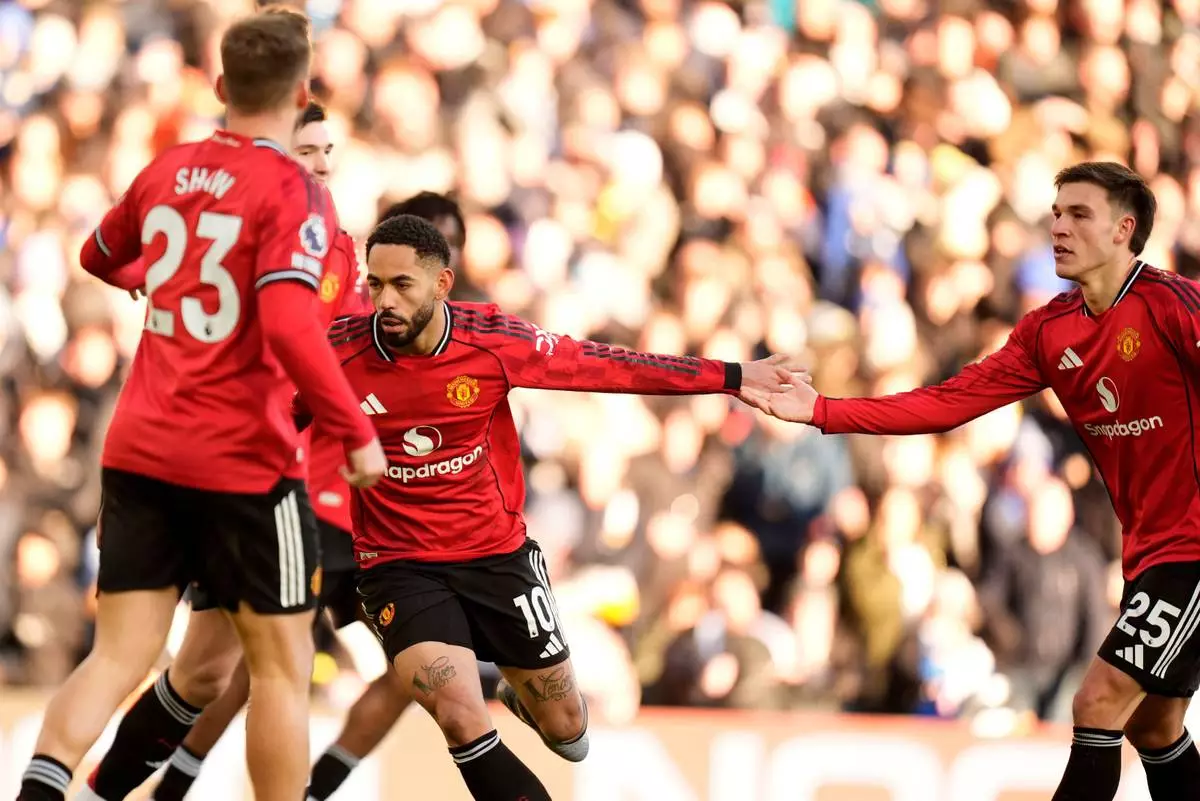
Manchester United's Matheus Cunha, center, celebrates after scoring his sides first goal during the English Premier League soccer match between Leeds United and Manchester United in Leeds, England, Sunday, Jan. 4, 2026. (Danny Lawson/PA via AP)