LOS ANGELES (AP) — Millie Bobby Brown and Jake Bongiovi adopted a daughter, the first child for the married couple, this summer, they announced Thursday.
“We are beyond excited to embark on this beautiful next chapter of parenthood in both peace and privacy,” the couple wrote in a social media statement. No further details were released.
Brown, 21, and Bongiovi, 23, were married in a private ceremony in May 2024. Representatives for Brown and Bongiovi did not immediately respond to The Associated Press’ request for comment.
Brown gained recognition for her starring role as Eleven in the Duffer brothers' sci-fi series “Stranger Things.” The fifth and final season will air this November and December, a culmination of nine years of the show's production. The British actor has pursued other acting and business ventures in that time, including the Netflix original “Enola Holmes” films and a “Godzilla” film. She even released a romance book in 2023.
Bongiovi is the son of Jon Bon Jovi, founder and frontman of the rock band Bon Jovi. Bongiovi debuted his own acting career as the star in “Rockbottom,” which released last year.
Brown stressed the importance of family during the 2024 premiere of her Netflix film “Damsel,” where Bongiovi and his parents were in attendance.
“I'm just so lucky that they're here tonight and it just means so much to me,” Brown told The Associated Press then. “Family is everything and just to have my second family here means everything.”
The couple lives in Georgia. She recently told the AP she enjoys living on a farm, largely disconnected from social media, while promoting her 2025 Netflix film “The Electric State.”

FILE - Millie Bobby Brown, left, and Jake Bongiovi arrive at the premiere of "The Electric State" on Monday, Feb. 24, 2025, at The Egyptian Theatre in Los Angeles. (Photo by Jordan Strauss/Invision/AP, File)

FILE - Millie Bobby Brown, left, and Jake Bongiovi arrive at the premiere of "The Electric State" on Monday, Feb. 24, 2025, at The Egyptian Theatre in Los Angeles. (Photo by Jordan Strauss/Invision/AP, File)
BOSTON (AP) — Marat Khusnutdinov and Viktor Arvidsson scored in the first 3:45 of the game, and the Boston Bruins held on to beat the Seattle Kraken 4-2 on Thursday night after raising Zdeno Chara's No. 33 to the rafters.
Mark Kastelic added a short-handed goal in the second period, and Jeremy Swayman stopped 26 shots for Boston, which swept a five-game homestand for the first time since 2019 and won for the seventh time in eight games. David Pastrnak scored an empty-netter with 15 seconds left after the Kraken picked up back-to-back penalties, then pulled the goalie to play five-on-four.
Chandler Stephenson and Eeli Tolvanen scored, and Joey Daccord made 20 saves for the Kraken, who have lost four of their last five games.
The Bruins began the night by honoring Chara, the Hall of Fame defenseman who was the captain of their 2011 Stanley Cup championship team. Hall of Famers Bobby Orr and current Bruins president Cam Neely were among those who took part in the ceremony, which ended with Chara's children raising his number to the TD Garden rafters.
Khusnutdinov took a long pass from Charlie McAvoy, skated in on Daccord and slipped in a backhand to make it 1-0 54 seconds into the game. Less than three minutes later, Arvidsson tried to center the puck to Casey Mittelstadt, but it was deflected into the net by Seattle's Jordan Eberle.
The Kraken called an early timeout, leaving them without one when they might have needed it down two players in the final minute.
After Stephenson made it a one-goal game, Kastelic poked the puck away from Kraken forward Matty Beniers and skated in on Daccord for the short-handed goal that made it 3-1.
The Kraken visit Utah on Saturday.
The Bruins visit Chicago on Saturday.
AP NHL: https://apnews.com/hub/nhl

Former Boston Bruins captain Zdeno Chara speaks during his number retirement ceremony before an NHL hockey game between the Boston Bruins and the Seattle Kraken Thursday, Jan. 15, 2026, in Boston. (AP Photo/Winslow Townson)

Boston Bruins' Viktor Arvidsson is congratulated at the bench after scoring against the Seattle Kraken during the first period of an NHL hockey game Thursday, Jan. 15, 2026, in Boston. (AP Photo/Winslow Townson)
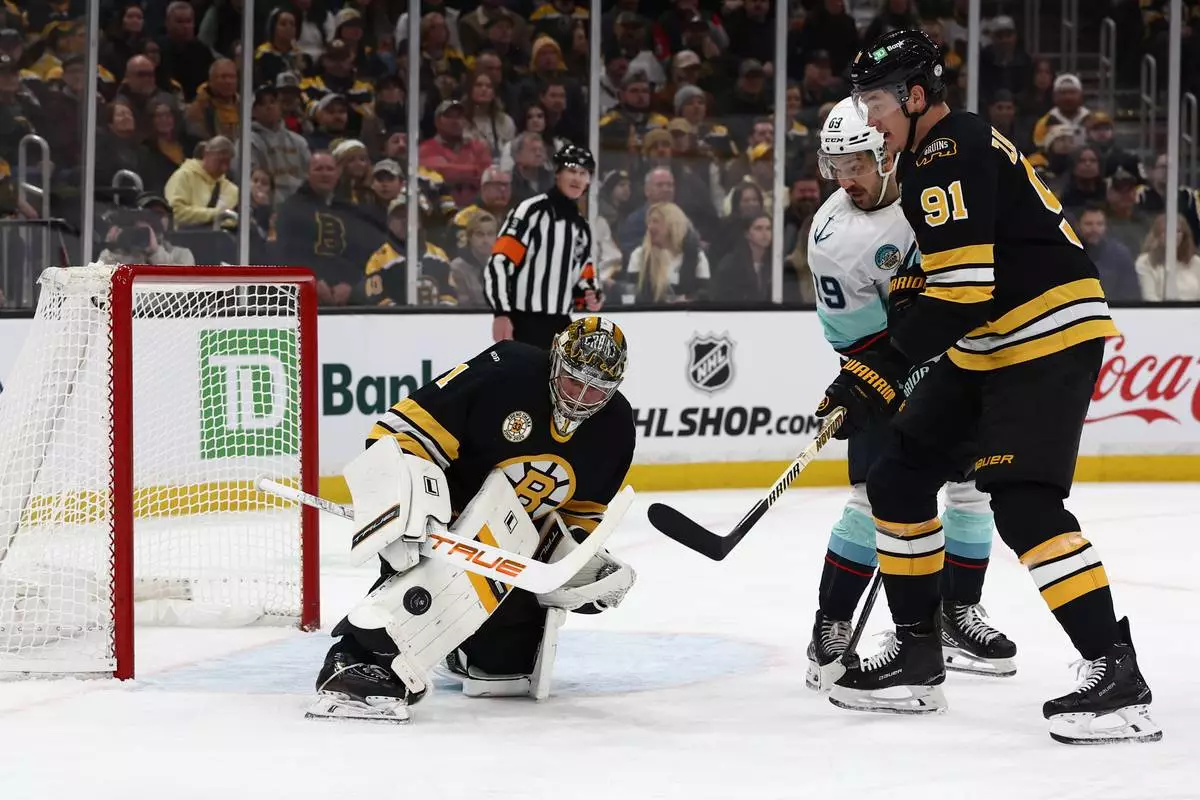
Boston Bruins goaltender Jeremy Swayman makes a save as defenseman Nikita Zadorov and Seattle Kraken's Frederick Gaudreau look for the rebound during the first period of an NHL hockey game, Thursday, Jan. 15, 2026, in Boston. (AP Photo/Winslow Townson)
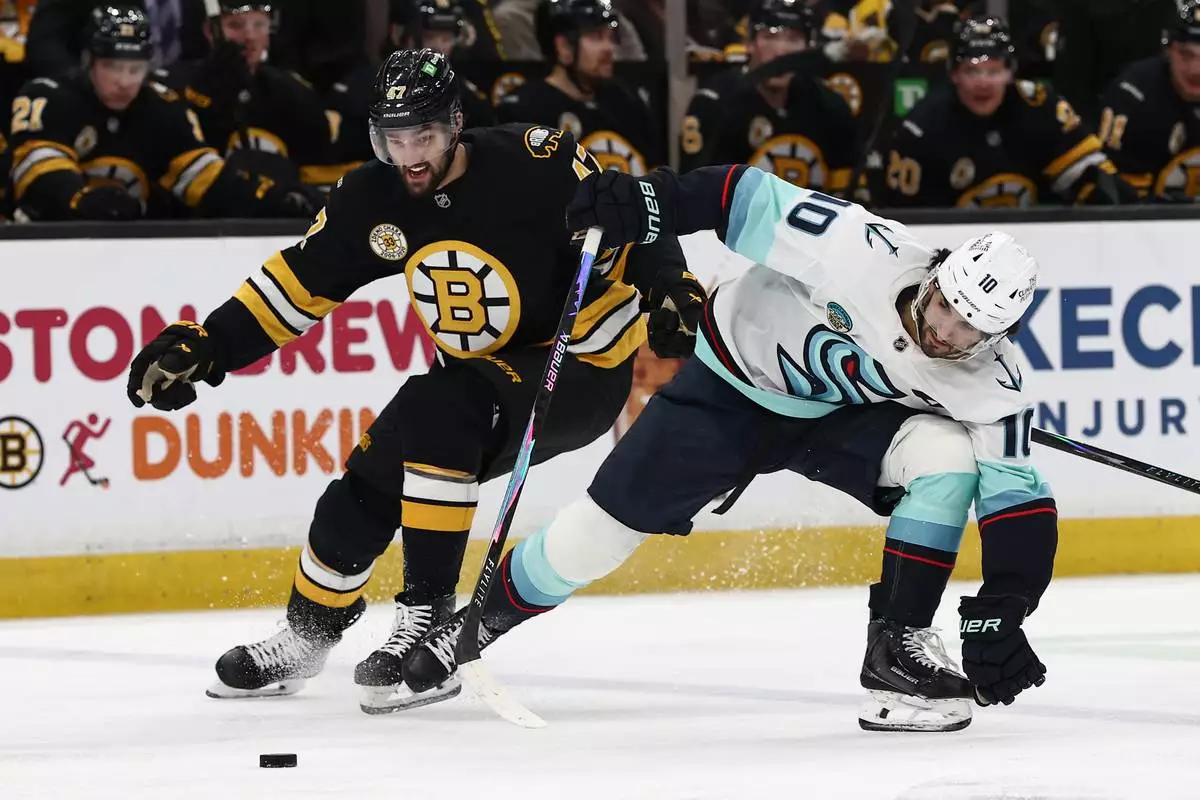
Boston Bruins' Mark Kastelic eyes a loose puck as he gets past Seattle Kraken's Matty Beniers during the second period of an NHL hockey game Thursday, Jan. 15, 2026, in Boston. (AP Photo/Winslow Townson)
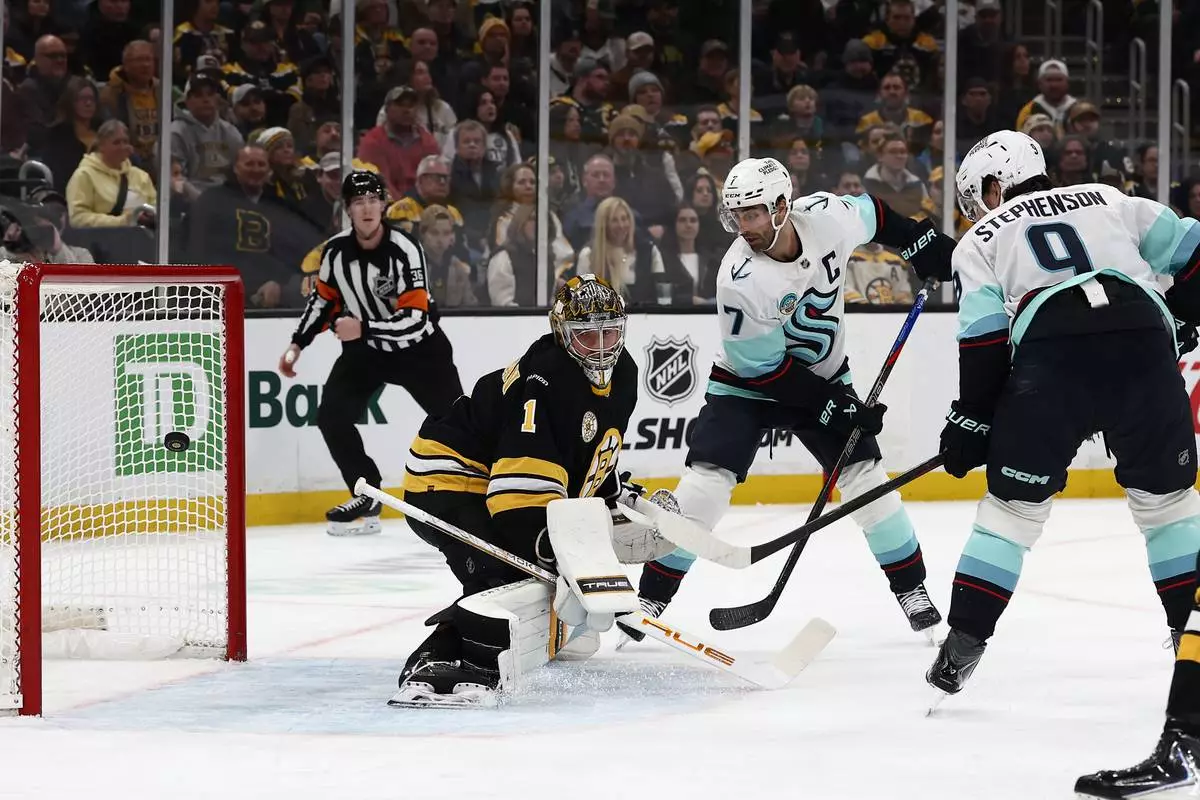
Seattle Kraken's Chandler Stephenson deflects the puck past Boston Bruins goaltender Jeremy Swayman for a goal during the first period of an NHL hockey game, Thursday, Jan. 15, 2026, in Boston. (AP Photo/Winslow Townson)