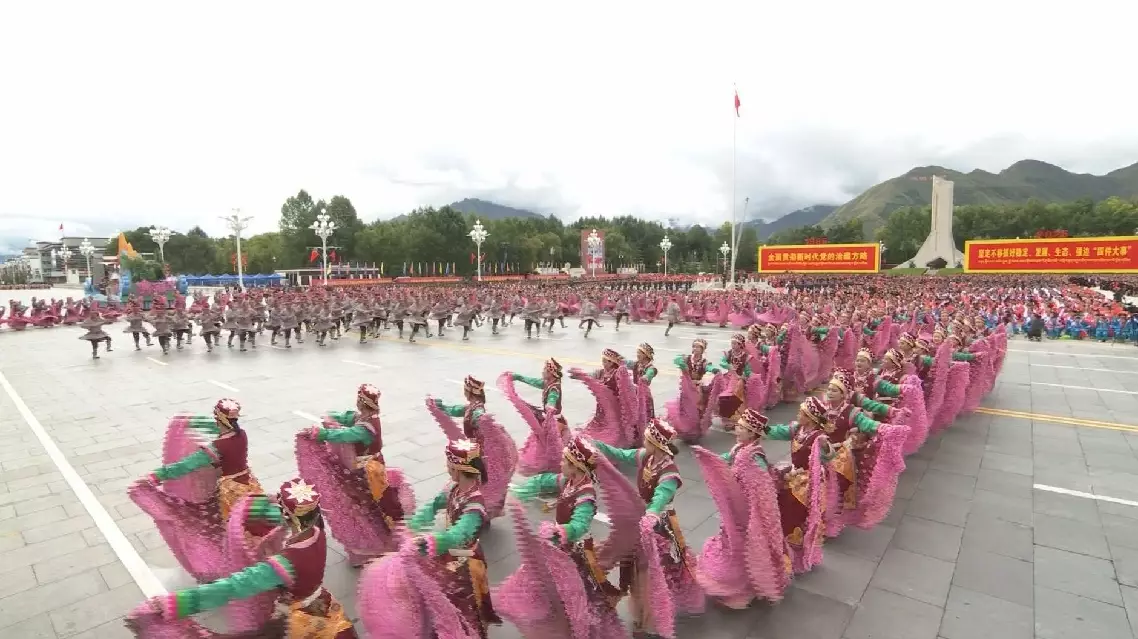
Performers dressed in both traditional costumes intricately sewn with intangible cultural heritage craft and modern apparels to demonstrate the great transformation of southwest China's Xizang Autonomous Region at a grand parade celebrating the plateau region's 60th founding anniversary in the capital Lhasa on Thursday.
At the grand gathering, each of the seven teams from the seven prefectures and cities of Xizang staged a one-minute performance.
Their dazzling costumes, distinctive instruments and spirited dances formed a living anthology of China's national intangible cultural heritage, while showcasing each region's unique cultural charm and uplifting spirit.
The first to appear was the Lhasa team.
Dressed in traditional Lhasa garments whose lineage stretches back 1,300 years, the performers exuded solemn elegance.
During their dancing, they replaced the ancient robes in an instant of only three seconds with modern Tibetan attire.
The startling change produced a breathtaking visual impact.
"When we first brainstormed how Lhasa's young men and women could stand out, two choreographers hit on the idea of an on-stage costume change, using our clothing to illustrate 60 years of Xizang's transformation," said Tashi Wangdu, director of the Lhasa team.
Next came the delegation of Xigaze City performing the Jiaxie dance, inscribed in 2008 on China's national intangible heritage list.
Such grand performance is traditionally reserved for the most momentous occasions.
The dancers of Shannan City, the only all-male squad, came next.
A total of 225 dancers in crimson Tibetan wool cloaks performed the 1,300-year-old Jiuhe Dro Dance, another intangible cultural heritage item.
Originally a work song that accompanied house-building, the dance now rallies morale and heightens festive atmosphere.
The team of Ngari Prefecture blended men's Xuangu drums with women's Xuanwu dance.
The women's eye-catching "peacock robes" stole the spotlight.
Now, Kejia Village in Purang County still preserves seven authentic peacock costumes.
"Peacock robes date back 1,000 years, inspired by the proud display of a peacock's tail. My cape is unveiled for the first time. Unlike the shawls of ordinary peacock costumes, the sleeves of this one are not worn but left to drape gracefully behind, exuding nobility and elegance," Yeshe Tsogyel, a performer of the Ngari delegation.
Parade performers display Xizang's rich cultural heritage through Tibetan attires