China is accelerating the building of a national platform to consolidate and monitor computing power resources across the country, marking a strategic move to strengthen its digital infrastructure amid surging demand driven by artificial intelligence (AI).
At the 2025 China computational power conference, which was held in north China's Datong City from Friday to Sunday, Chinese authorities said that so far, ten provincial-level regions have joined the platform, laying the groundwork for a unified national network capable of supporting large-scale AI applications and industrial innovation.
The platform intends to gather computing power resources from different regions and sectors to conduct full-scale collection and dynamic monitoring of facilities and data, enabling a more precise understanding of computing power development nationwide, according to experts.
"For now, the platform has over 100 computing service providers and more than 1,000 industry users. It now includes nearly 100 mainstream basic large models and vertical models, offering diversified online invocation services for over 1,000 developers," said Wei Liang, deputy director at the China Academy of Information and Communications Technology.
China's computing power has grown at an annual rate of about 30 percent in recent years, driven by the accelerating adoption of AI technologies.
"Till 2035, AI will contribute more than 11 trillion yuan (about 1.53 trillion U.S. dollars) to China's GDP, taking up four to five percent of the total. This could drive a tenfold or even a hundredfold increase in the demand for computing power," said Rao Shaoyang, director at the Strategic Development Institute of China Telecom Research Institute.
Computing power is now deeply embedded in key sectors such as generative AI models, autonomous driving, embodied intelligence, smart city development, and industrial manufacturing.
This year, China's computing power capacity is projected to expand by over 40 percent, underscoring its pivotal role in driving technological advancement and economic growth.
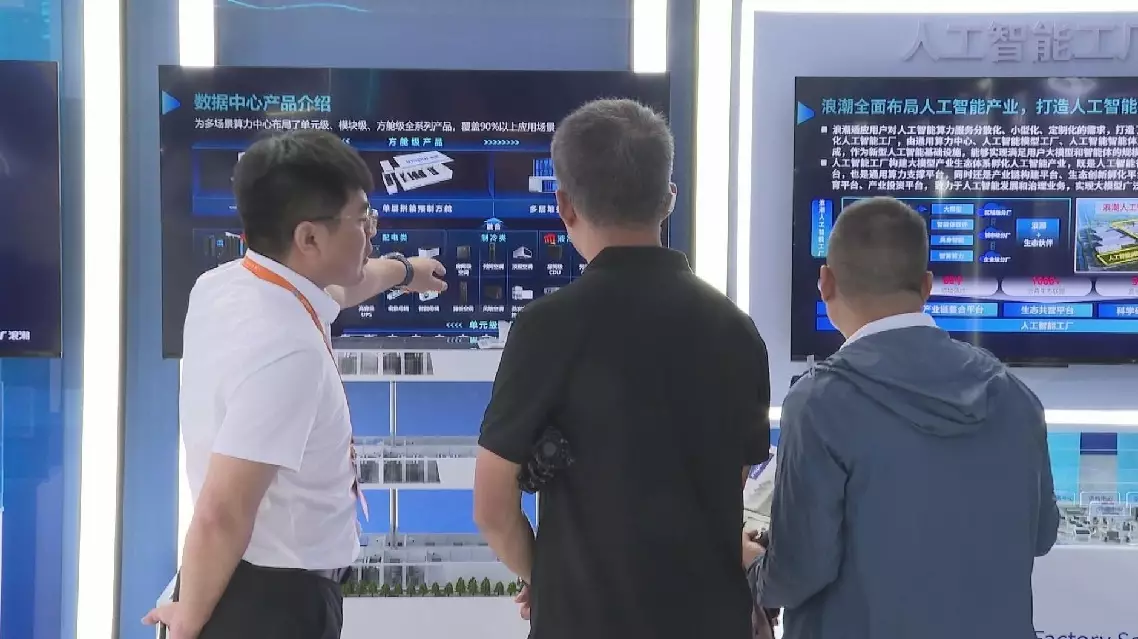
China steps up national platform building to pool computing resources across regions
Attempts to curb China's scientific and technological advancement are futile, a fact that has already been proven, said Kishore Mahbubani, former permanent representative of Singapore to the United Nations, in an interview aired Friday.
In an exclusive interview with China Central Television (CCTV) in Beijing, Mahbubani said he had stated this position in one of his articles published in the United States.
"Actually, I published an article, you know the two, I guess two leading journals in the United States on international relations. One is Foreign Affairs and the other is Foreign Policy. And last year I co-authored an article with two other co-authors, saying that all the efforts to stop China's scientific and technological development will fail. And it has failed always. You know, for example, the Soviet Union tried to prevent the spread of nuclear technology to China, China develops its own. The United States didn't want to share its technology on international space station with China. China develops its own space station. So clearly, efforts to stop China in the area of scientific innovation and technological development have failed. And so it'd be wiser for the West, including United States, to work with China other than to try and stop China seek development," he said.
Regarding China's progress on robots, Mahbubani said China is leading the world in the sector and hopes the country will share its expertise with the rest of the world.
"If there's one country that is preparing for the future well, it is China, because one in six human beings in the world is Chinese. But one in three robots in the world is Chinese, and one in two baby robots being born every day is Chinese. So China is producing far more robots than any other country is. So clearly it's preparing for the world of the future when we will have, for example, labor shortages, as you know, as you develop an aging society. So China is wisely investing in robots. But I hope that China will also share its learning and expertise with other countries. Also because the robots like that can also be helpful even to developing countries cause you can enhance the productivity of their populations, of their factories and so on so forth. So the world should be happy that China is leading the world in manufacturing, producing robots," he said.

Attempts to stop China's sci-tech development doomed to fail: former Singaporean diplomat