Astronauts on the Chinese space station Tiangong have recently worked in coordination with ground-based researchers to complete an experiment in which tungsten alloy was heated to over 3,100 degrees Celsius.
Since the beginning of this year, the space application system under the Chinese Academy of Sciences has implemented 58 scientific and application projects in orbit, making a series of new progress.
The experiment was led by a research team from the School of Physical Science and Technology at Northwestern Polytechnical University. In a ground-based laboratory, the team developed an electrostatic levitation device that uses the electric force to overcome gravity, allowing the experimental materials to maintain a stable suspension within the experiment cabinet aboard the space station. The team conducted extensive preliminary experiments in ground-based environments and subsequently designed a research plan for the space station.
"We conduct experiment on tungsten alloys aboard the space station for two main reasons. First, the microgravity on the space station allows tungsten metal to achieve a perfectly spherical state after melting, which is extremely beneficial for accurately determining its physical and chemical properties. Second, because tungsten has a very high density, adding other elements to it on the ground would form a layered, uneven structure, with heavier elements sinking and lighter elements floating up. However, making tungsten alloys aboard the space station results in a highly uniform structure and composition, which is highly beneficial for improving material performance," said Hu Liang, a professor at the school.
Tungsten has the highest melting point known to date, at 3,412 degrees Celsius. Due to its ultra-high melting point, tungsten and its alloys can be used in extreme environments such as nuclear fusion reactors.
Tungsten alloys have been successfully heated to over 3,100 degrees Celsius in the space station's containerless experiment cabinet, setting a new world record for the highest heating temperature in space materials science experiments.
The cabinet can hold samples in a state of suspension to avoid possible shape changes caused by contact with a container surface.
"This experiment not only validates the exceptional performance of China's independently designed space material science experiment cabinet, but also accumulates a wealth of raw data from on-orbit ultrahigh-temperature material experiment. These findings will provide an important theoretical basis for the design and performance improvement of new tungsten alloys, and will play a significant role in fundamental research on the application of ultrahigh-temperature materials in the nuclear industry and aerospace," Hu said.
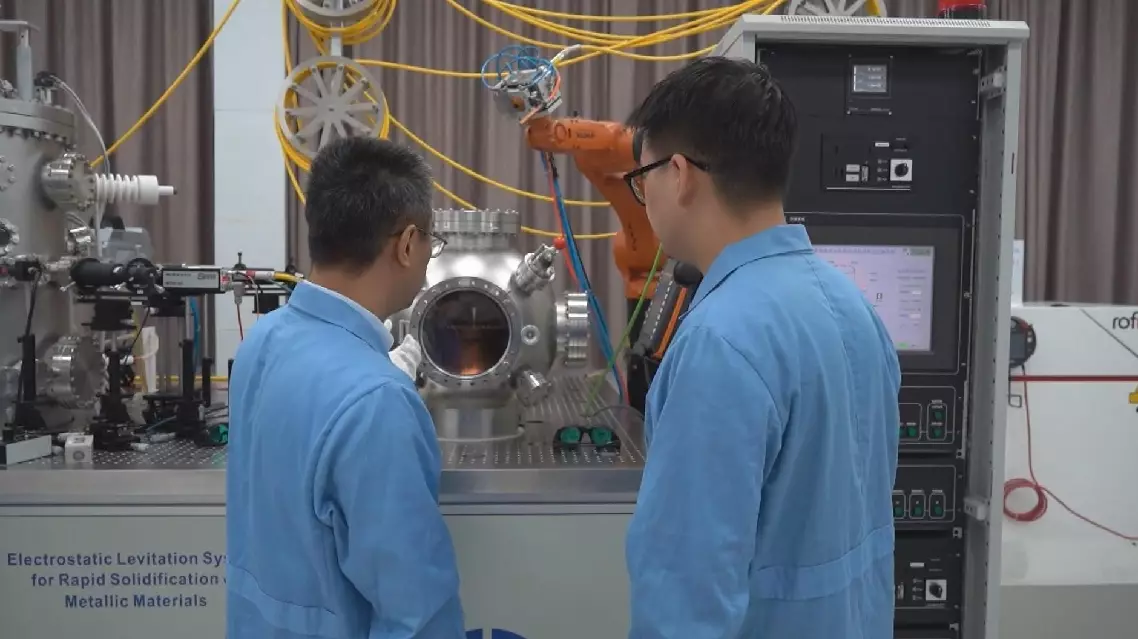
Chinese researchers make progress in space tungsten heating experiment