A series of ecological corridors constructed in the Mount Fanjing, southwest China's Guizhou Province have served as essential pathways for the critically endangered Guizhou snub-nosed monkey to expand their habitats.
With a population of only around 850, the Guizhou snub-nosed monkey is under top-level state protection in China. It is one of five snub-nosed monkey species globally and one of the three endemic to China.
Their habitat, Mount Fanjing, boasts a geological history dating back 1.4 billion years. Its ancient forests of fir, hemlock, and dove trees provide a specialized ecosystem for the monkeys, but also limit their interaction with the outside world.
"The core habitat of the Guizhou snub-nosed monkey is formed by ancient metamorphic rock and karst topography. The surrounding steep peaks and deep valleys create natural barriers, confining the monkeys in the areas of Mount Fanjing," said Zhao Jing, an engineer at the Mount Fanjing National Nature Reserve Administration.
In recent years, human activities such as tourism development and road construction have further disrupted the monkey's habitats.
To address this challenge, a project was launched in 2023 by the counties of Yinjiang, Songtao and Jiangkou, where Mount Fanjing is located.
A total of seven corridors, extending 46 kilometer long, have been built to reconnect the fragmented habitats, expanding the monkeys' home by 295 square kilometers.
These corridors are carefully designed to meet the monkeys' needs, featuring their preferred tree species, drinking water points, and monitoring equipment.
"After more than two years of research, we estimate the current population of Guizhou snub-nosed monkeys to be around 850," said Ran Jingcheng, director of Guizhou Academy of Forestry Sciences.
Boasting rich natural resources and high vegetation coverage, Mount Fanjing was listed as a UNESCO World Natural Heritage Site in 2018.
To better protect wildlife species and their habitats, China designated 49 candidate areas by the end of 2022, covering around 1.1 million square kilometers, as national park space. Mount Fanjing is one of them.
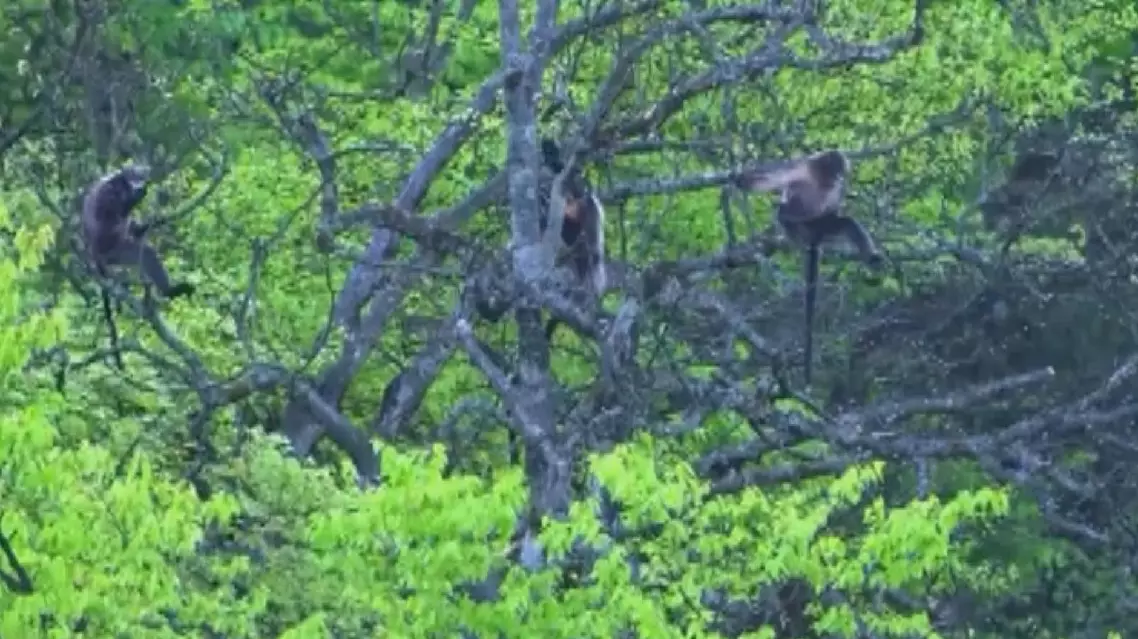
Ecological corridor expands habitat for snub-nosed monkeys in southwest China's Guizhou