Court users may use integrated Court Case Management System for commercial cases, construction and arbitration cases, and intellectual property cases in High Court
The following is issued on behalf of the Judiciary:
The Judiciary announced that starting from August 29, the integrated Court Case Management System (iCMS) will be extended to cover commercial cases (HCCL), construction and arbitration cases (HCCT), and intellectual property cases (HCIP) in the Court of First Instance of the High Court to allow court users to handle filing and payments electronically.
Progressively implemented across various court levels, the iCMS aims to facilitate the electronic handling of court-related documents and payments, offering a convenient, all-in-one and all-weather solution for filing documents anytime, anywhere. Major electronic services include sending and receiving case-specific court documents to and from the courts, inspecting or searching filed documents and other case-related information held by the courts, searching cause books, and making payments for court services.
The iCMS application currently covers personal injury actions, tax claim proceedings, civil action proceedings and employees' compensation cases in the District Court, summons cases in the Magistrates' Courts, bulk claims in the Small Claims Tribunal, and civil appeal cases (CACV) in the Court of Appeal of the High Court. It will then be extended incrementally to other case types in the High Court, including HCCL, HCCT and HCIP cases with effect from August 29.
Using the iCMS obviates the need for court users to file or submit documents to the courts in paper form, providing convenience and enhancing efficiency for court users. Case parties, particularly law firms, are strongly encouraged to use e-filing for iCMS-enabled case types in the High Court, namely CACV, HCCL, HCCT and HCIP. With the iCMS, there is no need to visit the court building to upload scanned documents and make payments for paper filing.
The Judiciary has been proactively reaching out to law firms that handle a relatively high volume of CACV, HCCL, HCCT and HCIP cases to offer dedicated technical support, with a view to facilitating their early migration from conventional paper mode to the iCMS. Specifically, from August 29, law firms are invited to make an appointment with the Judiciary for technical assistance on using the iCMS, either at the High Court Building or in their own offices, when they are initiating a new case of an iCMS-enabled case type for the first time. This aims to encourage them to try using e-filing (instead of paper filing) for case initiation in preparation for mandatory e-filing in future. The Judiciary also welcomes any law firms to approach it early for assistance in this regard.
To encourage migration to the iCMS, a 20 per cent concession is offered to iCMS users for three years on fee items of the High Court that are primarily or directly related to the electronic handling of court documents.
Eligible users need to register for a user account to access the full range of services under the iCMS. They include parties of ongoing or new e-proceedings and their legal representatives (if any), the Hong Kong Bar Association, the Law Society of Hong Kong, law firms, government departments, law enforcement agencies and statutory bodies. Registration is free of charge.
Unregistered members of the public may also use certain types of iCMS services, mainly related to searching for electronic documents that are open to public inspection.
Regarding technical requirements, the iCMS can be accessed using personal computers or mobile devices with an Internet connection, commonly used operating systems and browsers.
The iCMS operates around the clock, except during system maintenance. Any e-filing and e-payment received under the iCMS after the registry and the accounts office are normally closed to the public (i.e. after 5.30pm on a working day) will be deemed to be received at the start of the normal opening hours of the registry and the accounts office on the following working day.
In the High Court, any party choosing to file or submit a document in paper form (instead of using the iCMS) for an iCMS-enabled case type must also provide an electronic copy of the document to facilitate the creation and maintenance of a complete set of e-filing records for e-inspection. Litigants-in-person (LiPs) can use the self-service kiosks located at the Resource Centre for Unrepresented Litigants in the High Court Building to scan and upload their documents to the iCMS. Non-LiPs, including law firms, are required to prepare the electronic copy of their documents on their own (outside the court building) and then use the kiosks solely for uploading the scanned documents to the iCMS. For law firms, this is the final transitional arrangement before the mandatory use of the iCMS for case types where the electronic mode has been made available, starting in 2026.
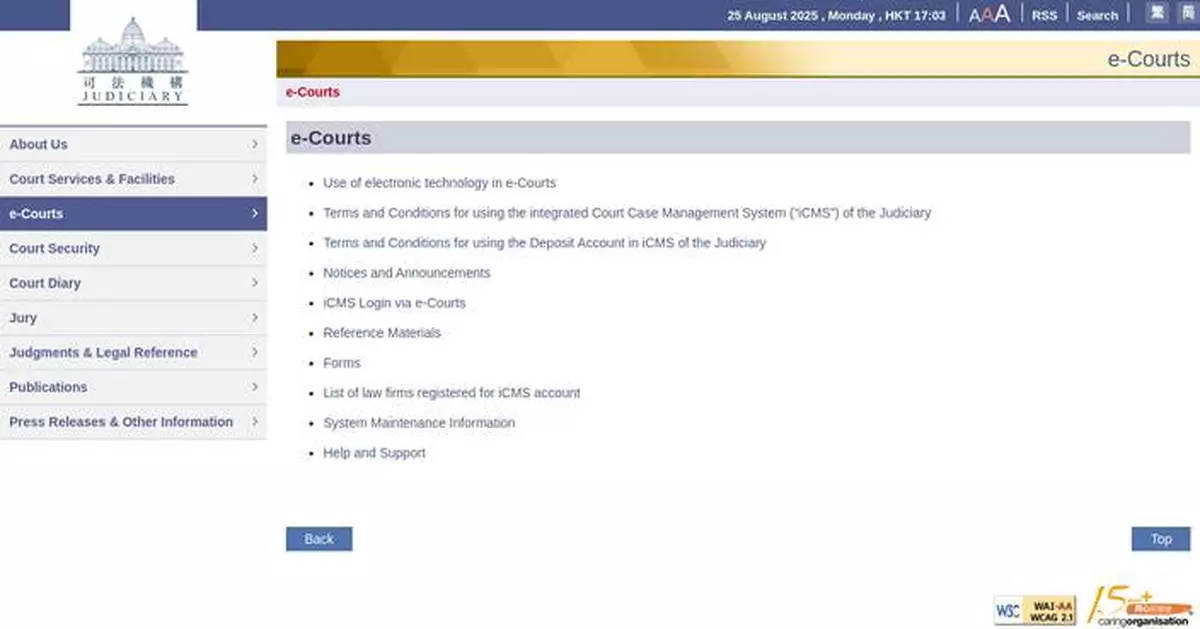
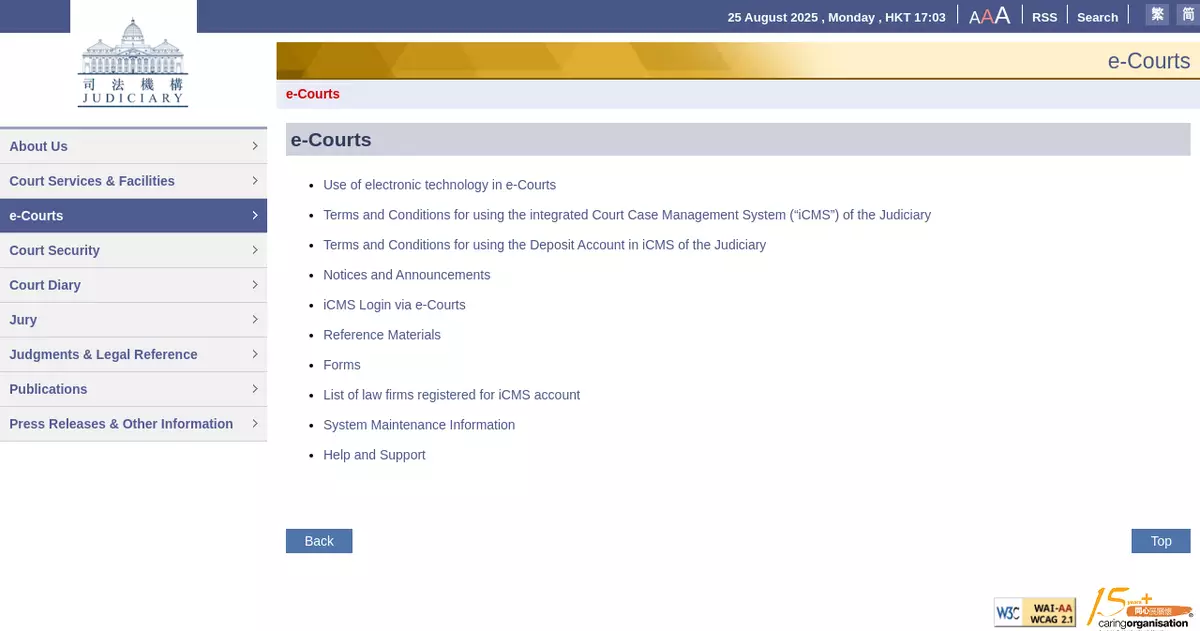
For more details about the iCMS, including its technical requirements, please visit the dedicated webpage on e-Courts of the Judiciary website atwww.judiciary.hk/en/e_courts/index.html.
For enquiries, please call the general enquiry hotline at 2477 1002 or the technical helpline at 2886 6474, email to enquiry@judiciary.hk or visit the Help Centre at 5/F, Wanchai Tower, 12 Harbour Road, Wan Chai.
Source: AI-found images