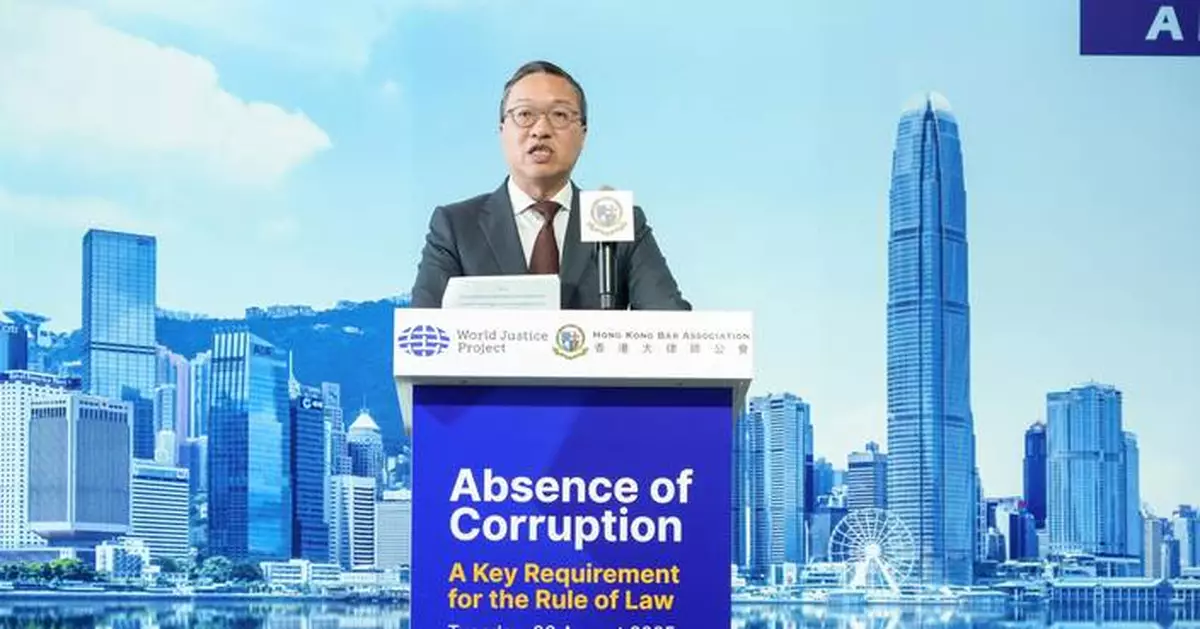
Speech by SJ at Hong Kong Bar Association - World Justice Project Conference "Absence of Corruption - A Key Requirement for the Rule of Law"
Following is the speech by the Secretary for Justice, Mr Paul Lam, SC, at the Hong Kong Bar Association and World Justice Project Conference "Absence of Corruption - A Key Requirement for the Rule of Law" today (August 26):
Dr Plipat (Asia Pacific Regional Director of the World Justice Project, Dr Srirak Pilpat), Mr Justice Macrae (Vice President of the Court of Appeal of the High Court, Mr Justice Andrew Macrae), Mr Maurellet, SC (Chairman of the Hong Kong Bar Association, Mr José-Antonio Maurellet), distinguished guests, ladies and gentlemen,
Good morning. I am very pleased and honoured to have the chance of speaking at today's conference co-organised by the World Justice Project (WJP) and the Hong Kong Bar Association, which is the first time the WJP organises such an event in Hong Kong. Before we hear from our eminent speakers, let me try to set the scene.
The interrelationship between the rule of law and absence of corruption is universally recognised. In the United Nations Declaration of the High-level Meeting on the Rule of Law dated September 19, 2012, member states recognised the negative impact of corruption, which obstructs economic growth and development, erodes public confidence, legitimacy and transparency, and hinders the making of fair and effective laws, as well as their administration, enforcement and adjudication; at the same time, they also stressed the importance of the rule of law as an essential element in addressing and preventing corruption.
Hong Kong is perhaps one of the best places to hold a conference on this important topic. Ever since 2015, Hong Kong has always been ranked within the top 10 in the factor component of "Absence of Corruption" under the WJP Rule of Law Index. This factor component takes into account three forms of corruption, namely bribery, improper influence by public or private interests, and the misappropriation of public funds or other resources. These three forms of corruption are examined with respect to government officers in the executive branch, the judiciary, the military, the police, and the legislature.
Corruption was widespread and a major social problem in Hong Kong in the 1960s and early 1970s. However, in a few decades' time, Hong Kong has become one of the least corrupt places in the world. In my view, Hong Kong's successful transformation in such a short time can be attributed to three main factors: first, our comprehensive legal framework; second, strong and independent law enforcement agencies and judiciary; and third, a deep anti-corruption culture in society.
Comprehensive legal framework
First, as to our anti-corruption law, even though bribery has always been a common law offence and the first Hong Kong anti-corruption statute was made back in 1898 namely, the Misdemeanors Punishment Ordinance, the most important development was undoubtedly the enactment of the Prevention of Bribery Ordinance (POBO) in 1971. POBO introduced novel offences and wide powers of investigations. For example, s.10 of POBO creates the offence of "possession of unexplained property", which imposes upon a public office holder the burden of giving a satisfactory explanation if he maintains a standard of living above that which is commensurate with his present or past emoluments, or if he is in control of pecuniary resources or property disproportionate to his past or present emoluments.
In addition to POBO, which is general in nature, there are other more specific anti-corruption statutes, such as the Elections (Corrupt and Illegal Conduct) Ordinance, which prohibits corrupt conduct and illegal conduct at elections.
Apart from statutory offences, the common law offence of misconduct in public office (MIPO) is a powerful anti-corruption legal tool. In the judgment of our Court of Final Appeal (CFA) in Hong Kong Special Administrative Region (HKSAR) v Hui Rafael Junior (2017) 20 HKCFAR 264, the CFA held that this common law offence may include solicitation or acceptance of a bride. The following acts and omissions have been held to constitute the offence: failing to disclose a relationship with a company and showing preferential treatment to that company by permitting it to tender for government contracts despite lacking the requisite experience; accepting free sexual favours provided by prostitutes controlled by the owner of a nightclub; obtaining and using the personal particular of patients of a public hospital to advertise the commencement of a private medical practice. The essence of the offence is the abuse of public trust by the officer. Hence, in that case, the CFA upheld the conviction against the defendant who, in anticipation of his appointment to a senior public office, received large sums of money from others as a "general sweetener" for favourable inclination while in office.
Criminal offences, whether under the common law or statutes, are supplemented by causes of action under our civil law, in particular, the law of constructive trusts, which may be used to compel corrupt public officials to disgorge illegal benefits derived from corruption. The common law principle was laid down by the Privy Council in its landmark opinion in AG for Hong Kong v Reid [1994] 1 AC 324, where it was held that bribe money received by a high-ranking government official, and the overseas property acquired thereafter by him and his wife with the bribe money, were held on constructive trust for the Hong Kong Government, and had to be given over to the Government on the ground that an employer obtains a proprietary interest in a bribe received by his employee.
In addition to the general duty to obey the relevant laws, public officers are obliged to comply with relevant codes of conduct in this respect which form part and parcel of their employment contracts. For example, the Civil Service Code requires all civil servants to stay vigilant against corrupt practices, observe the highest standards of conduct and guard against possible breach of POBO and MIPO; they should ensure that no actual, perceived or potential conflict of interest will arise between their official duties and private interests; they should not use their official position to further personal interests or the private interest of others; they should not solicit or accept, directly or indirectly, any advantage of a gift which would influence, or might reasonably be seen to influence, the discharge of their duties and responsibilities. The Code for Officials under the Political Appointment System contains similar provisions; and because they will have access to highly sensitive information, they are also required to declare their investments and interests and such declarations will be made available for public inspection.
Importantly, while the WJP places emphasis on absence of corruption in the public sector, the laws of Hong Kong are equally strict insofar as corruption in the private sector is concerned. Section 9 of POBO makes it an offence for a person to offer an agent, or for an agent to solicit or accept, an advantage in return for him doing an act in relation to his principal's affairs or business. "Agent" includes any person employed by or acting for another. The Court of Appeal in HKSAR v Fung Hok Cheung [2008] 5 HKLRD 846 rejected the argument that a principal/agent relationship will only arise when a fiduciary relationship exists between those two persons; and held that the word "agent" should be given its natural and ordinary meaning not restricted by the principles of agency developed in the common law of contract. The civil remedies based on constructive trust that I have mentioned a moment ago are equally applicable to agents receiving brides in the private sector.
Strong and independent law enforcement agencies and judiciary
Let me turn to the second key factor. No matter how comprehensive the laws are, they can only achieve their intended purposes if they can be, and are in fact, enforced effectively. While many law enforcement agencies are involved, the turning point insofar as the Hong Kong experience is concerned must be the establishment of the IndependentCommission Against Corruption in 1974. Apart from being given very wide investigation and related powers, the most crucial feature is its independence. S.5(2) of the Independent Commission Against Corruption Ordinance provides expressly that "The Commissioner shall not be subject to the direction or control of any person other than the Chief Executive."
Having regard to the fact that Hong Kong is an international financial centre, it is worth mentioning that the Securities and Futures Commission, an independent statutory body set up pursuant to the Securities and Futures Commission Ordinance responsible for the regulation of Hong Kong's securities and futures markets, has a strong focus on tackling corruption, particularly related to market manipulation and other financial misconduct.
The significant contributions made by our strong and independent judiciary must, of course, not be overlooked. The judgments that I have referred to are good examples where our courts developed important jurisprudence in relevant areas of the law, and ensured that they would be fairly and properly applied.
Deep anti-corruption culture
The third key factor, namely, a deep anti-corruption culture in society is, in my view, probably the most critical one. Many fellow citizens belonging to the older generations of Hong Kong were once victims of corruption: for example, in the old days, even hospital amahs would ask for "tips" before giving patients a glass of water. Most naturally, they would share their painful experiences with the younger generations. Today, as a result of the tremendous efforts made by the Hong Kong people collectively, Hong Kong has become one of the least corrupt places in the world. Hong Kong's global competitiveness has risen back to the third place in the IMD World Competitiveness Ranking 2025; and most importantly for the present purpose, Hong Kong's ranking of "Bribery and corruption do not exist" as one of the criteria under the competitiveness factor "Government Efficiency" is the fourth in the world, and the first in the Asia-Pacific region. Hong Kong people, of course, cherish and are proud of these achievements. We have zero-tolerance to corruption; and are very proactive in reporting and assisting in the investigation of suspected corruption cases. I would venture to suggest that anti-corruption has already become an integral part of the "genetic makeup" of Hong Kong people.
The future
While there is no room for complacency, I have full confidence that HongKong's fight against corruption will go from strength to strength in future. Putting aside the fact that the anti-corruption culture is already ingrained in our society, another very important reason is that the comprehensive legal framework as well as our strong and independent institutions are well preserved by the Basic Law pursuant to the fundamental and long-lasting principle of "one country, two systems". For example, the Basic Law provides constitutional guarantees that the common law system shall continue; the judiciary shall have independent judicial power including that of final adjudication; and the Commission against Corruption shall function independently and be accountable to the Chief Executive.
International co-operation
Lastly, let me turn to international co-operation, it is essential in the fight against corruption. The United Nations (UN) Convention Against Corruption is applicable to Hong Kong; and Hong Kong is an active member of relevant international organisations such as the United Nations Office on Drugs and Crime. In the past decade, the Department of Justice has processed over 2 800 mutual legal assistance requests and more than 40 surrender cases that concern offences covered by the UN Convention.
Another important aspect of international co-operation is capacity building and experience sharing. International independent non-government organisations such as the WPJ clearly play an important role in this respect. Today's conference serves as a prime example and an excellent starting point in our collaboration with WJP in this respect, and I therefore look forward to more collaborations between the WJP and Hong Kong in future. On this note, I wish you all a very constructive and enjoyable conference. Thank you.

Source: AI-found images

Speech by SJ at Hong Kong Bar Association - World Justice Project Conference "Absence of Corruption - A Key Requirement for the Rule of Law" Source: HKSAR Government Press Releases
Source: AI-found images