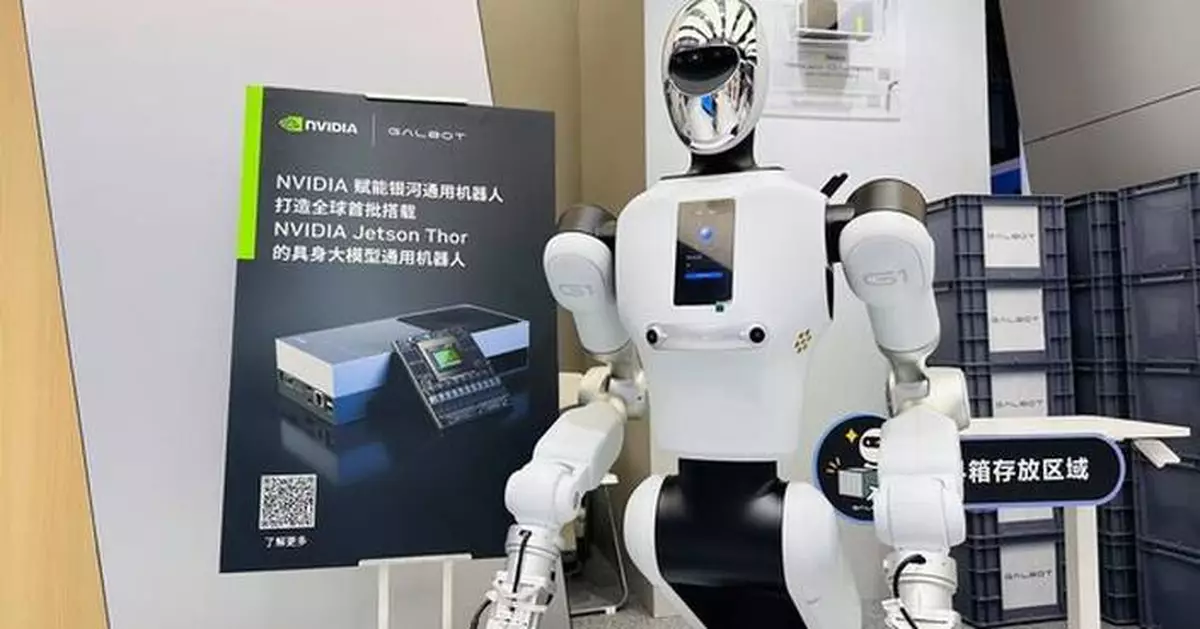
BEIJING, Aug. 26, 2025 /PRNewswire/ -- Galbot, a global leader in embodied intelligence and robotics, is integrating NVIDIA Jetson AGX Thor into its G1 Premium robot, recently shown at the World Robotics Conference (WRC). As one of the early adopters in the industry, Galbot is leveraging Jetson Thor to elevate performance—unlocking swifter, smoother, and more intelligent autonomy—while setting new benchmarks for deployment across retail, healthcare, and logistics sectors.
By integrating NVIDIA Jetson Thor, Galbot has significantly raised the bar for general-purpose robotics, accelerating its roadmap and demonstrating how cutting-edge compute drives stronger autonomy and broader commercial deployment. Built on Jetson Thor, the G1 Premium has already achieved major gains in speed, fluidity, and real-time reasoning. With 7.5x the AI compute of the previous generation NVIDIA Jetson Orin and 3.5x greater energy efficiency, Galbot's robots can now execute complex planning and motion with a level of precision that redefines what's possible in embodied intelligence.
"Our G1 Premium, now running on NVIDIA Jetson Thor, delivers significant gains in speed and real-time reasoning, enabling our proprietary VLA models to achieve enhanced real-world performance" said Professor Wang He, Founder & CTO of Galbot. The robot's performance was showcased at the WRC, where the G1 Premium was recognized as the "swiftest humanoid worker."
Building on this foundation, Galbot has partnered with Tsinghua University and Shanghai Qi Zhi Institute to co-develop OpenWBT_Isaac—a specialized simulation platform for whole-body teleoperation of humanoid robots. Leveraging the OpenWBT system's full-body control capabilities and powered by NVIDIA L20/RTX 5880 Ada GPUs with virtual-real fusion, OpenWBT_Isaac enables efficient and advanced development of humanoid robotics.
At the core of Galbot's achievements is its unique Sim2Real methodology, which utilizes massive pre-training on large-scale, high-quality synthetic datasets and is refined with minimal real-world data. This approach drastically reduces dependence on costly real-world data collection while significantly improving generalizability across complex environments.
Galbot further demonstrated its technical capabilities by winning the championship at the World Humanoid Robot Games, competing fully autonomously without teleoperation and achieving first place in every round from preliminaries to finals. Driven by Galbot's proprietary Sim2Real methodology and large VLA models, Galbot's G1 robots are already operating fully autonomously in over10 pharmacies in Beijing, with plans to expand to over 100 locations nationwide by the year-end. Galbot has also partnered with leading manufacturers such as Bosch Group to deploy its AI-powered platform in smart production, replacing traditional robotic arms with more intelligent, adaptable solutions.
** The press release content is from PR Newswire. Bastille Post is not involved in its creation. **
Galbot to Accelerate Robotics with NVIDIA Jetson Thor
SAN MATEO, Calif., Dec. 13, 2025 /PRNewswire/ -- AI infrastructure company EverMind has recently released EverMemOS, an open-source Memory Operating System designed to address one of artificial intelligence's most profound challenges: equipping machines with scalable, long-term memory.
The Memory Bottleneck
For years, large language models (LLMs) have been constrained by fixed context windows, a limitation that causes "forgetfulness" in long-term tasks. This results in broken context, factual inconsistencies, and an inability to deliver deep personalization or maintain knowledge coherence. The issue extends beyond technical hurdles; it represents an evolutionary bottleneck for AI. An entity without memory cannot exhibit behavioral consistency or initiative, let alone achieve self-evolution. Personalization, consistency, and proactivity, which are considered the hallmarks of intelligence, all depend on a robust memory system.
There is a consensus that memory is becoming the core competitive edge and defining boundary of future AI. Yet existing solutions, such as Retrieval-Augmented Generation (RAG) and fragmented memory systems, remain limited in scope, failing to support both 1-on-1 companion use cases and complex multi-agent enterprise collaboration. Few meet the standard of precision, speed, usability, and adaptability required for widespread adoption. Equipping large models with a high-performance, pluggable memory module remains a core unmet demand across AI applications.
Discoverative Intelligence
"Discoverative Intelligence" is a concept proposed in late 2025 by entrepreneur and philanthropist Chen Tianqiao. Unlike generative AI, which mimics human output by processing existing data, Discoverative Intelligence describes an advanced AI form that actively asks questions, forms testable hypotheses, and discovers new scientific principles. It prioritizes understanding causality and underlying principles over statistical patterns, a shift Chen argues is essential to achieving Artificial General Intelligence (AGI).
Chen contrasted two dominant AI development paths: the "Scaling Path," which relies on expanding parameters, data, and compute power to extrapolate within a search space, and the "Structural Path," which focuses on the "cognitive anatomy" of intelligence and how systems operate over time.
Discoverative Intelligence falls into the latter category, built on a brain-inspired model called Structured Temporal Intelligence (STI) that requires five core capabilities in a closed loop: neural dynamics (sustained, self-organizing activity to keep systems "alive"), long-term memory (storing and selectively forgetting experiences to build knowledge), causal reasoning (inferring "why" events occur), world modeling (an internal simulation of reality for prediction), and metacognition & intrinsic motivation (curiosity-driven exploration, not just external rewards).
Among these capabilities, long-term memory serves as the vital link between time and intelligence, highlighting its indispensable role in the path toward achieving true AGI.
EverMind's Answer
EverMemOS is EverMind's answer to this need: an open-source Memory Operating System designed as foundational technology for Discoverative Intelligence. Inspired by the hierarchical organization of the human memory system, EverMemOS features a four-layer architecture analogous to key brain regions: an Agentic Layer (task planning, mirroring the prefrontal cortex), a Memory Layer (long-term storage, like cortical networks), an Index Layer (associative retrieval, drawing from the hippocampus), and an API/MCP Interface Layer (external integration, serving as AI's "sensory interface").
The system delivers breakthroughs in both scenario coverage and technical performance. It is the first memory system capable of supporting both 1-on-1 conversation use cases and complex multi-agent enterprise collaboration. On technical benchmarks, EverMemOS achieved 92.3% accuracy on LoCoMo (a long-context memory evaluation) and 82% on LongMemEval-S (a suite for assessing long-term memory retention), significantly surpassing prior state-of-the-art results and setting a new industry standard.
The open-source version of EverMemOS is now available on GitHub, with a cloud service version to be launched late this year. The dual-track model, combining open collaboration with managed cloud services, aims to drive industry-wide evolution in long-term memory technology, inviting developers, enterprises, and researchers to contribute to and benefit from the system.
About EverMind
EverMind is redefining the future of AI by solving one of its most fundamental limitations: long-term memory. Its flagship platform, EverMemOS, introduces a breakthrough architecture for scalable and customizable memory systems, enabling AI to operate with extended context, maintain behavioral consistency, and improve through continuous interaction.
To learn more about EverMind and EverMemOS, please visit:
Website: https://evermind.ai/
GitHub: https://github.com/EverMind-AI/EverMemOS
X: https://x.com/EverMindAI
Reddit: https://www.reddit.com/r/EverMindAI/
** The press release content is from PR Newswire. Bastille Post is not involved in its creation. **

AI Infrastructure Company EverMind Released EverMemOS, Responding to Profound Challenges in AI