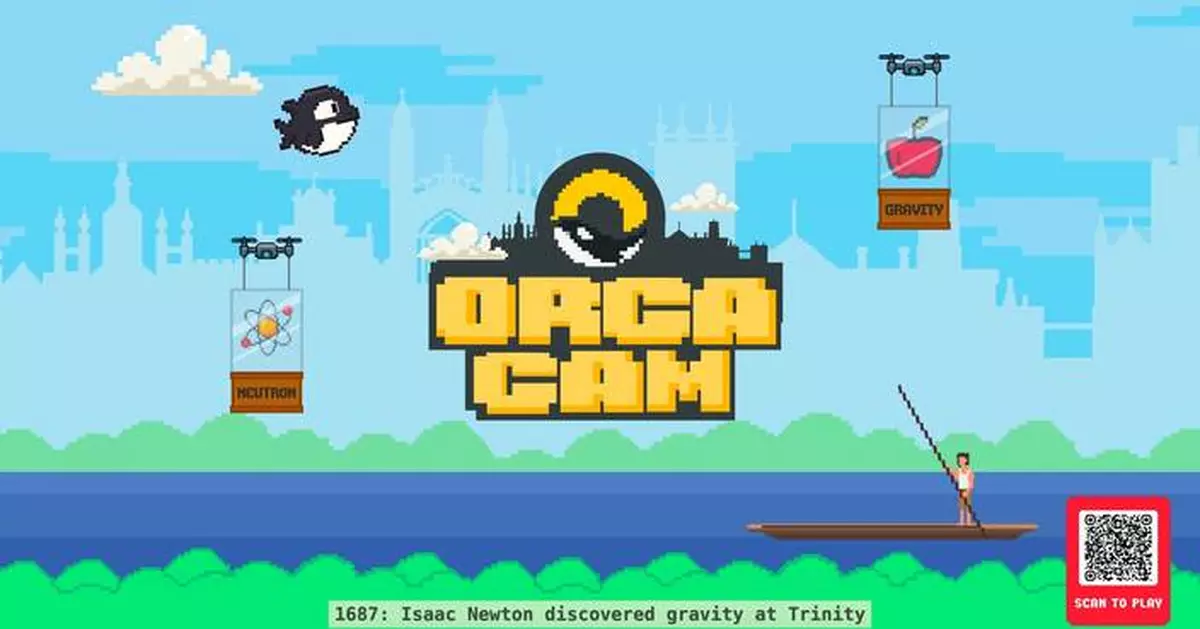
CAMBRIDGE, England, Sept. 3, 2025 /PRNewswire/ -- 'OrcaCam' showcases Cambridge's history of innovation and demonstrates how a simple QR code can instantly launch a cross-platform game on any device - with no download required.
As part of the award-winning Grand Discoveries Exhibition, Orca Scan has launched OrcaCam - a retro-style arcade game that challenges players to guide an orca through the River Cam, dodging a series of history-making innovations, including the discovery of DNA, the world's first successful heart transplant, the invention of the webcam and even the rules of football. Each obstacle reflects a real scientific or cultural contribution born in Cambridge.
John Doherty, Founder and CEO of Orca Scan, says: "Cambridge has changed the world in ways many might not realise. OrcaCam is our way of telling that story. Just scan the QR code to start playing instantly on your phone - no app, no install, just scan and play."
Orca Scan's in-house development team created the game, which officially launched on 4 August as part of Grand Discoveries 2025, a two-month event hosted and organised by Cambridge's Grand Arcade in partnership with over 20 leading science and technology organisations, including Raspberry Pi, University of Cambridge, QualComm, Illumina and Supersense Technologies. It invites visitors of all ages to explore the city's scientific and technological legacy through immersive exhibits and activities.
Julie Kervadec, Marketing Manager for the Grand Arcade, adds: "We're thrilled to welcome Orca Scan to Grand Discoveries. Their interactive exhibit and new game bring a fun, fresh perspective to innovation in Cambridge. As a Cambridge-born company, Orca Scan perfectly embodies the city's innovative spirit, and it's been a real pleasure to work with their team, who brought such creative ideas to the event."
A live leaderboard is inside Cambridge's Grand Arcade, and is expected to be seen by over 2 million people during the exhibition. For those unable to visit in person, OrcaCam is accessible online, allowing players worldwide to join in at https://orcascan.com/game.
Founded in Cambridge in 2016 and supported by the Judge Business School Accelerate Programme, Orca Scan helps organisations worldwide track inventory and assets using barcode technology, with no technical skills required. The platform is now used in 167 countries by over 50,000 organisations, including 58% of the Fortune 500.
Please see our media kit for images and gameplay videos.
** The press release content is from PR Newswire. Bastille Post is not involved in its creation. **

Scan, Play, Discover: Orca Scan Launches QR-Powered Retro Game
SAN MATEO, Calif., Dec. 13, 2025 /PRNewswire/ -- AI infrastructure company EverMind has recently released EverMemOS, an open-source Memory Operating System designed to address one of artificial intelligence's most profound challenges: equipping machines with scalable, long-term memory.
The Memory Bottleneck
For years, large language models (LLMs) have been constrained by fixed context windows, a limitation that causes "forgetfulness" in long-term tasks. This results in broken context, factual inconsistencies, and an inability to deliver deep personalization or maintain knowledge coherence. The issue extends beyond technical hurdles; it represents an evolutionary bottleneck for AI. An entity without memory cannot exhibit behavioral consistency or initiative, let alone achieve self-evolution. Personalization, consistency, and proactivity, which are considered the hallmarks of intelligence, all depend on a robust memory system.
There is a consensus that memory is becoming the core competitive edge and defining boundary of future AI. Yet existing solutions, such as Retrieval-Augmented Generation (RAG) and fragmented memory systems, remain limited in scope, failing to support both 1-on-1 companion use cases and complex multi-agent enterprise collaboration. Few meet the standard of precision, speed, usability, and adaptability required for widespread adoption. Equipping large models with a high-performance, pluggable memory module remains a core unmet demand across AI applications.
Discoverative Intelligence
"Discoverative Intelligence" is a concept proposed in late 2025 by entrepreneur and philanthropist Chen Tianqiao. Unlike generative AI, which mimics human output by processing existing data, Discoverative Intelligence describes an advanced AI form that actively asks questions, forms testable hypotheses, and discovers new scientific principles. It prioritizes understanding causality and underlying principles over statistical patterns, a shift Chen argues is essential to achieving Artificial General Intelligence (AGI).
Chen contrasted two dominant AI development paths: the "Scaling Path," which relies on expanding parameters, data, and compute power to extrapolate within a search space, and the "Structural Path," which focuses on the "cognitive anatomy" of intelligence and how systems operate over time.
Discoverative Intelligence falls into the latter category, built on a brain-inspired model called Structured Temporal Intelligence (STI) that requires five core capabilities in a closed loop: neural dynamics (sustained, self-organizing activity to keep systems "alive"), long-term memory (storing and selectively forgetting experiences to build knowledge), causal reasoning (inferring "why" events occur), world modeling (an internal simulation of reality for prediction), and metacognition & intrinsic motivation (curiosity-driven exploration, not just external rewards).
Among these capabilities, long-term memory serves as the vital link between time and intelligence, highlighting its indispensable role in the path toward achieving true AGI.
EverMind's Answer
EverMemOS is EverMind's answer to this need: an open-source Memory Operating System designed as foundational technology for Discoverative Intelligence. Inspired by the hierarchical organization of the human memory system, EverMemOS features a four-layer architecture analogous to key brain regions: an Agentic Layer (task planning, mirroring the prefrontal cortex), a Memory Layer (long-term storage, like cortical networks), an Index Layer (associative retrieval, drawing from the hippocampus), and an API/MCP Interface Layer (external integration, serving as AI's "sensory interface").
The system delivers breakthroughs in both scenario coverage and technical performance. It is the first memory system capable of supporting both 1-on-1 conversation use cases and complex multi-agent enterprise collaboration. On technical benchmarks, EverMemOS achieved 92.3% accuracy on LoCoMo (a long-context memory evaluation) and 82% on LongMemEval-S (a suite for assessing long-term memory retention), significantly surpassing prior state-of-the-art results and setting a new industry standard.
The open-source version of EverMemOS is now available on GitHub, with a cloud service version to be launched late this year. The dual-track model, combining open collaboration with managed cloud services, aims to drive industry-wide evolution in long-term memory technology, inviting developers, enterprises, and researchers to contribute to and benefit from the system.
About EverMind
EverMind is redefining the future of AI by solving one of its most fundamental limitations: long-term memory. Its flagship platform, EverMemOS, introduces a breakthrough architecture for scalable and customizable memory systems, enabling AI to operate with extended context, maintain behavioral consistency, and improve through continuous interaction.
To learn more about EverMind and EverMemOS, please visit:
Website: https://evermind.ai/
GitHub: https://github.com/EverMind-AI/EverMemOS
X: https://x.com/EverMindAI
Reddit: https://www.reddit.com/r/EverMindAI/
** The press release content is from PR Newswire. Bastille Post is not involved in its creation. **

AI Infrastructure Company EverMind Released EverMemOS, Responding to Profound Challenges in AI