Skip to Content Facebook Feature Image

The president blamed AI and embraced doing so. Is it becoming the new 'fake news'?

ENT

The president blamed AI and embraced doing so. Is it becoming the new 'fake news'?
ENT

ENT

The president blamed AI and embraced doing so. Is it becoming the new 'fake news'?

2025-09-04 12:02 Last Updated At:12:11

Artificial intelligence, apparently, is the new “fake news."

Blaming AI is an increasingly popular strategy for politicians seeking to dodge responsibility for something embarrassing — among others. AI isn't a person, after all. It can't leak or file suit. It does make mistakes, a credibility problem that makes it hard to determine fact from fiction in the age of mis- and disinformation.

And when truth is hard to discern, the untruthful benefit, analysts say. The phenomenon is widely known as “the liar's dividend.”

On Tuesday, President Donald Trump endorsed the practice. Asked about viral footage showing someone tossing something out an upper-story White House window, the president replied, “No, that's probably AI” — after his press team had indicated to reporters that the video was real.

But Trump, known for insisting the truth is what he says it is, declared himself all in on the AI-blaming phenomenon.

“If something happens that’s really bad," he told reporters, “maybe I’ll have to just blame AI.”

He's not alone.

On the same day in Caracas, Venezuelan Communications Minister Freddy Ñáñez questioned the veracity of a Trump administration video it said showed a U.S. strike on a vessel in Caribbean that targeted Venezuela’s Tren de Aragua gang and killed 11. A video of the strike posted to Truth Social shows a long, multi-engine speedboat at sea when a bright flash of light bursts over it. The boat is then briefly seen covered in flames.

“Based on the video provided, it is very likely that it was created using Artificial Intelligence,” Ñáñez said on his Telegram account, describing “almost cartoonish animation.”

Blaming AI can at times be a compliment. (“He’s like an AI-generated player,” tennis player Alexander Bublik said of his U.S. Open opponent Jannik Sinner's talent on ESPN ). But when used by the powerful, the practice, experts say, can be dangerous.

Digital forensics expert Hany Farid warned for years about the growing capabilities of AI “deepfake” images, voices and video to aid in fraud or political disinformation campaigns, but there was always a deeper problem.

“I’ve always contended that the larger issue is that when you enter this world where anything can be fake, then nothing has to be real,” said Farid, a professor at the University of California, Berkeley. “You get to deny any reality because all you have to say is, ‘It’s a deepfake.’”

That wasn't so a decade or two ago, he noted. Trump issued a rare apology ("if anyone was offended") in 2016 for his comments about touching women without their consent on the notorious “Access Hollywood" tape. His opponent, Democrat Hillary Clinton, said she was wrong to call some of his supporters “a basket of deplorables.”

Toby Walsh, chief scientist and professor of AI at the University of New South Wales in Sydney, said blaming AI leads to problems not just in the digital world but the real world as well.

“It leads to a dark future where we no longer hold politicians (or anyone else) accountable,” Walsh said in an email. “”It used to be that if you were caught on tape saying something, you had to own it. This is no longer the case."

Danielle K. Citron of the Boston University School of Law and Robert Chesney of the University of Texas foresaw the issue in research published in 2019. In it, they describe what they called “the liar's dividend.”

“If the public loses faith in what they hear and see and truth becomes a matter of opinion, then power flows to those whose opinions are most prominent—empowering authorities along the way," they wrote in the California Law Review. “A skeptical public will be primed to doubt the authenticity of real audio and video evidence.”

Polling suggests many Americans are wary about AI. About half of U.S. adults said the increased use of AI in daily life made them feel “more concerned than excited,” according to a Pew Research Center poll from August 2024. Pew’s polling indicates that people have become more concerned about the increased use of AI in recent years.

Most U.S. adults appear to distrust AI-generated information when they know that’s the source, according to a Quinnipiac poll from April. About three-quarters said they could only trust the information generated by AI “some of the time” or “hardly ever.” In that poll, about 6 in 10 U.S. adults said they were “very concerned” about political leaders using AI to distribute fake or misleading information.

They have reason, and Trump has played a sizable role in muddying trust and truth.

Trump's history of misinformation and even lies to suit his narrative predates AI. He's famous for the use of “fake news,” a buzz term now widely known to denote skepticism about media reports. Leslie Stahl of CBS' “60 Minutes” has said that Trump told her off camera in 2016 that he tries to “discredit” journalists so that when they report negative stories, they won't be believed.

Trump's claim on Tuesday that AI was behind the White House window video wasn't his first attempt to blame AI. In 2023, he insisted that the anti-Trump Lincoln Project used AI in a video to make him “look bad.”

In the spot titled ” Feeble,” a female narrator taunts Trump. “Hey Donald ... you’re weak. You seem unsteady. You need help getting around.” She questions his ”manhood," accompanied by an image of two blue pills. The video continues with footage of Trump stumbling over words.

“The perverts and losers at the failed and once-disbanded Lincoln Project, and others, are using A.I. (Artificial Intelligence) in their Fake television commercials in order to make me look as bad and pathetic as Crooked Joe Biden,” Trump posted on Truth Social.

The Lincoln Project told The Associated Press at the time that AI was not used in the spot.

Associated Press writers Ali Swenson in New York, Matt O'Brien in Providence, Rhode Island, Linley Sanders in Washington and Jorge Rueda in Caracas, Venezuela, contributed to this report.
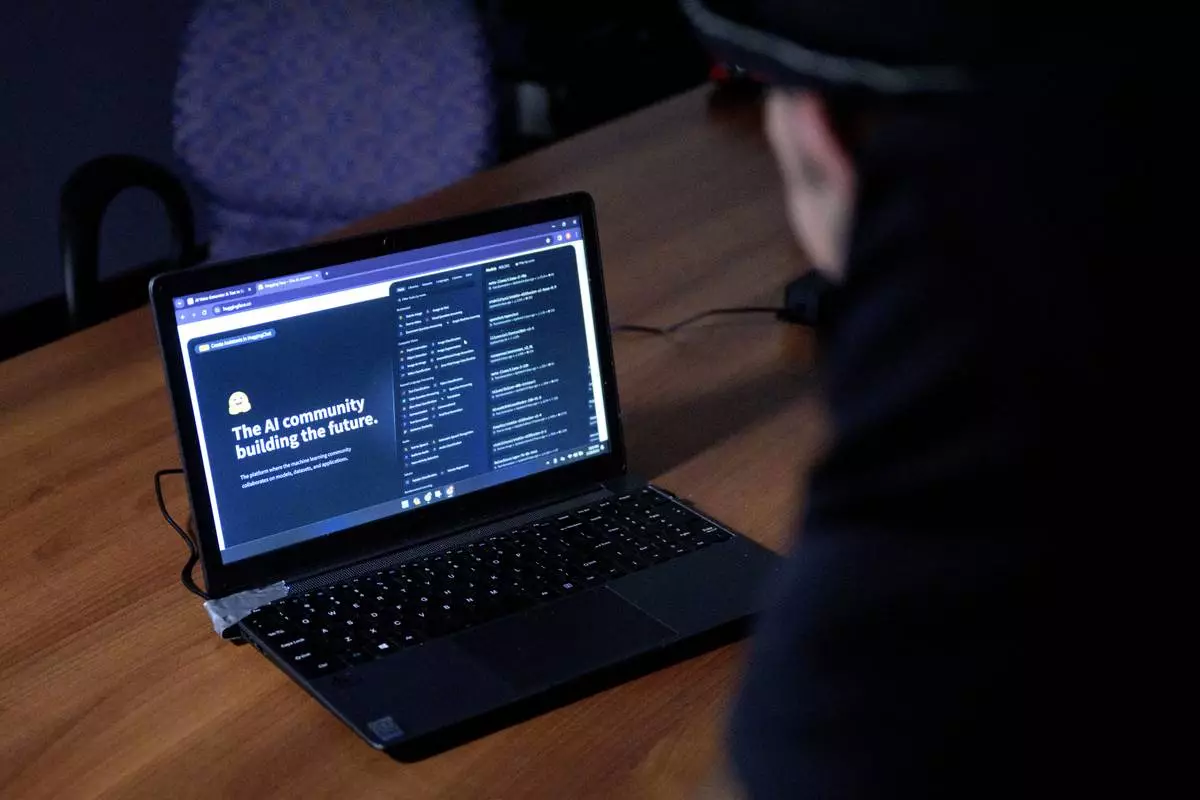
FILE - Paul Carpenter describes AI software during an interview in New Orleans, Feb. 23, 2024. (AP Photo/Matthew Hinton, File)
FILE - Paul Carpenter describes AI software during an interview in New Orleans, Feb. 23, 2024. (AP Photo/Matthew Hinton, File)

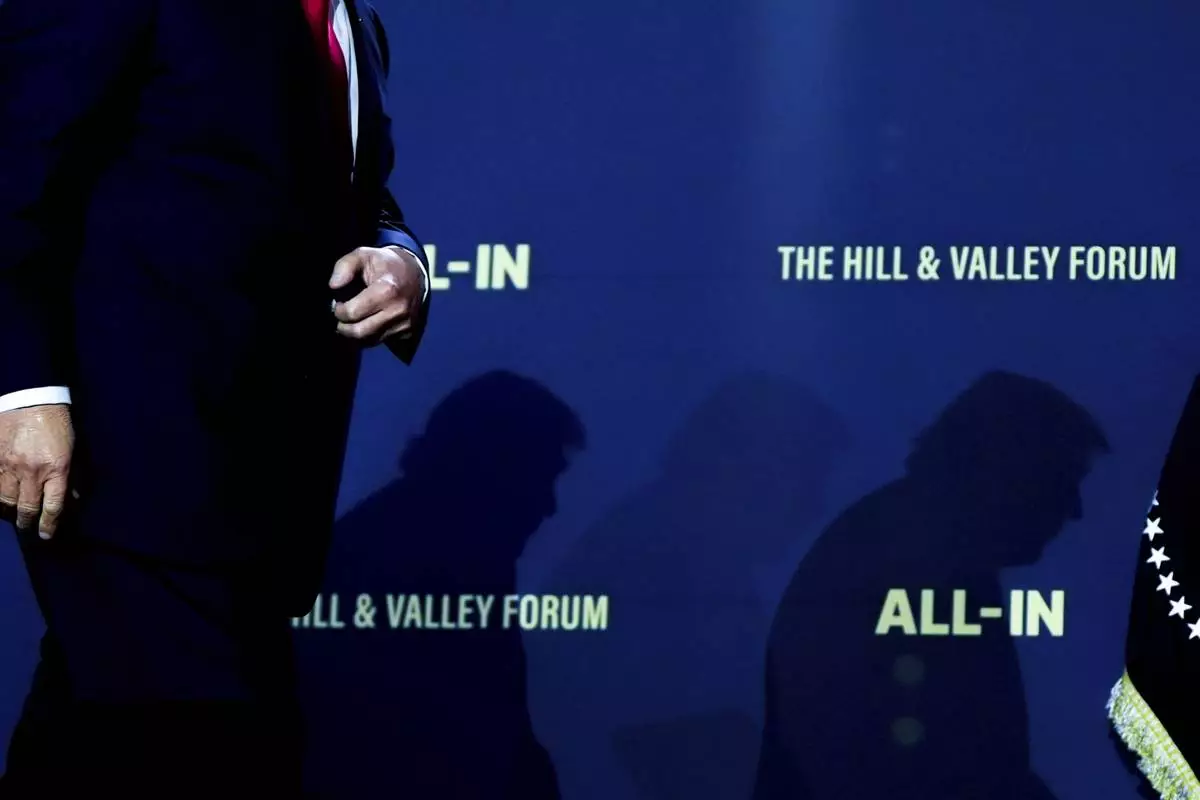
FILE - President Donald Trump walks to sign executive orders during an artificial intelligence summit at the Andrew W. Mellon Auditorium, July 23, 2025, in Washington. (AP Photo/Julia Demaree Nikhinson, File)
FILE - President Donald Trump walks to sign executive orders during an artificial intelligence summit at the Andrew W. Mellon Auditorium, July 23, 2025, in Washington. (AP Photo/Julia Demaree Nikhinson, File)
MINNEAPOLIS (AP) — President Donald Trump on Thursday threatened to invoke an 1807 law and deploy troops to quell persistent protests against the federal officers sent to Minneapolis to enforce his administration's massive immigration crackdown.

The threat comes a day after a man was shot and wounded by an immigration officer who had been attacked with a shovel and broom handle. That shooting further heightened the fear and anger that has radiated across the city since an Immigration and Customs Enforcement agent fatally shot Renee Good in the head.

Trump has repeatedly threatened to invoke the Insurrection Act, a rarely used federal law, to deploy the U.S. military or federalize the National Guard for domestic law enforcement, over the objections of state governors. In 2020, for example, he threatened to use the act to quell protests after George Floyd was killed by Minneapolis police, and in recent months he threatened to use it for immigration protests.

“If the corrupt politicians of Minnesota don’t obey the law and stop the professional agitators and insurrectionists from attacking the Patriots of I.C.E., who are only trying to do their job, I will institute the INSURRECTION ACT, which many Presidents have done before me, and quickly put an end to the travesty that is taking place in that once great State,” Trump said in social media post.

Presidents have invoked the law more than two dozen times, most recently in 1992 by President George H.W. Bush to end unrest in Los Angeles. In that instance, local authorities asked for the assistance.

“I’m making a direct appeal to the President: Let’s turn the temperature down. Stop this campaign of retribution. This is not who we are,” Gov. Tim Walz, a Democrat, said on X.

Minnesota Attorney General Keith Ellison said he would challenge any such action in court. He's already suing to try to stop the surge by the Department of Homeland Security, which says officers have arrested more than 2,500 people since Nov. 29 as part of an immigration operation in the Twin Cities called Metro Surge.

The operation grew when ICE, which is a DHS agency, sent 2,000 officers and agents to the area in early January.

Protesters gathered Thursday night at the federal building that is being used as a base for the crackdown, yelling “shame on you” at the officers guarding the facility.

Demonstrations have become common since Good was fatally shot Jan. 7, but this night's protest was slightly more subdued a day after the governor and mayor implored protesters to remain peaceful.

“This is an impossible situation that our city is presently being put in and at the same time we are trying to find a way forward to keep people safe,” Minneapolis Mayor Jacob Frey said Wednesday.

The American Civil Liberties Union of Minnesota filed a class-action lawsuit on behalf of three people who said they were questioned or detained in recent days. The lawsuit says two are Somali and one is Hispanic; all three are U.S. citizens. The lawsuit seeks an end to what the ACLU describes as a practice of racial profiling and warrantless arrests. The government did not immediately comment.

Similar lawsuits have been filed in Los Angeles and Chicago and despite seeing initial success, have tended to fizzle in the face of appeal. In Chicago, for example, last year a judge ordered a senior U.S. Border Patrol official to brief her nightly following a lawsuit by news outlets and protesters who said agents used too much force during demonstrations. But three days later, an appeals court stopped the updates.

Homeland Security said in a statement that federal law enforcement officers on Wednesday stopped a driver from Venezuela who is in the U.S. illegally. The person drove off then crashed into a parked car before fleeing on foot, DHS said.

Officers caught up, then two other people arrived and the three started attacking the officer, according to DHS.

“Fearing for his life and safety as he was being ambushed by three individuals, the officer fired a defensive shot to defend his life,” DHS said. The confrontation took place about 4.5 miles (7.2 kilometers) from where Good was killed.

Police Chief Brian O’Hara said the man who was shot did not have a life-threatening injury. O’Hara's account of what happened largely echoed that of Homeland Security, which later said the other two men were also in the U.S. illegally from Venezuela.

The FBI said several government vehicles were damaged and property inside was stolen when agents responded to the shooting. Photos show broken windows and insults made with paint. A reward of up to $100,000 is being offered for information. The FBI’s Minneapolis office did not immediately reply to messages seeking more details.

St. Paul Public Schools, with more than 30,000 students, said it would begin offering an online learning option for students who do not feel comfortable coming to school. Schools will be closed next week until Thursday to prepare for those accommodations.

Minneapolis Public Schools, which has a similar enrollment, is also offering temporary remote learning. The University of Minnesota will start a new term next week with different options depending on the class.

Madhani reported from Washington, and Golden from Seattle. Associated Press writers Sophia Tareen in Chicago, Bill Barrow in Atlanta, Rebecca Santana in Washington and Ed White in Detroit contributed.

Federal immigration officers confront protesters outside Bishop Henry Whipple Federal Building, Thursday, Jan. 15, 2026, in Minneapolis. (AP Photo/John Locher)

Federal immigration officers confront protesters outside Bishop Henry Whipple Federal Building, Thursday, Jan. 15, 2026, in Minneapolis. (AP Photo/John Locher)

Law enforcement officers at the scene of a reported shooting Wednesday, Jan. 14, 2026, in Minneapolis. (AP Photo/Adam Gray)

Law enforcement officers at the scene of a reported shooting Wednesday, Jan. 14, 2026, in Minneapolis. (AP Photo/Adam Gray)

A woman covers her face from tear gas as federal immigration officers confront protesters outside Bishop Henry Whipple Federal Building, Thursday, Jan. 15, 2026, in Minneapolis. (AP Photo/Adam Gray)

A woman covers her face from tear gas as federal immigration officers confront protesters outside Bishop Henry Whipple Federal Building, Thursday, Jan. 15, 2026, in Minneapolis. (AP Photo/Adam Gray)

A protester throws back a tear gas canister during a protest after a shooting on Wednesday, Jan. 14, 2026, in Minneapolis. (AP Photo/John Locher)

A protester throws back a tear gas canister during a protest after a shooting on Wednesday, Jan. 14, 2026, in Minneapolis. (AP Photo/John Locher)

Federal immigration officers confront protesters outside Bishop Henry Whipple Federal Building, Thursday, Jan. 15, 2026, in Minneapolis. (AP Photo/Adam Gray)

Federal immigration officers confront protesters outside Bishop Henry Whipple Federal Building, Thursday, Jan. 15, 2026, in Minneapolis. (AP Photo/Adam Gray)

Minneapolis City Council Member Jason Chavez, second from left, blows a whistle with other activists to warn people of federal immigration officers Thursday, Jan. 15, 2026, in Minneapolis. (AP Photo/John Locher)

Minneapolis City Council Member Jason Chavez, second from left, blows a whistle with other activists to warn people of federal immigration officers Thursday, Jan. 15, 2026, in Minneapolis. (AP Photo/John Locher)

Tear gas surrounds federal law enforcement officers as they leave a scene after a shooting on Wednesday, Jan. 14, 2026, in Minneapolis. (AP Photo/John Locher)

Tear gas surrounds federal law enforcement officers as they leave a scene after a shooting on Wednesday, Jan. 14, 2026, in Minneapolis. (AP Photo/John Locher)

A child and family are escorted away after federal law enforcement deployed tear gas in a neighborhood during protests on Wednesday, Jan. 14, 2026, in Minneapolis. (AP Photo/Adam Gray)

A child and family are escorted away after federal law enforcement deployed tear gas in a neighborhood during protests on Wednesday, Jan. 14, 2026, in Minneapolis. (AP Photo/Adam Gray)

A protester holds an umbrella as sparks fly from a flash bang deployed by law enforcement on Wednesday, Jan. 14, 2026, in Minneapolis. (AP Photo/Adam Gray)

A protester holds an umbrella as sparks fly from a flash bang deployed by law enforcement on Wednesday, Jan. 14, 2026, in Minneapolis. (AP Photo/Adam Gray)

Monica Travis shares an embrace while visiting a makeshift memorial for Renee Good, who was fatally shot by an ICE officer last week, Monday, Jan. 12, 2026, in Minneapolis. (AP Photo/John Locher)

Monica Travis shares an embrace while visiting a makeshift memorial for Renee Good, who was fatally shot by an ICE officer last week, Monday, Jan. 12, 2026, in Minneapolis. (AP Photo/John Locher)

A protester yells in front of law enforcement after a shooting on Wednesday, Jan. 14, 2026, in Minneapolis. (AP Photo/John Locher)

A protester yells in front of law enforcement after a shooting on Wednesday, Jan. 14, 2026, in Minneapolis. (AP Photo/John Locher)

Tear gas surrounds federal law enforcement officers as they leave a scene after a shooting on Wednesday, Jan. 14, 2026, in Minneapolis. (AP Photo/John Locher)

Tear gas surrounds federal law enforcement officers as they leave a scene after a shooting on Wednesday, Jan. 14, 2026, in Minneapolis. (AP Photo/John Locher)

Protesters shout at law enforcement officers after a shooting on Wednesday, Jan. 14, 2026, in Minneapolis. (AP Photo/Abbie Parr)

Protesters shout at law enforcement officers after a shooting on Wednesday, Jan. 14, 2026, in Minneapolis. (AP Photo/Abbie Parr)

Law enforcement officers stand amid tear gas at the scene of a reported shooting Wednesday, Jan. 14, 2026, in Minneapolis. (AP Photo/Adam Gray)

Law enforcement officers stand amid tear gas at the scene of a reported shooting Wednesday, Jan. 14, 2026, in Minneapolis. (AP Photo/Adam Gray)

Recommended Articles