Skip to Content Facebook Feature Image

Joe Biden undergoes surgery to remove skin cancer on forehead

News

Joe Biden undergoes surgery to remove skin cancer on forehead
News

News

Joe Biden undergoes surgery to remove skin cancer on forehead

2025-09-05 06:45 Last Updated At:06:51

WASHINGTON (AP) — Joe Biden recently underwent surgery to remove skin cancer lesions, a spokesperson said Thursday, the latest health challenge for the former president.

His spokesperson Kelly Scully confirmed the surgery after Inside Edition published video of Biden leaving church in Delaware with a fresh scar on his forehead.

She said Biden received Mohs surgery, a procedure used to cut away skin until no evidence of cancer remains.

Two years ago, while Biden was in office, he had a lesion removed from his chest. The lesion was basal cell carcinoma, a common form of skin cancer.

In May, Biden’s office announced that he had been diagnosed with an aggressive form of prostate cancer that had spread to his bones.

“Cancer touches us all,” Biden wrote on social media at the time. “Like so many of you, Jill and I have learned that we are strongest in the broken places.”

The Biden family has faced cancer repeatedly over the years. Biden’s son Beau died of a brain tumor, and his wife, Jill, had two cancerous lesions removed.

This story has been updated to correct when Biden's office announced his prostate cancer diagnosis. It was May 2025, not March.
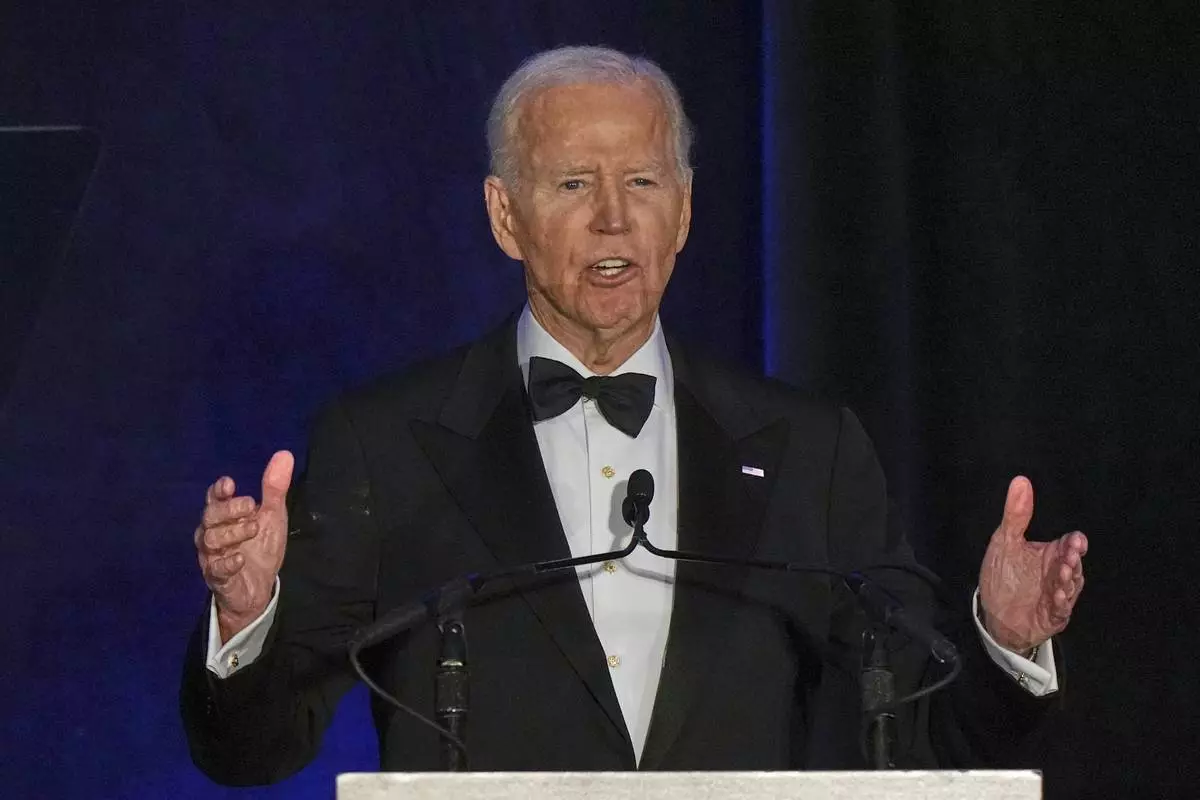
FILE - Former President Joe Biden speaks during the National Bar Association's 100th Annual Awards Gala in Chicago, July 31, 2025. (AP Photo/Nam Y. Huh, File)

FILE - Former President Joe Biden speaks during the National Bar Association's 100th Annual Awards Gala in Chicago, July 31, 2025. (AP Photo/Nam Y. Huh, File)

WASHINGTON (AP) — Venezuelan opposition leader María Corina Machado discussed her country's future with President Donald Trump at the White House on Thursday, even though he has dismissed her credibility to take over after an audacious U.S. military raid captured then-President Nicolás Maduro.

Trump has raised doubts about his stated commitment to backing democratic rule in Venezuela and signaled his willingness to work with acting President Delcy Rodríguez, who was Maduro’s No. 2. Along with others in the deposed leader’s inner circle, Rodríguez remains in charge of day-to-day government operations and was set to deliver her first state of the union speech Thursday.

In endorsing Rodríguez so far, Trump has sidelined Machado, who has long been a face of resistance in Venezuela. She also had sought to cultivate relationships with Trump and key administration voices like Secretary of State Marco Rubio among the American right wing in a gamble to ally herself with the U.S. government.

White House press secretary Karoline Leavitt said Trump had been looking forward to the lunchtime meeting with Machado and called her “a remarkable and brave voice” for the people of Venezuela. But Leavitt also said Trump's opinion of Machado had not changed, calling it "a realistic assessment."

Trump has said it would be difficult for Machado to lead because she “doesn’t have the support within or the respect within the country.” Her party is widely believed to have won 2024 elections rejected by Maduro.

Leavitt went on to say that Trump supported new Venezuelan elections “when the time is right” but did not say when he thought that might be.

Leavitt said Machado sought the face-to-face meeting without setting expectations for what would occur. Machado previously offered to share with Trump the Nobel Peace Prize she won last year, an honor he has coveted.

“I don’t think he needs to hear anything from Ms. Machado," the press secretary said, other than to have a ”frank and positive discussion about what’s taking place in Venezuela.”

Machado spent about two and a half hours at the White House but left without answering questions on whether she'd offered to give her Nobel prize to Trump, saying only “gracias."

After her White House stop, Machado plans to have a meeting at the Senate. Her Washington visit began after U.S. forces in the Caribbean Sea seized another sanctioned oil tanker that the Trump administration says had ties to Venezuela.

It is part of a broader U.S. effort to take control of the South American country’s oil after U.S. forces seized Maduro and his wife at a heavily guarded compound in the Venezuelan capital of Caracas and brought them to New York to stand trial on drug trafficking charges.

Leavitt said Venezuela's interim authorities have been fully cooperating with the Trump administration and that Rodríguez's government said it planned to release more prisoners detained under Maduro. Among those released were five Americans this week.

Rodríguez has adopted a less strident position toward Trump then she did immediately after Maduro's ouster, suggesting that she can make the Republican administration's “America First” policies toward the Western Hemisphere, work for Venezuela — at least for now.

Trump said Wednesday that he had a “great conversation” with Rodríguez, their first since Maduro was ousted.

“We had a call, a long call. We discussed a lot of things,” Trump said during an Oval Office bill signing. “And I think we’re getting along very well with Venezuela.”

Even before indicating the willingness to work with Venezuela's interim government, Trump was quick to snub Machado. Just hours after Maduro's capture, Trump said of Machado that “it would be very tough for her to be the leader.”

Machado has steered a careful course to avoid offending Trump, notably after winning the peace prize. She has since thanked Trump, though her offer to share the honor with him was rejected by the Nobel Institute.

Machado’s whereabouts have been largely unknown since she went into hiding early last year after being briefly detained in Caracas. She briefly reappeared in Oslo, Norway, in December after her daughter received the Nobel Peace Prize on her behalf.

The industrial engineer and daughter of a steel magnate began challenging the ruling party in 2004, when the nongovernmental organization she co-founded, Súmate, promoted a referendum to recall then-President Hugo Chávez. The initiative failed, and Machado and other Súmate executives were charged with conspiracy.

A year later, she drew the anger of Chávez and his allies again for traveling to Washington to meet President George W. Bush. A photo showing her shaking hands with Bush in the Oval Office lives in the collective memory. Chávez considered Bush an adversary.

Almost two decades later, she marshaled millions of Venezuelans to reject Chávez’s successor, Maduro, for another term in the 2024 election. But ruling party-loyal electoral authorities declared him the winner despite ample credible evidence to the contrary. Ensuing anti-government protests ended in a brutal crackdown by state security forces.

Garcia Cano reported from Caracas, Venezuela, and Janetsky from Mexico City. AP Diplomatic Writer Matthew Lee in Washington contributed to this report.

Venezuelan opposition leader María Corina Machado gestures to supporters on Pennsylvania Avenue as she leaves the White House after meeting with President Donald Trump Thursday, Jan. 15, 2026, in Washington. (AP Photo/Pablo Martinez Monsivais)

Venezuelan opposition leader María Corina Machado gestures to supporters on Pennsylvania Avenue as she leaves the White House after meeting with President Donald Trump Thursday, Jan. 15, 2026, in Washington. (AP Photo/Pablo Martinez Monsivais)

Venezuelan opposition leader María Corina Machado waves to supporters on Pennsylvania Avenue as she leaves the White House after meeting with President Donald Trump Thursday, Jan. 15, 2026, in Washington. (AP Photo/Pablo Martinez Monsivais)

Venezuelan opposition leader María Corina Machado waves to supporters on Pennsylvania Avenue as she leaves the White House after meeting with President Donald Trump Thursday, Jan. 15, 2026, in Washington. (AP Photo/Pablo Martinez Monsivais)

Venezuelan opposition leader María Corina Machado smiles on Pennsylvania Avenue as she leaves the White House after meeting with President Donald Trump Thursday, Jan. 15, 2026, in Washington. (AP Photo/Pablo Martinez Monsivais)

Venezuelan opposition leader María Corina Machado smiles on Pennsylvania Avenue as she leaves the White House after meeting with President Donald Trump Thursday, Jan. 15, 2026, in Washington. (AP Photo/Pablo Martinez Monsivais)

Venezuelan opposition leader María Corina Machado waves to supporters on Pennsylvania Avenue as she leaves the White House after meeting with President Donald Trump Thursday, Jan. 15, 2026, in Washington. (AP Photo/Pablo Martinez Monsivais)

Venezuelan opposition leader María Corina Machado waves to supporters on Pennsylvania Avenue as she leaves the White House after meeting with President Donald Trump Thursday, Jan. 15, 2026, in Washington. (AP Photo/Pablo Martinez Monsivais)

FILE - U.S. President George Bush, right, meets with Maria Corina Machado, executive director of Sumate, a non-governmental organization that defends Venezuelan citizens' political rights, in the Oval Office of the White House, Washington, May 31, 2005. (AP Photo/Charles Dharapak, File)

FILE - U.S. President George Bush, right, meets with Maria Corina Machado, executive director of Sumate, a non-governmental organization that defends Venezuelan citizens' political rights, in the Oval Office of the White House, Washington, May 31, 2005. (AP Photo/Charles Dharapak, File)

FILE - Opposition leader Maria Corina Machado gestures to supporters during a protest against President Nicolas Maduro the day before his inauguration for a third term, in Caracas, Venezuela, Thursday, Jan. 9, 2025. (AP Photo/Ariana Cubillos, file)

FILE - Opposition leader Maria Corina Machado gestures to supporters during a protest against President Nicolas Maduro the day before his inauguration for a third term, in Caracas, Venezuela, Thursday, Jan. 9, 2025. (AP Photo/Ariana Cubillos, file)

Recommended Articles