The steel dome for the nuclear island of Unit 4 of the Haiyang Nuclear Power Plant in Haiyang City, east China's Shandong Province was successfully lifted into place on Saturday, signifying that half of the Phase II construction of the plant has been completed.
The dome measures about 40 meters in diameter with a weight of about 658 tons.
It took over three hours to hook, suspend, rotate and position the steel dome into place.
As key national-level projects, Units 3 and 4 of the Haiyang nuclear power plant are expected to enter full operation in 2027.
"By now, more than half of the Phase II construction has been completed. When they are put into full operation in 2027, the four nuclear power units at the plant will generate up to 40 billion kilowatt-hours of electricity annually, meeting the power needs of half of Shandong's population," said Zhang Zhongwei, on-site supervisor of Phase II of the Haiyang Nuclear Power Plant.
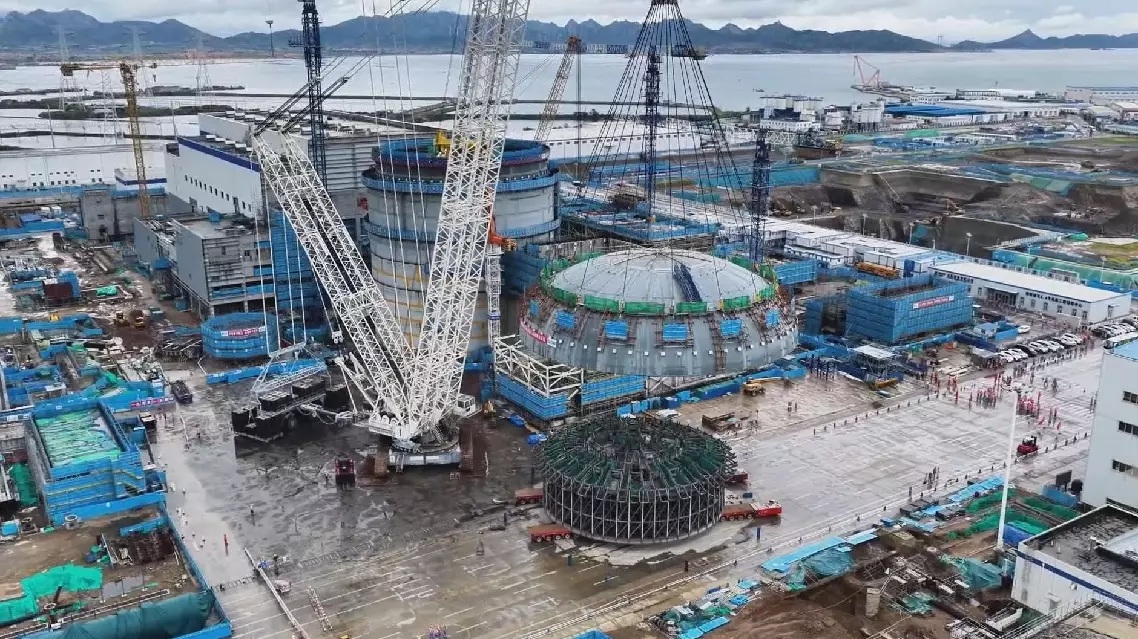
Steel module for Unit 4 of China's Haiyang nuclear power plant lifted into place
Steel module for Unit 4 of China's Haiyang nuclear power plant lifted into place
A senior World Economic Forum (WEF) director has hailed China's rapid adoption of advanced technologies in manufacturing as well as the country's prudent investments in various emerging industries.
Gim Huay Neo, the WEF's Chair of Greater China, has visited several cutting-edge enterprises in Hangzhou City, east China's Zhejiang Province this year. The experience has left her with a profound impression that China setting a model example in how new technologies can be applied to high-end production.
"Many of us took pictures of the robotic technologies that we saw. I met the innovators; I saw how technology and AI was being deployed into manufacturing processes. So there's a lot that we can learn from China in how technology, advanced practices, can be deployed to enhance productivity," said Neo, who is also Managing Director of the WEF's Centre for Nature and Climate.
Her comments underscored the WEF's ongoing research focus on how innovation is integrated into advanced manufacturing to boost productivity.
The Global Lighthouse Network (GLN), launched by the WEF in 2018, now comprises more than 200 factories around the globe. In September, 12 factories were incorporated into the network, with Chinese facilities accounting for half.
The GLN was formed when the WEF teamed up with McKinsey and Company in 2018 to identify the most innovative leaders in manufacturing. The WEF introduces the GLN as a globally recognized community transforming factory and value chain operations with Fourth Industrial Revolution technologies, with each member indisputably a leader in its respective industry.
"Forty percent of the best lighthouses, we call them 'dengta', lighthouses around the world are actually in China. We have close to 50 percent of the best ways to deploy AI for people and planet being based in China as well. So yes, China is at the forefront of many of these areas. This country is now reaping the dividends of the investments into technology and people over the last decade and we're now seeing the dividends and the results of how this is made China very competitive across many industries," she said.

Senior WEF director witnesses China's leadership in tech-driven manufacturing